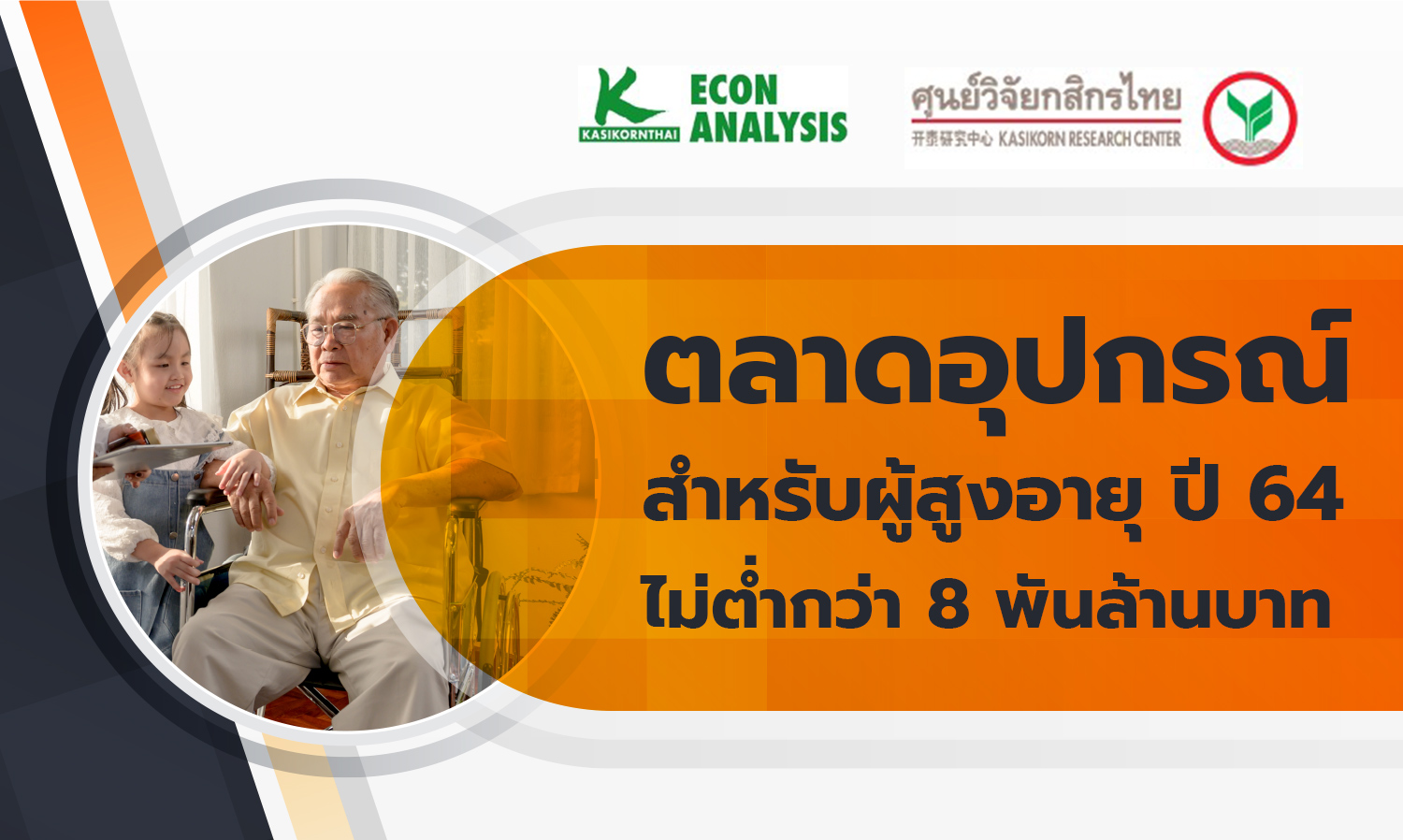
Market for Elderly Equipment in 2021 Estimated at No Less Than 8 Billion Baht
• Kasikorn Research Center estimates that the spending on medical equipment and facilities for the elderly in Thailand in 2021 will be between 8,000 and 9,000 million baht, with an average growth rate of 7.8% per year over the next five years. This aligns with Thailand's transition into an aging society, where the majority of the market value is still concentrated in the business-to-business (B2B) sector, particularly in non-hospital businesses such as elderly care centers, nursing homes, and senior living residences. Additionally, the COVID-19 situation has led some elderly individuals to stay at home for treatment, increasing the demand for equipment among those with purchasing power during this period.
• The Kasikorn Research Center believes that in the near future, categories of convenience and safety equipment, such as electric wheelchairs, electric beds, sensor devices, and real-time emergency call buttons, will likely see significant growth as they meet the needs of both businesses and elderly individuals who have sufficient purchasing power and require more assistance in their daily lives.
• However, most production in Thailand still focuses on basic equipment using relatively simple technology, necessitating reliance on imports of goods or components from abroad. This presents a challenge for domestic manufacturers to elevate production standards and develop products that better meet the needs of the elderly, considering factors such as purchasing power, sales models, and appropriate marketing strategies to expand market opportunities in line with the trends of Thailand's aging society.
The trend of increasing single-person households and living alone, amidst Thailand's complete transition to an aging society by 2022, will lead to a higher dependency ratio, both for elderly individuals needing care and those who can care for themselves but require essential tools and equipment to facilitate their daily lives. Therefore, the market for medical equipment aimed at preventive care and convenience for the elderly in Thailand has the potential to grow in response to the demand for health services and the enhancement of the quality of life for the elderly in the future. Nonetheless, the market still faces limitations in terms of purchasing power and the development of products that better address the needs of the elderly, presenting both opportunities and challenges for businesses.
The demand for elderly equipment is expected to increase from both the business (B2B) and direct consumer (B2C) sectors. The majority of usage still comes from the business sector, particularly in healthcare facilities focusing on an aging clientele, as well as non-healthcare businesses like elderly care centers and nursing homes, which are likely to increase alongside the growing elderly population. Simultaneously, direct consumer demand is expected to grow in line with the number of elderly individuals who need medical equipment for disease prevention and equipment for daily convenience and safety.
The market for elderly equipment benefiting from the increasing demand can be divided into two main categories:
1) Medical equipment for preventive care, such as blood pressure monitors, blood glucose meters, oxygen meters, and suction devices.
2) Convenience and safety equipment, such as beds, wheelchairs, grab bars, anti-slip flooring, ramps, wheelchair lifts, and emergency assistance devices connected to the internet, as well as sensor devices that alert for falls.
Kasikorn Research Center estimates that the spending on medical equipment and facilities for the elderly in Thailand in 2021 will be between 8,000 and 9,000 million baht, accounting for approximately 8-10% of the total medical equipment and instruments market in Thailand. The majority of the market value is still concentrated in the B2B sector. Additionally, the ongoing COVID-19 situation has led some elderly individuals to stay at home for treatment, as they cannot travel to hospitals as usual, increasing the demand for equipment among those with purchasing power during this period.
Kasikorn Research Center anticipates that in the next five years, spending on equipment for the elderly is likely to grow at an average rate of 7.8% per year. Convenience and safety equipment will likely see greater growth compared to medical equipment for preventive care, particularly due to the increasing number of elderly care facilities and residences for the elderly, leading to a higher demand for these installations, especially for technology-driven convenience devices that cater to the purchasing power of the elderly.
However, products in both the medical equipment and convenience equipment categories produced in Thailand may not fully meet domestic demand, as most are still basic equipment using simple technology. Initially, importers and distributors of foreign products are likely to benefit from the increasing demand, with significant sources of imports including China, Japan, and Taiwan. Domestic manufacturers will need to upgrade their production to include more technologically advanced equipment, though still not overly complex, to meet the needs of the elderly and increase market share in the future. Potential products for production include electric beds and electric wheelchairs, alongside the development of product standards, affordable pricing, and marketing strategies that will influence purchasing decisions.
Notably, the convenience and safety equipment of interest includes mobility aids with enhanced convenience features. Products in this category are classified as medical equipment, with most domestic manufacturers still producing basic devices with limited technological complexity, such as standard wheelchairs and beds. More complex devices may still rely on imports or the importation of certain components for assembly in the country, presenting a challenge for domestic manufacturers to elevate production standards to meet the needs of elderly individuals with purchasing power seeking more technologically advanced equipment, such as electric wheelchairs that can adjust to standing positions or assist with rising, as well as electric beds that can adjust height and position and include mechanisms for turning.
Simultaneously, non-medical convenience equipment, such as aids for installation in residences, is also expected to grow to address the need for home modifications that enhance safety for the elderly, such as grab bars, anti-slip ramps, and impact-reducing flooring in residences. This includes operators in the medical, health, and construction material sectors increasingly entering the elderly equipment market, as well as tracking devices for elderly individuals that can alert caregivers or emergency assistance centers immediately, in the form of devices for installation in various areas of the home and Smart IoT Devices like smartwatches and tracking sensors, which are becoming more popular due to their real-time data connectivity via the internet to provide timely assistance to the elderly, most of which are still imported from abroad.
Although there are some domestic manufacturers of self-use medical equipment and convenience devices for the elderly, in addition to price competition, there are challenges in competing with imported products in terms of brand, technology level, and marketability. Therefore, Kasikorn Research Center believes that the strengths of Thai manufacturers lie in understanding the lifestyles and needs of the elderly in Thailand and creating product differentiation that aligns with these needs in two main areas:
1) Purchasing power: The majority of the elderly population in the country still relies on welfare through the National Health Insurance system, which provides access to medical equipment like wheelchairs for those with mobility issues. Thus, the primary customer base for businesses will be elderly individuals with the purchasing power to buy equipment themselves and sufficient income in the future. Kasikorn Research Center estimates that the proportion of elderly individuals with purchasing power will be only 20-30% of the total elderly population by 2030, or about 3.4 million people, who are expected to have income covering their health expenses independently.
2) Product/service design: Using lightweight materials that are easy to carry, user-friendly, and adjustable to suit the physical characteristics of Thai elderly individuals. Products that require installation in residences, such as ramps, wheelchair lifts, and anti-slip flooring, should be designed to fit into existing homes without high costs or extensive renovations, making them usable across all ages. For electric wheelchairs and electric beds, longer warranty periods or additional insurance for extended after-sales service could be offered to alleviate elderly individuals' concerns about expenses.