BIM and Enhancing Efficiency while Reducing Construction Costs for 'Lumpini Wisdom'

Mr. Prabhan Sak Raksaiwan, Managing Director of Lumpini Wisdom and Solutions Co., Ltd., a research and consulting company in design under the LP.N. Development Public Company Limited group, commented on the development of construction systems by integrating an innovative design approach known as Building Information Modeling (BIM) as part of the design process, cost management, construction, and building management effectively.
According to the National Economic and Social Development Council, the average construction value in Thailand is between 1-1.2 trillion baht per year, with residential construction accounting for 50% of the total construction value, 30% for government projects, and 20% for industrial and commercial buildings. Meanwhile, construction projects typically experience a loss rate of about 15% due to design and operational processes, such as cutting tiles, pipes, and various construction systems, resulting in an estimated loss of 100-150 billion baht annually.
“The economic loss from construction processes is significant. Implementing a management system for design, construction, and building management using BIM from design to building management can help reduce these losses, allowing real estate developers to lower construction costs while also enabling them to develop quality housing for consumers,” said Mr. Prabhan Sak.
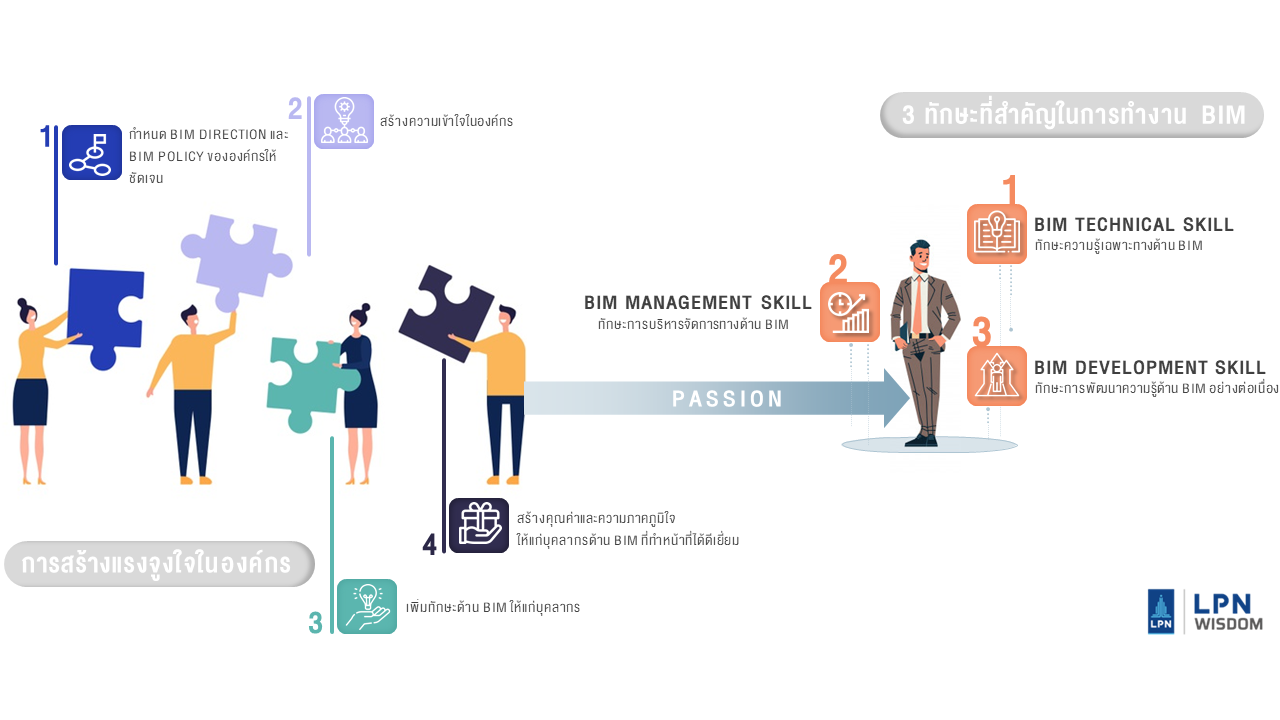
Key factors in developing BIM work include three main aspects: process development, technology development, and personnel development. A current challenge in BIM development is the shortage of personnel who understand the BIM workflow from design to construction and building management. Personnel skilled in BIM development must possess three essential skills: BIM Technical Skill, BIM Management Skill, and BIM Development Skill.
Mr. Prabhan Sak stated that developing personnel with BIM expertise requires fostering passion for the work. Organizations should establish clear BIM policies and goals, as well as communicate effectively to enhance understanding and skills in BIM among personnel to ensure successful implementation and management that reduces construction costs and enhances building management efficiency.
Currently, many Asian countries, including Singapore and Japan, have effectively adopted BIM. In Thailand, however, BIM usage is still limited to large developers who can leverage economies of scale in project development. While implementing BIM in design and construction incurs operational costs, the expenses associated with BIM implementation typically do not exceed 5% of the project value, which is lower than the savings achieved through design and construction using BIM, which can reduce costs from construction losses by approximately 10-15%.
“If we prioritize the development of personnel with BIM expertise, it will play a crucial role in enhancing efficiency and reducing construction costs, significantly contributing to the future development of the construction industry in the country,” Mr. Prabhan Sak concluded.