Understanding the 'Infection Cycle and COVID-19 Prevention'
As COVID-19 is an unavoidable situation, the only way to ensure everyone's safety is to learn and understand the disease clearly, in order to create a protective barrier for ourselves and those close to us. <\/span><\/strong><\/p>
Dr. Opas Karnkawinpong, Director-General of the Department of Disease Control, <\/span><\/strong>explained the infection cycle, stating that COVID-19 is a contagious disease transmitted from person to person. Once we contract the virus, we enter the incubation period, which lasts about 7 days after exposure. After this period, patients may show symptoms; however, it has been observed that more than half of the infected individuals are asymptomatic yet can still spread the virus. A small percentage may become severely ill and die, accounting for about 1%. Once recovered, individuals develop immunity and do not spread the virus further. For those infected with the virus, <\/strong><\/span>if they wear a mask, the virus will remain on the mask 100%. This is extremely important, which is why there is strict enforcement for everyone to wear masks at all times. Typically, the COVID-19 virus spreads within a distance of 1-2 meters. Therefore, maintaining a distance of more than 1-2 meters is essential, significantly reducing the chance of transmission if everyone follows the recommended measures. <\/p>
Crucially, to reduce the spread of the virus, <\/strong><\/span>we must minimize travel and reduce activities that involve interaction between individuals. This is the principle behind the term 'lockdown.' The primary objective of lockdown measures is to keep people apart, reduce activities, and limit travel. "If someone is infected and wears a mask, the virus will remain on the mask and not spread to another person, especially if the distance is more than 1 meter, the risk of transmission is further minimized." <\/strong><\/span><\/p>
<\/p>
If an infected person coughs or sneezes and then touches doorknobs or other surfaces, and someone else touches those surfaces, they can contract the virus. Therefore, handwashing is crucial after touching public surfaces. "The measures of wearing masks, maintaining distance, reducing activities, and limiting travel are primary prevention methods implemented for the public to prevent virus transmission. Additionally, using the Mor Chana or Thai Chana apps allows officials to track where individuals have been, facilitating easier disease investigation."<\/span><\/strong><\/p>
Currently, the urgent task for officials is <\/strong><\/span>to identify patients and contacts after an infection occurs to prevent further outbreaks. Laboratory tests are conducted for symptomatic and asymptomatic individuals, and patients are immediately placed into the treatment system. Subsequently, officials will conduct proactive searches for contacts in each circle to bring them into the treatment system. <\/p>
COVID-19 is a contagious disease that requires the discipline of everyone in society to cooperate in reducing activities and travel to minimize new infections, prevent widespread transmission, and help build immunity for those who have not yet contracted the virus in the country, so that the number of infections in Thailand does not increase further in the future. <\/p>
<\/p>
<\/p> 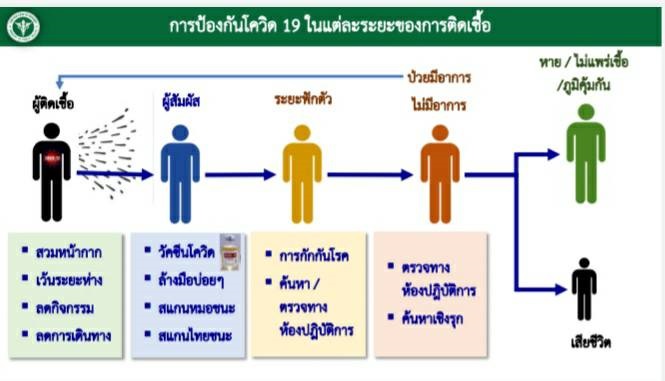 <\/strong><\/span><\/p>