EEC Budget of 22.2 Billion Baht to Boost Public-Private Investment in 2021
The consideration of the draft budget bill for the fiscal year 2021 has passed the review of the special committee and is set to enter the second and third readings before being enacted on October 1, 2020.
The budget allocation for the Integrated Development Plan of the Eastern Economic Corridor (EEC) for the fiscal year 2021 proposes a budget of 22.712 billion baht, with an additional 817 million baht from off-budget sources and 775 million baht for support missions to develop modern and environmentally friendly economic activities.
This includes the development of efficient infrastructure and public utilities that are easily accessible, aiming to create a livable city with international standards, enhancing Thailand's role as a gateway to the Asia region in a global context.
The goal of this budget is to attract investments from both the public and private sectors in the EEC (Chachoengsao, Chonburi, Rayong) of no less than 300 billion baht, divided into six strategies, which include:
1. Development of Infrastructure and Public Utilities with a total budget of 18.413 billion baht, including 740 million baht from off-budget sources, focusing on the development of transportation systems (roads, rail, water, air) that are ready, convenient, fast, and efficient, seamlessly connecting economic areas through four systems:
Infrastructure for roads of no less than 191 kilometers, enhancing the capacity of deep-sea ports to meet standards at one location, developing rail transport infrastructure of no less than 220 kilometers, and enhancing airport capabilities to create one aviation metropolis.
Additionally, the investment will begin on the high-speed rail project connecting three airports (Don Mueang, Suvarnabhumi, U-Tapao), which will involve relocating utilities in the construction areas of various agencies, such as the Provincial Electricity Authority (PEA) and the Provincial Waterworks Authority (PWA).
Moreover, efforts will be made to enhance the efficiency of public utilities, developing 11 additional water supply systems, benefiting no less than 8,760 households in the area.
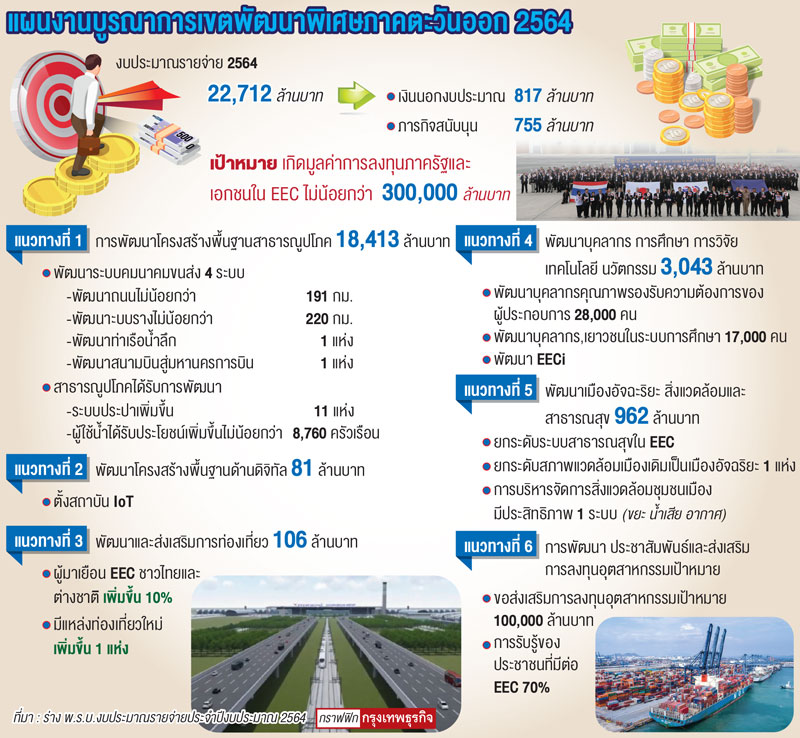
2. Development of Digital Infrastructure with a total budget of 81.07 million baht, where the Digital Economy Promotion Agency will establish an IoT institute to develop the future digital industry.
3. Development and Promotion of Tourism with a total budget of 106 million baht, including 9 million baht from off-budget sources, aiming to increase the number of visitors to the EEC from both Thai and foreign tourists by 10% and to add one new tourist attraction, with the responsible agencies being the Office of the Promotion of Meetings and Exhibitions (Public Organization) and Pattaya City.
4. Development of Human Resources, Education, Research, Technology, and Innovation with a total budget of 3.043 billion baht, aiming to produce and develop quality personnel to meet the needs of targeted industries of no less than 28,000 people, including the development of at least 17,000 entrepreneurs and professionals, and at least 11,000 personnel and youth in the education system.
Additionally, the National Science and Technology Development Agency (NSTDA) will push forward the development of the Innovation Zone in the Eastern Special Economic Corridor (EECi), along with intensive training programs on Industrial Internet of Things (IIoT) for vocational personnel, digital technology capability development for teachers and youth in the EEC, and promoting science and technology learning in schools within the EEC.
Meanwhile, the Digital Economy Promotion Agency will promote the project to upgrade learning centers for technology and digital innovation for future industries (AI Vocational) in the EEC.
5. Development of Smart Cities, Environment, and Public Health with a total budget of 962 million baht, including 68 million baht from off-budget sources, aiming to elevate the public health system in the EEC to international standards to meet the needs of the population in five areas, with the Department of Disease Control implementing disease and health hazard surveillance projects in the EEC.
This also includes upgrading existing urban environments to become smart cities in at least one area, with the Navy implementing smart city, environment, and public health development projects, while the Digital Economy Promotion Agency will promote the EEC livable city project.
Furthermore, an efficient urban environmental management system will be developed (waste, wastewater, air).
6. Development, Promotion, and Investment in Targeted Industries with a total budget of 106 million baht, aiming to create a value of investment promotion requests in targeted industries of no less than 100 billion baht, and to raise public awareness of the EEC to 70%, with the responsible agencies being the Department of Science Service, the Department of Local Administration, and the Eastern Special Development Zone Policy Committee (ESDC).
SOURCE: www.bangkokbiznews.com