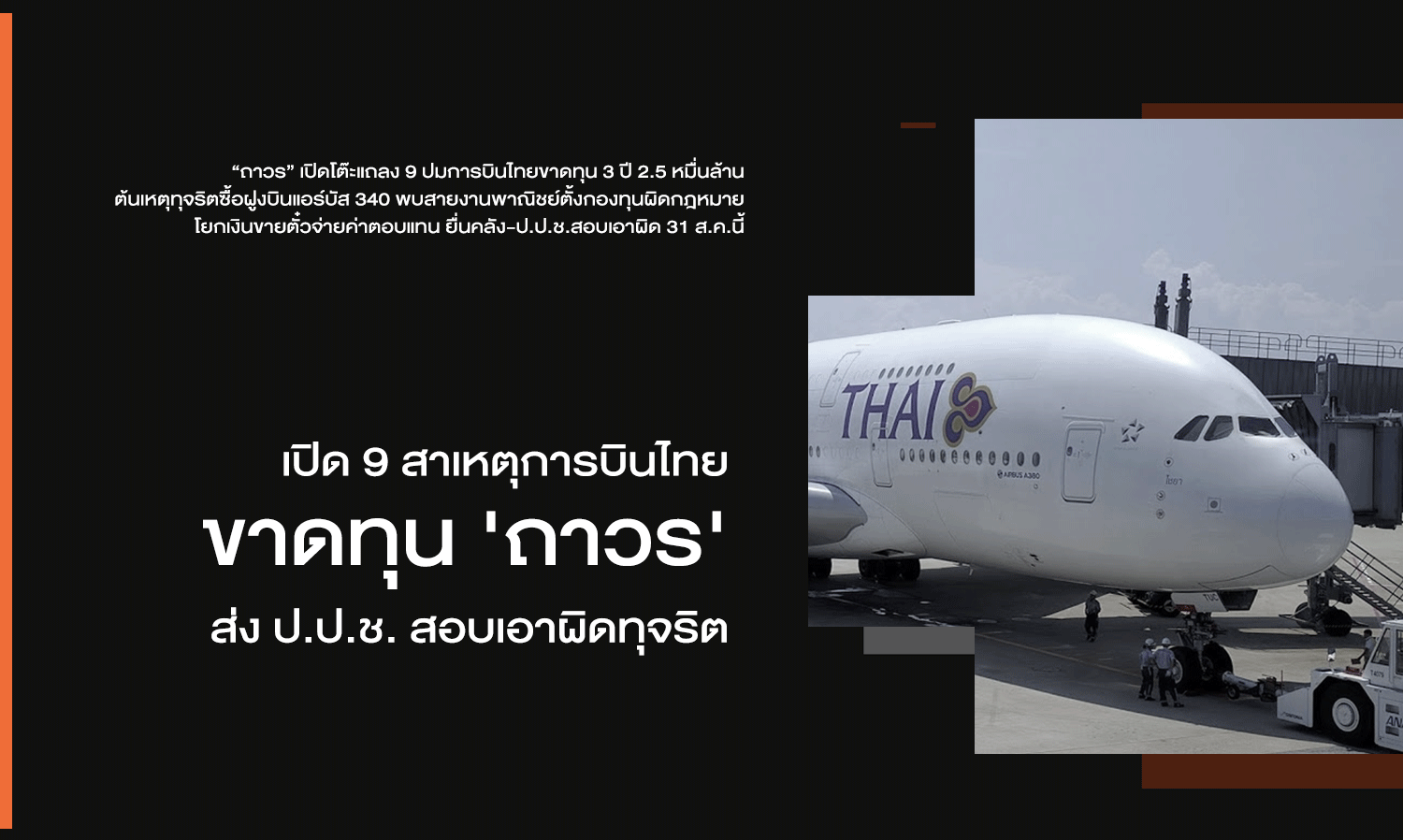
Revealing 9 Reasons for Thai Airways' 'Permanent' Losses, Submitting to NACC for Corruption Investigation
"Permanent" reveals 9 issues behind Thai Airways' losses totaling 25 billion baht over 3 years, citing corruption in the purchase of Airbus A340 aircraft, illegal fund establishment in the commercial department, and misallocation of ticket sales revenue for compensation. Submitting to the Ministry of Finance and NACC for investigation by August 31.
The continuous accumulated losses of Thai Airways International Public Co., Ltd. have led to a petition for rehabilitation in the Central Bankruptcy Court, while the Ministry of Transport has appointed a working group to investigate the reasons behind Thai Airways' losses.
Mr. Thaworn Senneam, Deputy Minister of Transport, disclosed the findings of the investigation into Thai Airways' management, stating that after being assigned to oversee the airline, he conducted a thorough investigation to address public concerns regarding the airline's persistent losses since 2008. A working group was established to audit the accounts for the past three years (2017-2019).
After gathering information, evidence, and testimonies from over 100 individuals, both disclosed and undisclosed, it was found that a significant cause of the accumulated losses stemmed from the purchase of 10 A340-500 and A340-600 aircraft. These aircraft incurred losses on every route since their inaugural flight from Bangkok to New York in July 2005 until the last one was retired in 2013, and they remain a burden to this day.
"The beginning of the losses dates back to 2008, after the A340 flights operated for 3 years, marking the first loss in the company's 60-year history, amounting to 21.45 billion baht. This issue had to be addressed by issuing bonds for the first time. The working group found that the losses of Thai Airways amount to no less than 62.803 billion baht, primarily due to the procurement of 10 A340 aircraft," he stated.
Mr. Thaworn mentioned that all the investigated information will be submitted to the Ministry of Finance, as the major shareholder of Thai Airways, and to the National Anti-Corruption Commission (NACC) by August 31 for investigation and prosecution of those involved in corruption. This will also be presented to the Prime Minister for decisive action.
He affirmed that all documents reviewed are authentic, sourced from reliable individuals within Thai Airways, and expressed confidence that this information will lead to accountability. He hopes that when the information is handed over to the authorities, such as the NACC, it will be a test of their seriousness and sincerity in taking action. He also urged those involved in planning and managing the rehabilitation of Thai Airways to ensure that the airline can move forward, as creditors are already trusting the rehabilitation plan.
"Prosecutors can take action because they can investigate retrospectively while it was a state enterprise. Those responsible for the company's losses include both former executives and some currently in positions of authority," he added.
Pol. Lt. Gen. Chanthaphet Sesavej, former Commander of the Metropolitan Police, as the head of the working group, revealed that this investigation has a time frame of only 43 days, with 6 subcommittees appointed. They have met 3 times and gathered information from over 100 individuals, both disclosed and undisclosed, and reviewed the minutes of various board meetings of Thai Airways over the past 3 years (2017-2019).
The working group investigated the years 2017-2019, during which Thai Airways incurred a total loss of 25.6 billion baht, identifying 9 reasons for the losses, including:
1. Significantly increased expenses, such as overtime costs in the engineering department amounting to 2.02 billion baht, with one employee clocking in 3,354 hours of overtime, working 419 days in a year despite there being only 365 days.
2. The procurement of 6 B787-800 aircraft on an operational lease, with price discrepancies of up to 589 million baht for identical aircraft, and compensation payments for returning 2 A330-300 leased aircraft totaling 1.458 billion baht.
3. The acting CEO received an additional compensation of 200,000 baht per month, which increased to 600,000 baht after 9 months, citing previous practices.
4. During the 3 years (2017-2019), the commercial department did not prepare budget forecasts but instead made unilateral budget changes through the company's policy management committee.
5. Tickets were sold at very low prices, with an average ticket price of only 6,081 baht in 2019, while the company had a cabin factor of nearly 80% and served 24.51 million passengers, generating ticket revenue of 149 billion baht.
6. Benefits were provided to ticket agents through commissions, tier payments, and incentives, with flash sale prices benefiting only 3-4 agents.
7. Executives in the commercial department appointed and transferred close associates to positions as general sales managers (AA) abroad, setting revenue targets to achieve desired incentives, leading to 10% of the incentive payments being funneled into a fund for the commercial department executives, which lacked any regulations, announcements, or legal backing from the company.
SOURCE : www.bangkokbiznews.com