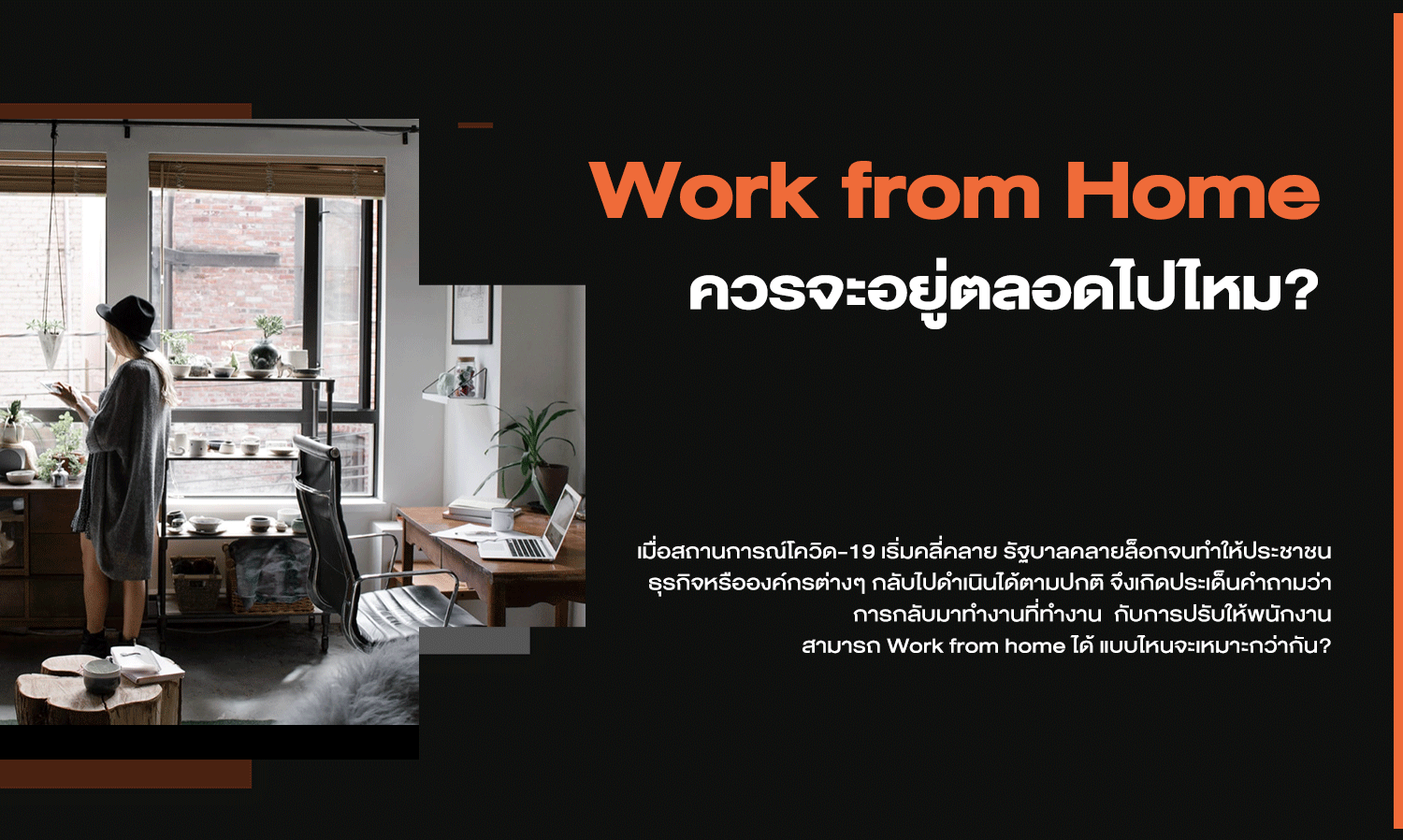
Should Work from Home Continue Forever?
As the COVID-19 situation begins to improve, the government has eased restrictions, allowing citizens, businesses, and organizations to return to normal operations. This raises the question: which is more suitable, returning to the workplace or allowing employees to work from home?
During this period of improvement in Thailand's COVID situation, many organizations and educational institutions have allowed their personnel to return to work and study in the traditional manner.
However, some organizations and educational institutions continue to emphasize allowing personnel to work from home/anywhere and maintain online learning. The question arises: if we set aside the risk of COVID transmission, which is more appropriate between returning to the traditional workplace and providing employees with more flexibility to work from home/anywhere?
Recently, Facebook announced that its employees can choose to work from home until July next year, a policy similar to that announced by Google earlier. However, Facebook's approach is bolder, offering each employee a budget of $1,000 to improve their homes for a suitable home office.
Allowing employees to choose their workplace seems to be a trend that will persist even after COVID is over. The benefits to organizations are not just about employee health or reducing operational costs; there are emerging statistics showing the advantages of working from home/anywhere on employee happiness and productivity.
One website has compiled statistics and research related to working from home/anywhere (WfH), revealing that more than half of employees in various organizations desire the flexibility to choose WfH.
At the same time, organizations with WfH policies can attract and retain younger employees. More than 70% of surveyed employees indicated the various benefits of having the option to work from home, including increased job satisfaction and a greater willingness to recommend their organization to new generations, as well as being a factor in job applicants' considerations, making them less likely to leave their current organization.
In addition to increased job satisfaction, having the option to work from home also boosts productivity. Over 70% of employees reported improved productivity and focus when working from home, while more than 50% stated they take fewer breaks or slack off less than when working in a traditional office.
Interestingly, even though many organizations have policies allowing work from anywhere, over 80% of respondents still prefer to work from home.
However, there is a growing perspective criticizing that WfH may not be as beneficial as it seems. The weaknesses of WfH are becoming more apparent, with supporters of this view arguing that the research showing improved productivity during WfH is due to the initial phase of the COVID crisis, where employees were more diligent and dedicated due to fears of job loss.
Additionally, many executives have begun to voice concerns that WfH is not suitable for jobs requiring collaboration between individuals or departments, nor for tasks that require back-and-forth idea exchange to create new concepts. Some organizations have found that when employees are dispersed, problems that would typically take 1-2 hours to resolve (when working together) take much longer due to the lack of opportunities for immediate interaction.
In summary, every approach has its pros and cons. Therefore, whether to continue WfH indefinitely should depend on the nature and culture of each organization, and importantly, it must be adaptable.
SOURCE: www.bangkokbiznews.com