In-Depth Look at the Healthcare Business: A Sector of Investment Opportunities
The healthcare business is a sector with significant growth potential and investment opportunities, driven by the global trend towards an aging society, changing lifestyles in major cities, and severe pandemics like COVID-19. Thanapol Ittinithipak, Vice President – Head of Thailand Business at BlackRock Inc., provides insights into the healthcare business in Thailand and globally, alongside investment experts Sukit Udomsirikul, Managing Director of Research at SCB Securities Co., Ltd. and Sornchai Sunetta, Managing Director of the Chief Investment Office at SCB Securities Co., Ltd., who discuss investment opportunities in the healthcare sector.
Overview of the Healthcare Business in Thailand and Abroad
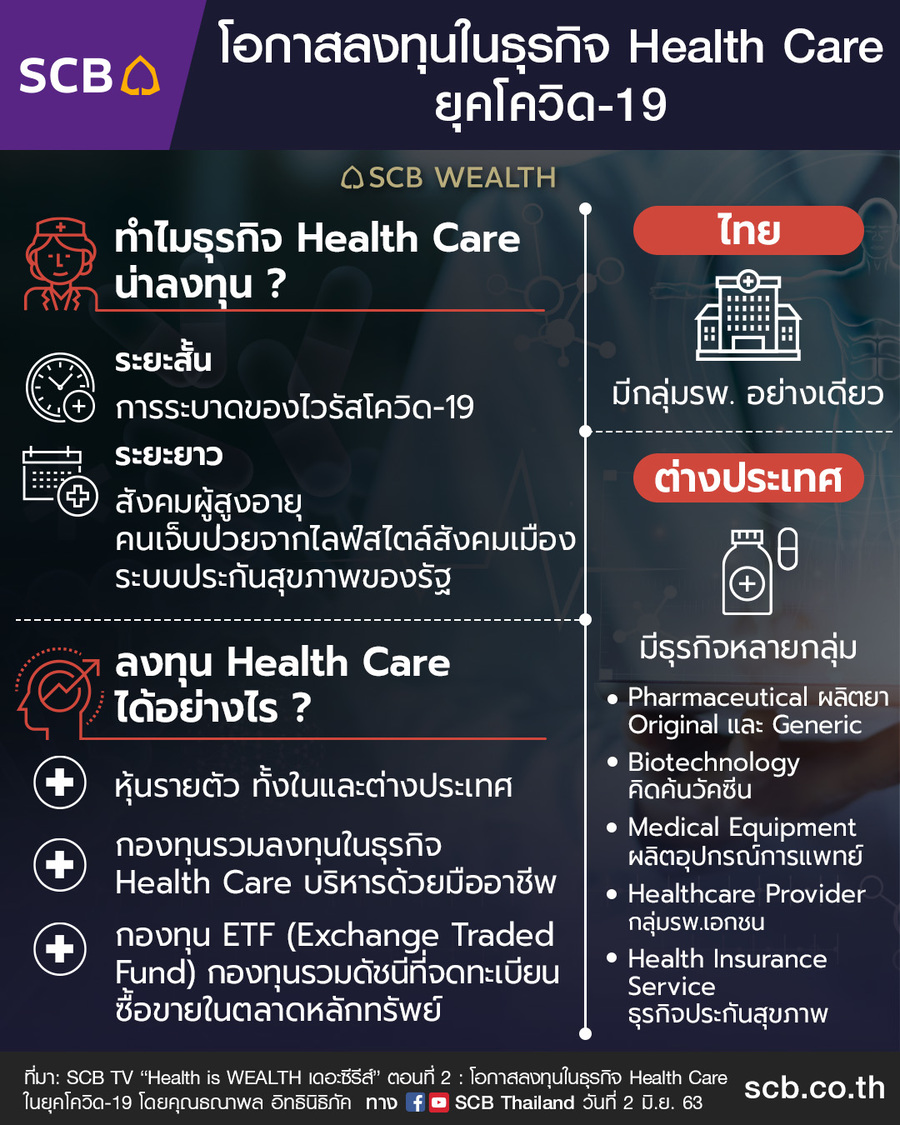
When it comes to investing in the healthcare business in Thailand, most people are familiar with private hospital groups, which are the only healthcare businesses in Thailand that can be invested in. However, looking at the global healthcare landscape reveals numerous interconnected sectors within this industry. Thanapol categorized the global healthcare business into four main sub-sectors and one service sector as follows:
1. Pharmaceutical Sector includes pharmaceutical companies that produce and sell drugs, divided into two types: Original drugs and Generic drugs.
- Original drugs are patented medications. Generally, the research and development process for each drug, from animal testing to human use, takes about 20 years. Once developed, companies patent the drug to gain exclusive rights for production and sales, typically for a period of 20 years, during which Original drugs can generate high revenue and profit margins.
- Generic drugs are common medications that have lost their patent protection and can be produced quickly and at lower costs. However, the production of Generic drugs faces high competition, particularly from China, which has lower production costs, resulting in lower profit margins.
Investment in the pharmaceutical sector focuses on global pharmaceutical companies that research and produce Original drugs, primarily located in developed countries such as Johnson & Johnson (USA), Roche (Switzerland), Takeda (Japan), and Sanofi (France). In Thailand, the production of Generic drugs is handled by the Government Pharmaceutical Organization and various private pharmaceutical companies.
2. Biotechnology Sector involves studying living organisms for beneficial applications, such as GMO plants, chromosomal modifications, and importantly, the development of various vaccines. Currently, with over 4 million COVID-19 patients globally, there is a significant demand for vaccines. Thanapol believes that for treating COVID-19 patients, the focus should be on vaccines. Dr. Anthony Fauci, head of the U.S. Centers for Disease Control and Prevention, anticipates that vaccines will be produced by the end of 2020, with commercial production expected in the latter half of 2021. This situation has made stocks in the biotechnology sector highly attractive for investment, with companies like AmGen, Biogen, Gilead (USA), and Bayer (Germany) leading the way.
3. Healthcare Equipment & Supplies Sector produces medical devices, which are divided into three categories: Single-Use Devices (e.g., syringes, rubber gloves), which account for 20% of production; Durable Medical Devices (e.g., hospital beds, wheelchairs, high-tech medical tools), which make up 75%; and Reagents and Test Kits for laboratory use, which constitute 5%. The most profitable items are Durable Medical Devices, followed by Single-Use Devices and diagnostic reagents.
Companies in the medical equipment sector include Abbott, Medtronic, DePuy Synthes (USA), and Siemens (Germany). Germany is the world's largest exporter of medical equipment, followed by the USA, Japan, and China in fourth place. However, medical devices produced in China typically use mid-level technology, unlike the top three countries that export advanced, high-tech equipment. In Thailand, the country exports the most medical devices in ASEAN, primarily Single-Use Devices, such as rubber gloves, which rank as the second-largest global export. Despite being the largest exporter in ASEAN, many manufacturing companies are foreign firms utilizing local raw materials for export. Additionally, the Single-Use Devices market is highly competitive, as it does not require advanced technology, allowing many players to enter the market, resulting in price competition where brand value is minimal.
4. Healthcare Provider Sector consists of private hospitals that generate revenue from medication fees, medical personnel services, laboratory/x-ray tests, and patient accommodations. A key competitive factor in the hospital business is having a large hospital network, which benefits from economies of scale in purchasing medical supplies for the entire network and the ability to attract high- to mid-level patients both domestically and internationally. Mergers and acquisitions are therefore a primary strategy in the hospital business. Smaller hospitals must specialize in specific areas, such as eye hospitals. Leading hospital groups include UnitedHealth Group, Teladoc Health (USA), and BDMS and Bumrungrad International (Thailand).
5. Healthcare Insurance Services are crucial in the healthcare industry, especially in the USA, where medical costs are high, but state welfare is limited compared to other developed countries. The only state welfare programs are Medicare for the elderly and Medicaid for low-income individuals, leaving most of the population to secure their own health insurance.
Why Invest in the Healthcare Business
The healthcare business is expected to grow in the long term due to the structural changes in countries transitioning to aging societies. It is projected that by 2020, there will be 1 billion people over the age of 60, accounting for 14% of the global population of 7.3 billion. This will lead to an increasing number of patients, particularly among the elderly, who often suffer from chronic diseases requiring continuous medical attention, such as hypertension, diabetes, and cardiovascular issues. Additionally, urban lifestyles contribute to obesity and various complications. Another reason is that many countries are improving their health insurance systems. When the system is effective, more people seek medical attention when ill, leading to increased medication use and further growth in the healthcare business.
In the short term, the COVID-19 pandemic has prompted people to pay more attention to their health. Although the Healthcare Provider sector may experience a downturn due to concerns about visiting hospitals and the enforcement of physical distancing, the Medical Equipment and Supplies sector has benefited from the increased demand for medical devices like ventilators and disposable equipment. In the Biotechnology sector, the stock price of Moderna, which developed a vaccine, has surged by 250-300% since the beginning of the year.
How to Invest in the Healthcare Business
Thanapol recommends three ways to invest in the healthcare business: 1) Investing in individual stocks, both domestically and internationally; 2) Purchasing mutual funds that invest in the healthcare industry, managed by professionals; and 3) Investing in ETFs (Exchange Traded Funds), which are index mutual funds traded on the stock exchange.
Regarding healthcare stock investments in Thailand, Sukit further analyzes that although hospital stocks have been impacted by the COVID-19 crisis, leading to fewer patients visiting hospitals and a decline in international patients, telemedicine technology has been adopted as a substitute. This situation is expected to improve gradually as the number of infections decreases. For international patients, recovery will depend on the resumption of travel. BDMS is the fourth-largest healthcare stock globally, with 30% of its patients being international, compared to BH, which has 66% international patients. According to SCB's analysis, businesses affected in the first half of 2020 due to COVID-19 are expected to recover in the latter half of 2020, with opportunities for continued growth in the long term, particularly concerning the aging population, specialized treatment centers, and the growth of international patients.
SOURCE: www.scb.co.th