Awaken Late, Thai People
Nowadays, we often see architects and activists designing award-winning Green Buildings that are environmentally friendly.
We observe activists who take only five buckets of water for bathing to conserve natural resources (and their body odor). We see NGOs that eat only vegetables because they oppose the massive energy consumption in the livestock industry.
However, we have yet to find any activist willing to sacrifice their body and mind for the strict practice of waking up late every day!
One thing that conservationists often overlook is that waking up to go to work at the same time is one of the most wasteful uses of energy in modern history.
Modern humans still cling to the habit of waking up together in the morning, just like in the agricultural era when people had to rise with the dawn. However, getting up to farm at the same time did not lead to energy waste like it does in the industrial era, as the energy used in agriculture is solar energy, which is free.
We know that after humans began moving to cities to support industrial production, one essential element became power plants, whether they produce electricity from coal, oil, natural gas, or nuclear energy.
From this perspective, the fact that humans need to use electricity simultaneously during the day means that the size (or number) of power plants must have enough capacity to meet the demand during that time, even if it is just for a short period (Peak Demand).
In many countries, including Thailand, there is a need to build many more power plants to meet the electricity demand during just a few hours of the day, when everyone moves to work and leaves work at the same time.
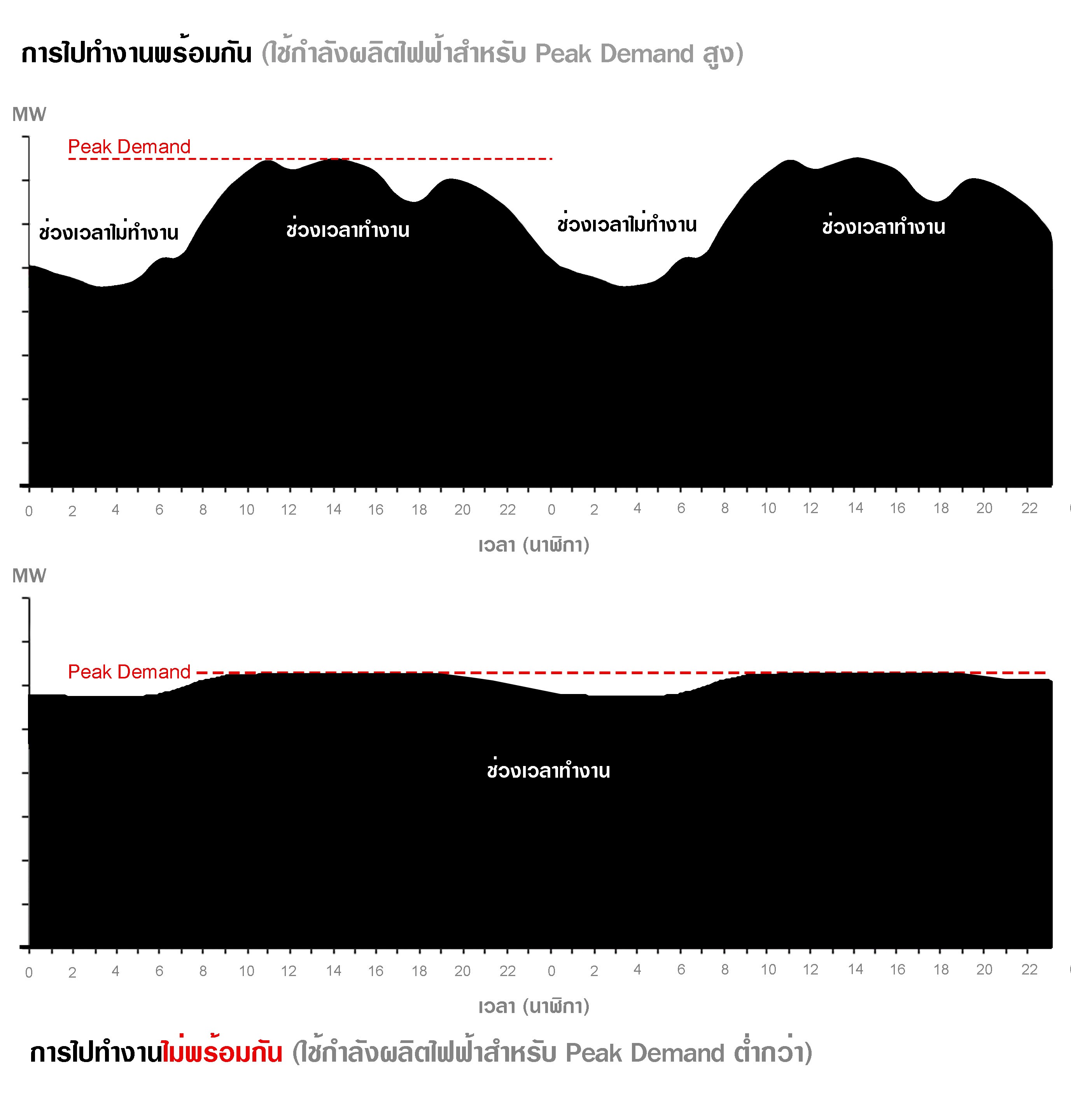
In today's world, the graph of electricity usage in major cities often resembles a mountain, with a Peak Demand occurring during the day when air conditioning, lighting, and energy for industrial production and offices are at their highest.
Of course, some heavy industries require many people to work simultaneously, but many industries and service businesses (such as in the Patpong area of Bangkok) do not necessarily need to operate during the day.
During the energy crisis in 2003, the government of the People's Republic of China announced that hundreds of industries in Shanghai would work at night.
This announcement was a measure that could drastically reduce Peak Demand, as the government recognized that China had a limited number of power plants and could not build more quickly enough to keep up with the rapid economic growth.
For China, working at night is not unusual, as among the revolutionary founders of the People's Republic of China, there were several who slept in the morning, such as Chairman Mao Zedong and Prime Minister Zhou Enlai, who worked until 5 a.m. before going to bed.
The need for humans to rush out to work at the same time may be an outdated habit that has yet to be filtered out from our routine.
In Denmark, there is a group of activists who call themselves B-Society. They believe that each person's biological clock is different. Some people wake up early and sleep early, while others wake up late and sleep late.
They have observed that if people who prefer to sleep early are forced to work at night, they will be unable to perform effectively. Conversely, if night owls are made to work in the morning, they will also struggle to be productive.
Global companies like Google and Apple allow employees to choose their working hours as long as they can demonstrate that they have produced creative and quality work. Time management is something employees can handle themselves.
Countries that wake up early to engage in low-wage export industries, even if they produce 1,000,000 computers, still cannot match the value of a single "algorithm" paper from a night owl.
In the present era, we are discovering that the "value of ideas" from citizens is worth more than the rental value of malls, hotel rents, or the total value of exported goods.
This raises the question of how the government will provide infrastructure and tools for citizens and youth to create intellectual value (why must a top-notch science museum be located in the middle of Rangsit, where public transport is inaccessible, while luxury malls can be situated next to every subway station?).
This indicates that we are still valuing cities based on an outdated system that relies on rental rates and product values.
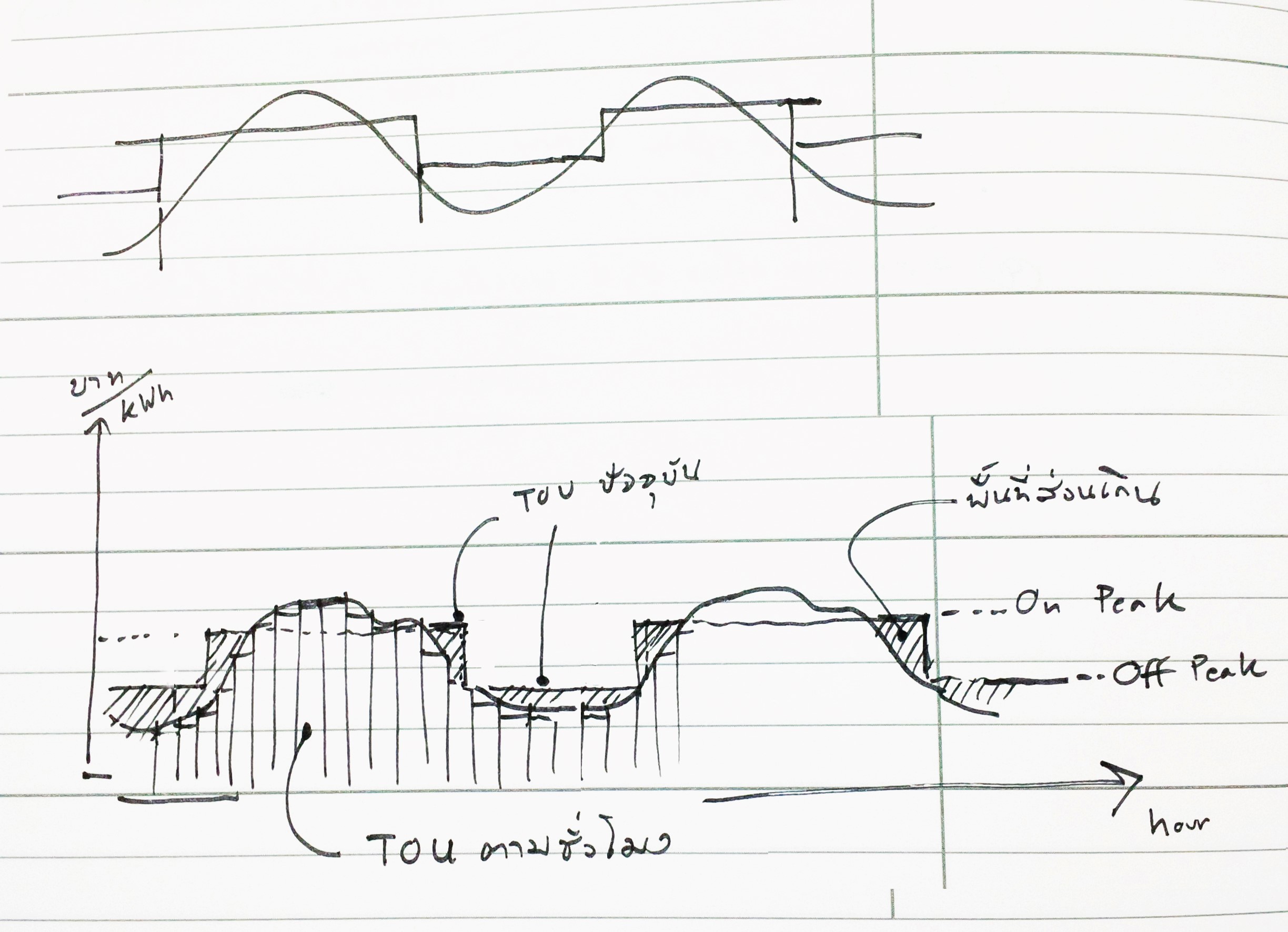
The government could implement a more frequent TOU (Time of Use) policy with hourly rates that align with actual electricity usage graphs, rather than just having two rates for On Peak and Off Peak. This would eliminate the "shadow" areas (measured in price/kW) that do not reflect actual demand during those times.
Hourly TOU could incentivize companies that see time flexibility as a profit.
Electricity companies might be able to pay lower rates during non-peak hours (just as railways can offer cheaper tickets during off-peak times)... architectural firms might start work from 8 p.m. to 4 a.m., except on days with client meetings... newspapers might begin printing at 3 a.m. (instead of noon)... condominium and hotel corporations nationwide might start laundry operations after midnight instead of at 2 p.m.... etc.
If there are more users of hourly TOU, the new demand graph could flatten out, resulting in a lower overall peak, which means fewer power plants would need to operate simultaneously on any given day.
Employees arriving at work at 9 a.m. does not necessarily mean they can communicate effectively at that time. If we try to call a client or friend on a Monday morning, we will find it very difficult to reach them immediately. We may not be able to contact them by phone at all that day.
Meanwhile, if we send a short chat message to them via mobile, we will likely receive a response just a few hours later. Therefore, having staggered working hours does not significantly impact communication in today's world, especially in businesses that prioritize "thinking" over exporting products.
Most communication in modern companies is done through email or text messages, but for urgent matters, phone calls are still used.
Nielsen, a leader in consumer data research, has noted that human phone usage has dramatically decreased in recent years. Most people prefer to conduct business through text messaging (email and chat) rather than phone calls, as calling may not reach the person immediately and often requires asking, "Are you free to talk?"
If they are not available, we may have to wait another half hour (as a courtesy) to call back, even though they might be free to talk just five minutes later.
Sending messages via Line or Chat from mobile is therefore a more continuous and efficient form of communication than using the phone (this is something teenagers and "flirt" hunters understand better than older businesspeople).
The waking and sleeping patterns of people in urban society are significant issues that consume vast amounts of resources and energy.
Waking up is not an old tradition that should be followed blindly; rather, it should be seriously studied where the system of early rising (diligence) to work together originated.
Waking up is not an Art but a Science.
Before long, we may see a new breed of activists who sacrifice waking up late to conserve energy and protect the world's resources. Soon, we might have to stand tall to honor the writer (the head of the water) who wakes up with the evening sunlight... at the very least, such individuals would significantly reduce the Peak Demand for energy in the city.
SOURCE: www.thaipublica.org