
Statistics Behind Work from Home: How Lonely People Continue to Work
The COVID-19 phenomenon has impacted the world significantly, causing many businesses to temporarily close. Organizations and companies can no longer have employees work together in the office as usual. It was time for people to adapt to a major change, leading to a new way of life or the New Normal. This shift not only transformed physical social interactions but also affected people's mental well-being.
When Life Reaches a Turning Point
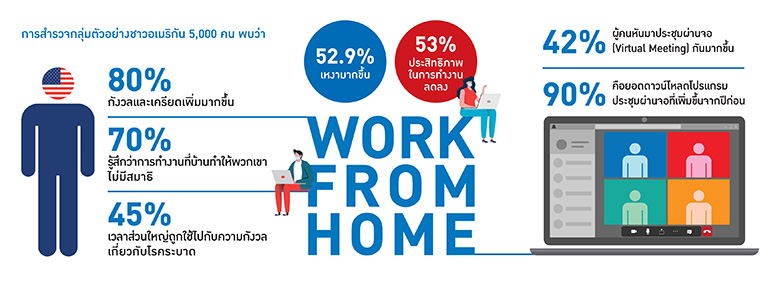
As "social distancing" became a primary measure used by the government to encourage citizens to reduce travel and close contact, many companies announced that most employees would start working from home (Work From Home). A survey by Thrive Global of 5,000 Americans found that over 80% of respondents reported increased levels of anxiety and stress due to the pandemic. Additionally, 70% felt that working from home made it difficult to concentrate, and reports indicated that over 45% of work time was spent worrying about the pandemic and its potential impacts.
Furthermore, teamblind.com, which primarily serves employees from major American companies like Apple, Amazon, Bloomberg, and Facebook, surveyed employees about their "fears" in the workplace. The results showed that, on average, more than half (57%) feared they might lose their jobs, while 23.7% admitted they were looking for ways to earn extra income. Additionally, 40.6% believed it would take at least 6 to 12 months for the situation to return to normal.
Loneliness as a Double-Edged Sword: Young People Not Meeting on Difficult Days
As people interacted less and social distancing helped reduce the transmission of the virus, it provided some comfort. However, being alone for extended periods naturally leads to feelings of loneliness, which in turn affects individual work performance. According to a survey by teamblind.com regarding mental well-being as a result of social distancing, involving 10,107 respondents, the findings were as follows:
- Increased Loneliness: 52.9% reported that working from home made them feel lonelier than usual (Apple employees reported a 52.3% increase in loneliness, Intel employees 50%, and Facebook employees 58.1%).
- Decreased Work Efficiency: 53% stated that their work performance was affected by changes in mental state due to working from home (69.7% of Facebook employees reported a decline in work efficiency, 64.3% of Google employees, and 57% of Amazon employees).
Stay Alone Together and 5G: The Future's Answer
Even when physically apart, modern video conferencing technology allows us to communicate and see each other through video. Tools like Zoom and Google Hangouts Meet saw global downloads reach 62 million within a week (from March 14 to 21, 2020), an increase of over 90% from the average downloads of the previous year.
A report from Doodle, an online meeting and calendar platform, indicated that people are increasingly turning to virtual meetings, with a 42% rise. In addition to one-on-one work discussions or organizational meetings, there has also been a notable increase in virtual meetings for other activities, such as:
- Scheduling exercise sessions, yoga, aerobics, or even Pilates through virtual meetings increased by 100%.
- Organizing game sessions, whether online games or traditional games like word guessing or trivia, increased by 44%.
- Social gatherings, such as having beers or sipping wine, surged by 296%.
The growing trend of remote work has made the quality of connectivity increasingly essential. Technology like 5G1 will play a crucial role in supporting connections between people, making remote work more stable and breaking down barriers of location, thus enabling more effective collaboration among people in different places.
|
Tips for Staying Focused While Working from Home
|
15th generation wireless technology that is not limited to mobile phones but includes all devices that can connect to the internet, offering speeds up to 20 times faster than current 4G.
Image Source: Charles Deluvio/Unsplash
Source:
Article “Video Conferencing Apps Surge from Coronavirus Impact” by Lexi Sydow from appannie.com
Article “What Studies Reveal About Social Distancing and Remote Working During Coronavirus” by Bryan Robinson from forbes.com
Report “Thriving in the New Normal” from thriveglobal.com
Written by: Nattacha Tawanachoti
SOURCE: www.tcdc.or.th