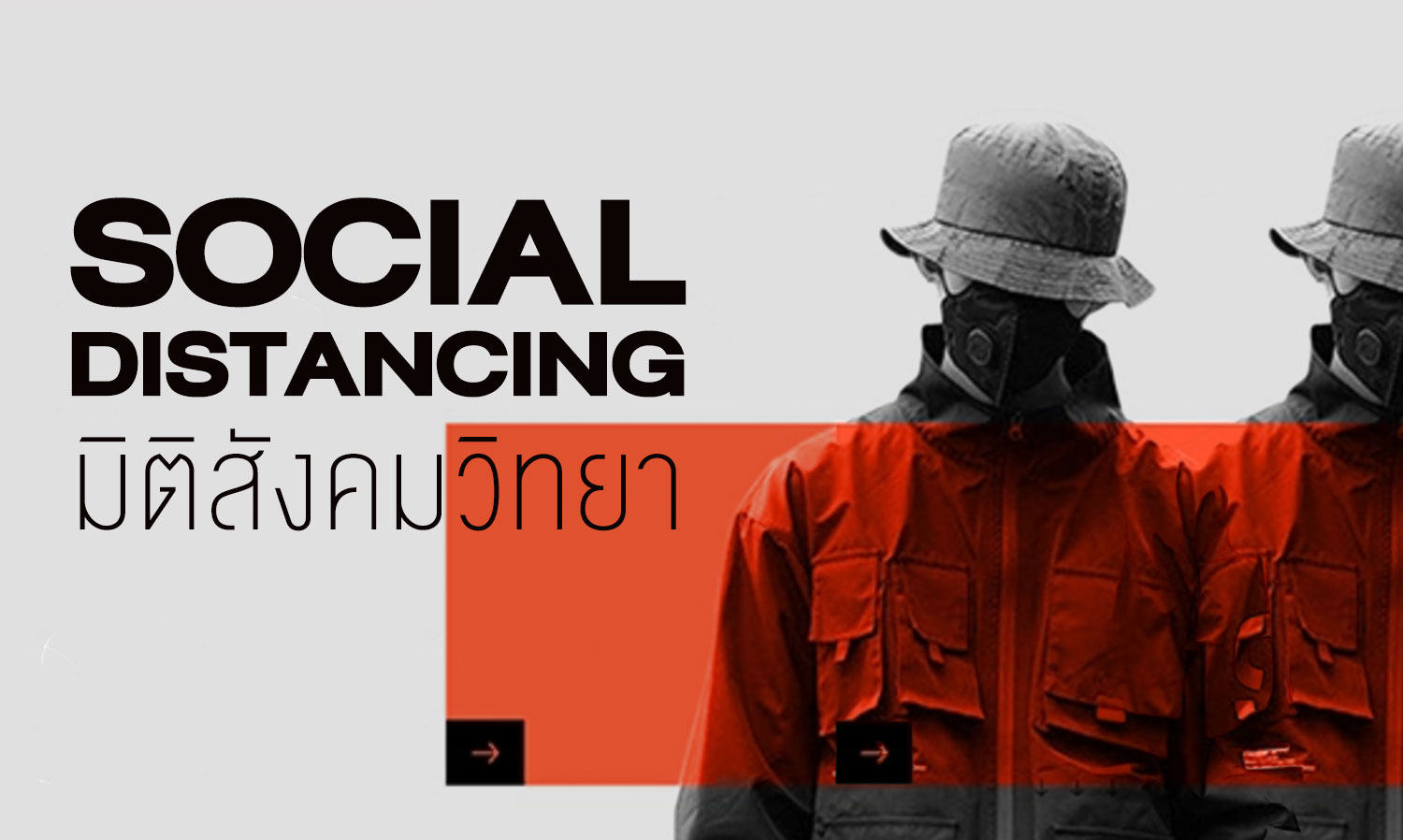
Social Distancing: A Sociological Perspective
The COVID-19 pandemic continues to spread globally. As of March 29, 2020, there have been over 600,000 confirmed cases, with the WHO warning that the United States may become a new epicenter of the outbreak. Meanwhile, Thailand has seen a rapid increase in cases, surpassing a thousand, concentrated mainly in Bangkok and its surrounding areas, as well as tourist provinces and the southern border. This situation has led the government to declare a state of emergency to control the spread of the virus and intensify social distancing measures.
Why implement social distancing measures?
In epidemiology, it is widely accepted that combating COVID-19 involves two approaches: (1) Mitigation by isolating vulnerable groups, such as the elderly, or quarantining patients or at-risk individuals, and (2) Suppression through social distancing to slow the spread of the virus, preventing the number of cases from exceeding the healthcare system's capacity. This is a crucial weapon in “flattening the curve” of patient numbers.
The lessons learned from the Spanish flu outbreak a century ago indicate that “social distancing” is not outdated and remains one of the best strategies to combat epidemics. The difference this time is the use of Big Data and AI technology, integrating health databases with immigration data to identify individuals, track travel histories, and provide real-time alerts. The government has implemented stringent measures to tackle this crisis, including tracking applications, remote work, prohibiting gatherings, closing businesses and educational institutions, and establishing rigorous checkpoints for interprovincial travelers.
After the closure of businesses in Bangkok and its vicinity, we learned about the hardships faced by many workers. The government has not remained idle, introducing measures to assist and mitigate economic impacts on all groups. One such measure is providing financial aid to informal workers under Sections 39 and 40, temporary employees, and freelancers affected, amounting to 5,000 baht per month for three months. Meanwhile, formal workers receive compensation according to social security criteria, with over 17 million applicants registered just one day after the registration opened on March 29, 2020.
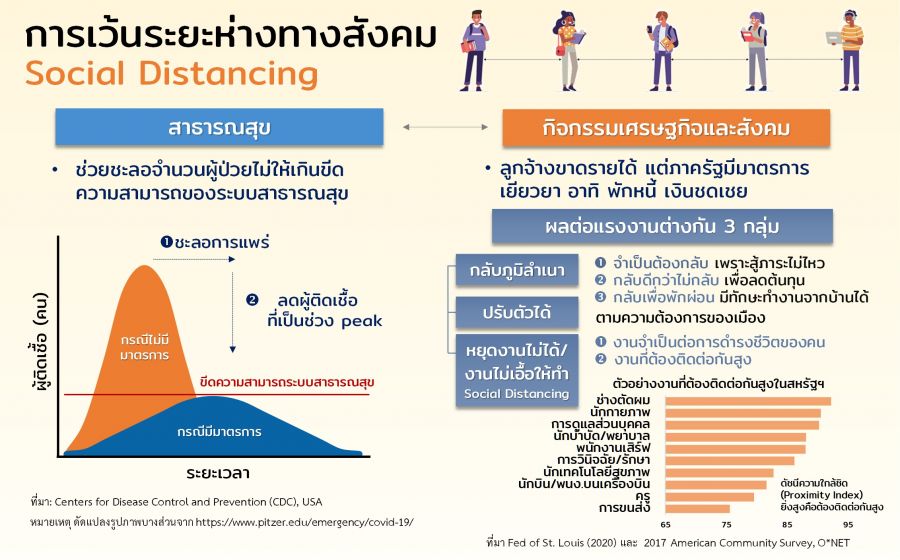
A study by the Federal Reserve Bank of St. Louis (2020) found that social distancing impacts all worker groups, particularly those in close contact with customers, primarily in service jobs such as hairdressers, physical therapists, and servers. In the U.S., there are about 27.3 million such workers, accounting for one in five of the total workforce. Applying the same principle to analyze Thailand, we find that the most vulnerable informal workers are in the service sector, totaling 5 million, along with 1.8 million in basic occupations such as laborers, delivery personnel, and cleaners, making a total of 6.8 million, or about one in five of the total workforce, similar to the U.S. case study. Working from home also presents challenges; according to the Pew Research Center (2020), only 7% of private sector workers and 4% of public sector workers in the U.S. can work from home, mostly executives and office staff, which likely reflects similar challenges in Thailand.
Sociological Dimension: Migrant Workers for Survival
“Social distancing” has led to reduced incomes for urban workers while expenses remain high, with no social protection, creating demographic pressures that drive waves of labor migration. Interviews with informal workers from the Chulalongkorn University Labor Research Coordination Center revealed that most returning workers are low-income daily wage earners, predominantly women in the service, hotel, and restaurant sectors. The decision to return to their hometowns is seen as a survival strategy during the crisis, categorized into three main groups:
(1) Those who must return include those laid off due to permanent business closures and those temporarily laid off, such as reduced workdays, wage cuts, or unpaid leave. Reduced income makes it impossible to bear the high cost of living in the city, but they are fortunate to have a hometown to return to, mostly agricultural households in rural areas. Some workers may return permanently if they can find work or start their own businesses.
(2) Those who prefer to return rather than stay include those who stopped working due to temporary business closures and those whose employers allow them to work from home. Although some have sufficient income or savings to live in the city, they wish to return to reduce costs, with the expectation that they can return to work when the situation normalizes.
(3) Those returning to rest or temporarily work from home in rural areas are mostly skilled workers who can work from home. Although they are not significantly affected, they choose to return because they find city life inconvenient. Some decided to return before the Songkran holiday or assessed that travel restrictions might be imposed.
Interestingly, some workers have adapted by changing their occupations to align with urban demands, such as shifting from sewing clothes to making and selling cloth masks or from driving taxis to delivering food.
“Stay home, stop the spread for the nation” to overcome the COVID-19 crisis
In times of crisis like this, understanding the social context of each group of people is challenging, especially for those lacking basic resources for social distancing, such as street vendors, the homeless, the elderly, and those with chronic illnesses, who urgently need government assistance. This includes the need to create jobs for migrant workers in their home areas and providing initial funding, knowledge, and technology for those wishing to start their own businesses.
Enhancing access to medical equipment and supplies to combat COVID-19 is crucial. Above all, the success of social distancing depends on the unity and cooperation of all Thais in strictly adhering to the rules. Finally, I would like to express my support on behalf of all Thais to the medical and health professionals who dedicate themselves to caring for patients and the public during this crisis. Together, we will overcome this challenge.
[This article represents personal opinions and does not necessarily reflect the views of the Bank of Thailand or Chulalongkorn University]
* Title: “COVID-19: Social Distancing and the Population Migration Wave from a Sociological Perspective: The Thai Power of ‘Stay Home, Stop the Spread for the Nation’”
By...
Dr. Sawanee Chantapong
Senior Expert, Macroeconomic Department, Bank of Thailand
Mr. Totsapol Tonghui
Senior Economist, Monetary Policy Department, Bank of Thailand
Asst. Prof. Dr. Rattiya Phulaor
Lecturer, Population Studies Program, Chulalongkorn University
Dr. Montakan Chimmaami
Lecturer, Social Research Institute, Chulalongkorn University
SOURCE: www.bangkokbiznews.com