Tax Money: What Is It Being Used For? "Central Budget" Stuck at Nearly 300 Billion Baht
The figures reveal that the central budget disbursement is 518 billion baht, with 289 billion baht still pending. Of the emergency and necessary budget, only 7.494 billion baht has been disbursed.
Following the previous discussion on the emergency budget to combat the COVID-19 crisis, amounting to 96 billion baht, it is now clear that the "central budget" allocated by the government for the fiscal year 2020 totals 518.771 billion baht, divided into 11 categories.
The funds available for use fall under the emergency or necessary budget category, with an allocation of 96 billion baht to address the COVID-19 pandemic or disasters like droughts and floods. Currently, approximately 88.50574 billion baht remains unspent, as the funds approved to assist with the COVID-19 crisis were only authorized last March, with the entire 96 billion baht approved in that month alone.
This clearly reflects the government's management in responding to the COVID-19 crisis, whether it is proactive or reactive, as the virus has been spreading for over three months since December 2019.
The remaining 10 categories in the 2020 budget act have clearly defined objectives for spending.
All 11 categories have specified topics and objectives for fund allocation, making it quite challenging to reallocate the budget for other purposes. Importantly, each central budget item has already been claimed by specific departments. For example, in healthcare, if the annual budget is insufficient, funds must be borrowed from the treasury and then budgeted for repayment in the following year.
For the overall spending of the central budget during the first six months of the fiscal year 2020 (from October 1, 2019, to March 25, 2020), there are 7 items under the responsibility of the Office of the Comptroller General at the Ministry of Finance, with the following details:
1) Emergency disaster relief expenses amounting to 3 billion baht, with 135.27 million baht disbursed, leaving approximately 2.86473 billion baht pending, which is 95.45% of the allocated budget.
2) Medical expenses for civil servants, employees, and state workers totaling 71.2 billion baht, with 41.85266 billion baht disbursed, leaving approximately 29.34734 billion baht pending, which is 41.22% of the allocated budget.
3) Financial assistance for civil servants, employees, and state workers amounting to 4.94 billion baht, with 2.29384 billion baht disbursed, leaving approximately 2.64616 billion baht pending, which is 53.57% of the allocated budget.
4) Pensions and retirement benefits totaling 265.716 billion baht, with 148.98809 billion baht disbursed, leaving approximately 116.72822 billion baht pending, which is 43.93% of the allocated budget.
5) Salary increases and adjustments for civil servants amounting to 10.465 billion baht, with no disbursement yet, leaving 100% pending.
6) Contributions for permanent employees totaling 670 million baht, with 340.41 million baht disbursed, leaving approximately 329.59 million baht pending, which is 49.19% of the allocated budget.
7) Reserve funds for civil servant contributions and compensations totaling 62.78 billion baht, with 27.71675 billion baht disbursed, leaving approximately 35.06325 billion baht pending, which is 55.85% of the allocated budget.
The remaining 100 billion baht is under the responsibility of the Budget Bureau under the Prime Minister's Office, with 4 items including:
8) Expenses related to royal visits and welcoming foreign dignitaries totaling 1 billion baht, with 386.46 million baht disbursed, leaving approximately 613.54 million baht pending, which is 61.35% of the allocated budget.
9) Expenses for projects resulting from royal initiatives totaling 2.5 billion baht, with 55.78 million baht disbursed, leaving approximately 2.44422 billion baht pending, which is 97.77% of the allocated budget.
10) Compensation for construction work totaling 500 million baht, with 23.51 million baht disbursed, leaving approximately 476.49 million baht pending, which is 95.30% of the allocated budget.
11) Reserve funds for emergencies or necessities totaling 96 billion baht, with 7.49426 billion baht disbursed, leaving approximately 88.50574 billion baht pending, which is 92.19% of the allocated budget.
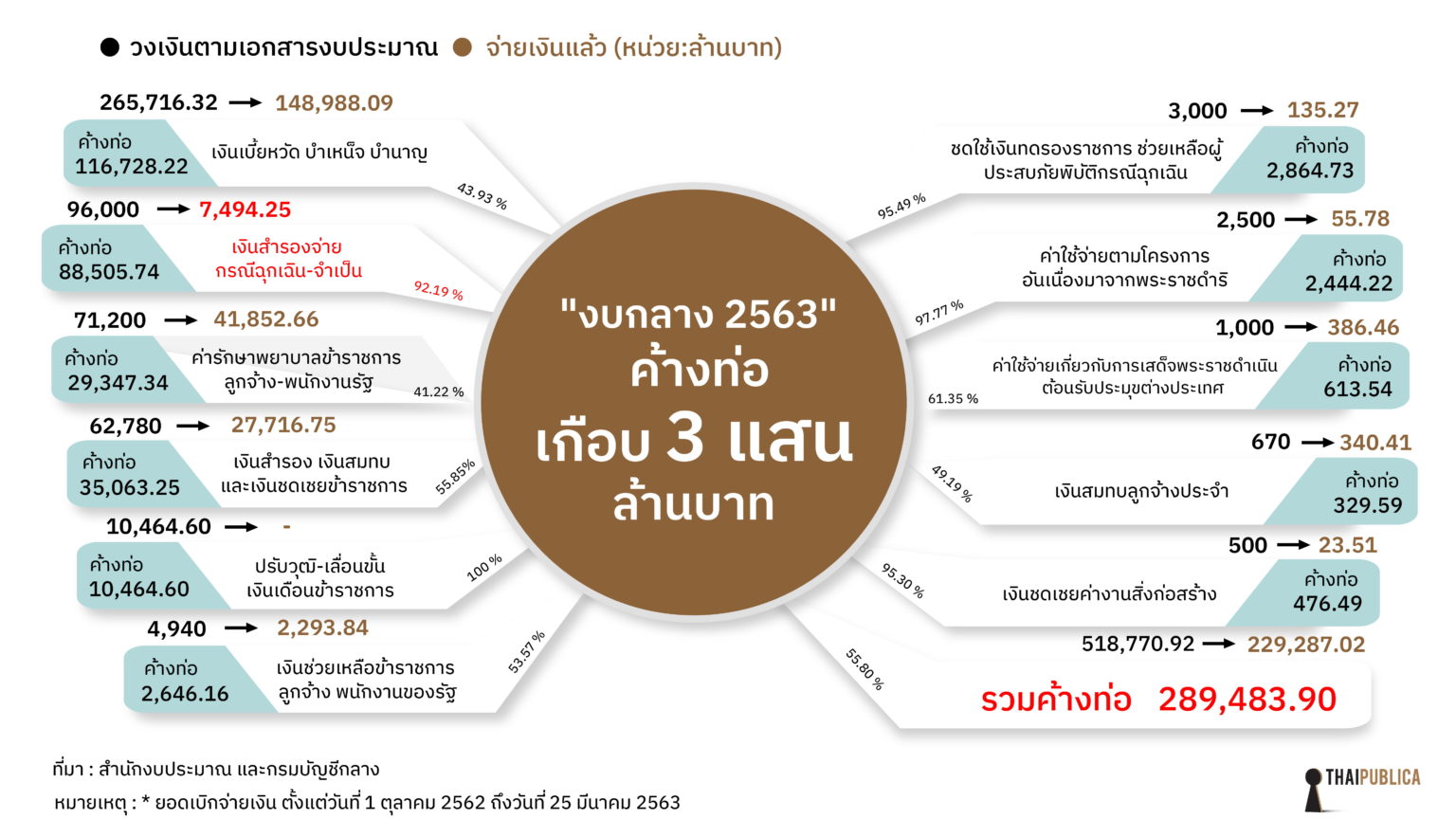
In summary, the disbursement from the central budget during the first six months of the fiscal year 2020, totaling 518.771 billion baht, has resulted in 229.287 billion baht disbursed, with approximately 289.484 billion baht pending.
Thus, the pending amount stands at approximately 289.484 billion baht, or about 55.80% of the allocated budget.
Within this nearly 300 billion baht pending amount, the urgent and necessary budget of 96 billion baht, with 88.505 billion baht still pending, needs to be addressed quickly. Of this, 79.841 billion baht is earmarked for relief and prevention of the COVID-19 outbreak.
Therefore, the question arises: in a time of national crisis, the emergency budget should not remain pending. Every department must work proactively, integrating data effectively. Hospitals that are heavily burdened with patient care, the stock of medical supplies, procurement processes, and various approvals must be expedited. It is crucial for government agencies to facilitate these processes, even though necessary items may be scarce in such urgent circumstances.
However, amidst the crisis, proactive management, communication, and collaboration are of utmost importance. The Thai people and the private sector are stepping up to help in every way possible, from donating money and goods to innovating and repurposing factories to produce essential items like face masks, hand sanitizers, and critical medical supplies for hospitals, healthcare personnel, and all Thai citizens.
SOURCE: www.thaipublica.org