
Lessons Learned from the U-Tapao Case and the Standard of 'Time' in Procurement Processes
Even though the selection committee for the U-Tapao Airport Development Project and Eastern Aviation City announced the results on January 30, 2020, stating that the BBS consortium, led by Dr. Prasert Prasartthong-Osoth of Bangkok Airways Public Company Limited, BTS Group Holdings Public Company Limited, and Sino-Thai Engineering and Construction Public Company Limited, submitted the highest bid of 305 billion baht, which provided the best return for the government, it was expected that the negotiation process, contract drafting, and technical details with the BBS consortium would be completed by March 2020.
However, the ruling of the Supreme Administrative Court on January 7, 2020, raised significant concerns regarding the issue of 'time,' which has been a contentious point for many. The defendants, including the selection committee for the U-Tapao Airport Development Project, argued that:
If the Supreme Administrative Court rules to accept the two problematic proposal envelopes, it will change the standard for proposal submissions and public procurement, disregarding time as a critical factor.
This prompts us to reflect and clarify doubts step by step, revisiting the judgment of the lower administrative court for comparison with the Supreme Administrative Court's ruling, as well as comparing it with other decisive judgments that many have brought up in relation to this case.
Understanding the Case Background: The 9-Minute Issue
To recap the case regarding the proposal submission for the U-Tapao Airport Development Project, the bidding process followed the criteria and methods outlined in the announcement by the Eastern Economic Corridor Policy Committee regarding the criteria, methods, conditions, and processes for public-private partnerships or private investments in 2017. Invitations, selection documents, joint investment contracts, additional documents related to the selection process, and other relevant documents were prepared by the Navy as the project owner.
The case originated from Than Holding Co., Ltd. and its partners (CP Group), who participated in the bidding on March 21, 2019, with the proposal submission period starting at 9:00 AM and closing at 3:00 PM. The CP Group was the first to arrive and registered at 12:20 PM, followed by the BBS consortium and the Grand Consortium. The selection committee informed all three bidders that they should present themselves when their documents were ready for submission before proceeding with the proposal submission and document verification process.
Both the BBS and Grand groups submitted their documents on time, while the CP Group's documents were incomplete, missing two envelopes. The selection committee instructed them to bring the documents by 3:00 PM, but the two envelopes from the CP Group arrived at 3:09 PM.
The proposal submission process began shortly before 3:00 PM and concluded after the CP Group submitted their proposal around 6:00 PM, with document verification completed around 9:00 PM. Consequently, the selection committee decided to postpone the opening of the first envelope, which was supposed to be completed that day. Later, the committee found that the two envelopes from the CP Group were submitted 9 minutes late, leading to the decision to reject those documents.
Subsequently, the CP Group, believing the decision was unjust, filed a lawsuit with the Central Administrative Court, which ruled against the CP Group, focusing on the time constraints outlined in the selection documents that the committee used to determine the bidding process. The key points of the ruling were as follows:
- The decision not to accept the two envelopes by the selection committee was justified and could not be waived; otherwise, it would constitute discrimination against other bidders.
The court noted that the CP Group's documents arrived after the clearly defined submission deadline of 3:00 PM on March 21, 2019. On that day, the selection committee received all documents from the CP Group, only to later discover that they arrived at 3:09 PM due to traffic delays.
- The processes of 'submission' and 'verification' of documents are separate, meaning that both sealed and unsealed proposals must be completed by 3:00 PM on March 21, 2019, as stipulated, while the verification of the completeness of unsealed documents is a subsequent step in the scoring process.
Thus, late submissions could only be accepted if there was a written extension as per the regulations. The selection committee's postponement of the unsealed envelope opening was merely for verification purposes. The rejection of the proposal did not need to occur on the same day; if facts emerged later indicating a mistake, the rejection could still be valid.
- The CP Group's letter dated March 28, 2019, informing the defendants that the process was not completed by 3:00 PM was considered an extension of the submission deadline as per clause 38 (3), indicating that they had the opportunity to clarify.
Therefore, the CP Group's claim that they were not informed of the facts leading to the order and were not given a chance to clarify was unfounded.
- The defendants were required to explicitly reserve their rights regarding the extension, which was not done in this case.
Consequently, the CP Group's assertion that the defendants accepted all proposal envelopes without hesitation or rejection, indicating that time was not a critical factor, was also unfounded.
- The requirement for all bidders to notify their readiness to submit proposals at the registration point by 3:00 PM was merely a procedural guideline to ensure smooth operations, and did not violate the selection criteria.
The selection documents clearly stated the criteria, location, date, and time for opening and closing submissions, specifying that submissions would be accepted on March 21, 2019, from 9:00 AM to 3:00 PM. Bidders were expected to be prepared to submit their proposals on that day. The CP Group's claim that there was no prior notification regarding the readiness of documents and the reality of not submitting documents on time was unsubstantiated.
However, the CP Group later appealed to the Supreme Administrative Court, which overturned the lower court's ruling, annulling the selection committee's decision not to accept the two envelopes from the CP Group. The Supreme Court considered the actual timeline of events and the presentation of the proposal. The key points from the ruling were:
- Determining whether the rejection of the proposal was incorrect must be based on the actual facts of the submission and acceptance process. The issue at hand was not that the plaintiff failed to participate in the proposal submission or took any action indicating a lack of desire to submit.
- Even though a deadline was set, it did not align with the actual submission and acceptance process as practiced. It was not the case that the plaintiffs submitted their proposals after the defendants closed the envelope submissions.
In fact, the process was sequential: 1) Presenting oneself as a bidder, 2) Submitting all proposals to the government, 3) The government reviewing the proposals, and 4) Opening all bidders' envelopes simultaneously.
According to the facts, the process began with registration before submitting proposals and verifying each proposal individually within the Navy's reception room. The CP Group expressed their intention to participate and registered within the designated time, just like other bidders. They received all proposals from all bidders, with clear documentation indicating that the proposal submission started around 3:00 PM and ended around 6:00 PM. During the submission of one bidder's proposal, other bidders waited outside, and the opening of the first envelope was scheduled for the same day at 4:00 PM, but in reality, it was postponed due to the large number of documents needing verification.
- There was no substantial evidence that the two envelopes arriving at the registration point after 3:00 PM resulted from the plaintiffs knowing the proposals of other bidders, which would have favored the plaintiffs or disadvantaged others, as the final selection depended on the defendants' evaluation.
Each bidder's documents remained in their possession until the verification time. Thus, the two envelopes that the defendants refused to consider did not have to be opened immediately.
- The essence of this case lies in the presentation of oneself as a bidder. The fact that the two envelopes passed through the registration point at 3:09 PM cannot be deemed a defect or improper conduct that would affect the joint venture process.
(Read the full ruling of the Administrative Court)
Reflecting on 5 Administrative Cases of 'Late Submission' – 'Is the U-Tapao Case a Benchmark for Bidding?'
After the Supreme Administrative Court ruled to annul the selection committee's decision not to accept the two envelopes from CP, five administrative cases concerning disputes over submission times were compared to this case, particularly a case where a private entity was late by only 39 seconds in submitting a bid to the Department of Revenue, which was raised by Rear Admiral Kriangkrai Wattanachai, the secretary of the selection committee, in court.
The 5 Administrative Cases that were cited as benchmarks regarding the significance of time in the bidding process share the following common points:
- All bidding processes were conducted electronically.
- The cases involved determining whether the defendants had the right to retain the plaintiff's bid guarantee, considering whether the plaintiff's actions constituted a breach of contract by being late for registration.
- In each case, the plaintiffs could not claim force majeure to excuse their late registration, even by just 38 seconds, as the court found that the delays were due to the plaintiffs' own negligence.
- Case between BCD Co., Ltd. and the Department of Rural Roads
- Case between Saisampan Partnership and the Department of Rural Roads
- Case between Gemini and Associates Co., Ltd. and Bangkok Metropolitan Administration
- Case between Chinsap Watthana Co., Ltd. and Bangkok Metropolitan Administration
- Case between TGS Enterprises Network Co., Ltd. and the Electricity Generating Authority of Thailand
These five cases share a similar dispute over time as in the U-Tapao case, as the Supreme Administrative Court must consider the selection committee's decision not to accept the two envelopes from the CP Group, focusing on the submission timing.
However, upon closer examination, it becomes evident that the five cases and the U-Tapao case differ in several aspects:
- In the bidding system, which affects the methods and procedures for bidding.
In the five cases, the court used the point of consideration to dismiss the plaintiffs and grant the bidding agency the authority to confiscate the bid guarantees because the plaintiffs could not register to 'submit a price' on time, which is the first step in the electronic bidding process, typically requiring registration between half an hour to an hour before testing the system and submitting bids sequentially, with each step having a clear timeline.
In contrast, in the U-Tapao case, the CP Group arrived to register at 12:20 PM, which was within the timeframe, as the bidding process had a single deadline: proposals were accepted on March 21, 2019, from 9:00 AM to 3:00 PM. The delay occurred when the two proposal envelopes were submitted at 3:09 PM, 9 minutes past the closing time, which was a delay in the 'submission' process, which the CP Group acknowledged, citing traffic congestion as the reason.
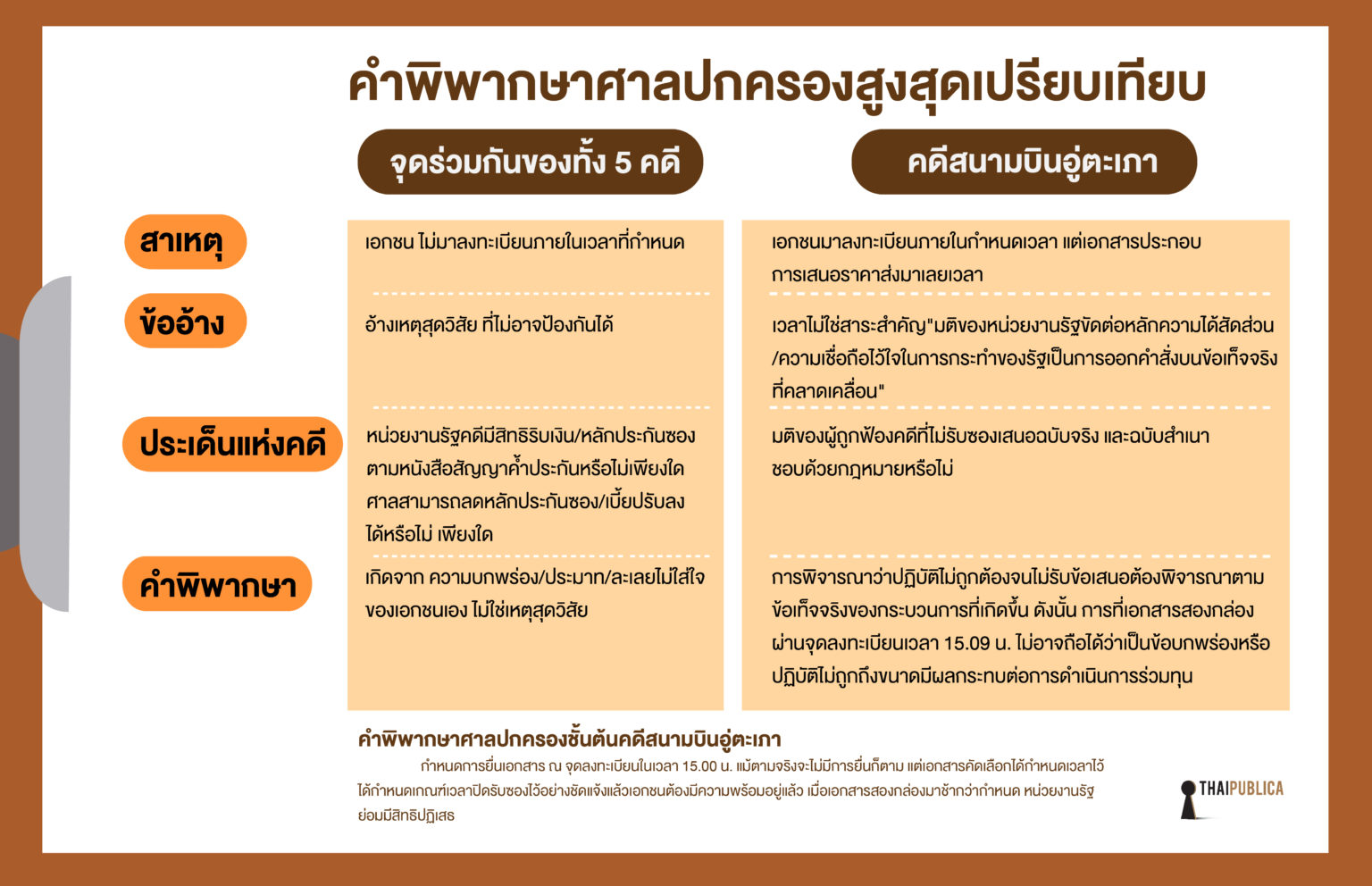
- The arguments regarding the reasons for the delays presented by the plaintiffs differ.
In the five cases, the plaintiffs cited 'force majeure', claiming that the circumstances causing their late registration were unforeseen and not due to their negligence.
In the U-Tapao case, the CP Group argued that 'time is not a critical factor', stating that although the proposal submission deadline was at 3:00 PM, the submission process began slightly before 3:00 PM and ended around 6:00 PM. During the submission of one bidder's proposal, other bidders waited outside, and the verification of all documents concluded at 9:00 PM. A strict interpretation of the selection process would render the acceptance of all proposals invalid.
Thus, while the timing is significant, the differences in methods and processes between late registration in electronic bidding and late document submission in the U-Tapao project, which has its own regulations, cannot be directly compared.
The Supreme Administrative Court's ruling did not alter the standard regarding the significance of time in bidding processes, as the U-Tapao case is considered a unique case. Its application to other cases must involve similar circumstances or facts.
Participants in this bidding process commented that the Navy may not be familiar with international bidding, which requires extensive documentation for proposal submissions. This bidding was divided into two rooms: a reception room and a bidding submission room. On that day, all bidders arrived before 3:00 PM and waited in the reception room. When it was time to submit bids, they had to walk to another room to submit their proposals, but only one staff member was available to receive documents, which took considerable time for verification.
Nonetheless, this case will serve as an important lesson for future bidding regulations, whether for small or large projects. The government, as an administrative agency, must clearly define timeframes for each process and avoid vague guidelines that could lead to disputes like this, as well as ensure readiness on the day of proposal submission.
- The Supreme Administrative Court ordered the return of CP's rights to bid for U-Tapao Airport.
- U-Tapao Airport bidding: 'The highest bid is not necessarily the winner' pending PwC and the Navy's decision on the 'financial model.'