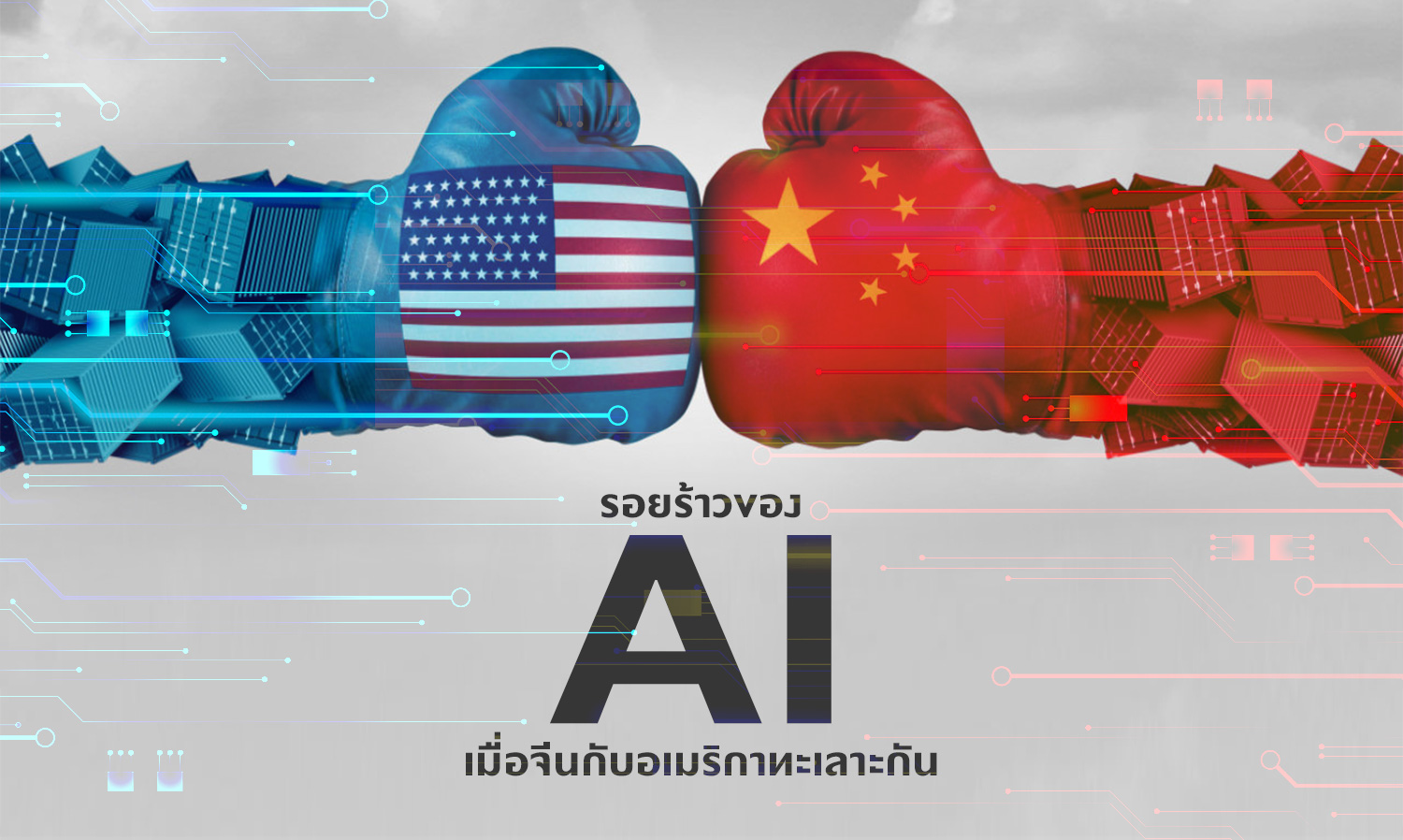
The Rift of AI as China and America Clash
In the past 5-6 years, organizations in China have rapidly increased their patents in artificial intelligence (AI) by an average of over 20% per year. When comparing the countries with the most AI patents globally, the United States and China rank in the top 5, demonstrating that both nations are highly committed to and focused on AI research and development, which is seen as the core of building the country's potential to become a leader in the global economy.
According to a survey by Accenture involving 12 developed countries, it is predicted that by 2035, AI will play a significant role in doubling the growth rate of the global economy. Additionally, a PwC survey forecasts that by 2030, the global GDP will increase by 14%, or approximately $15.7 trillion. Both reports agree that AI will enhance work efficiency through automation, where machines or technology perform tasks instead of humans, thereby increasing productivity and speed, starting from factories and transportation and expanding into other industries. In the future, the opportunity to own platforms will lead to vast amounts of data, enabling a better understanding of consumer needs, which can create personalized experiences, enhance product and service efficiency, increase revenue, and drive the economy at both national and global levels. For this reason, who wouldn't want to be in that position?
Regarding economic relations, China and the United States are closely intertwined. China, being both a major producer and consumer, has a policy of rapid national development, exporting goods, raw materials, and investments, along with a quality workforce of students and researchers. Meanwhile, the United States exports agricultural products and semiconductors to China (if readers are interested in the relationship between China and the United States, I recommend reading Dr. Arm Tangnirand's book on China-America, which is very enjoyable).
The trade war between the United States and China has impacted global AI development, especially recently, as media portray AI in the context of an arms race, which is a dangerous narrative for the world. Although AI is a dual-use technology applicable in both military and civilian contexts, true leadership in AI research and development should involve collaboration that considers ethical principles in design and application to benefit humanity and global society.
Currently, researchers are concerned about issues ranging from the use of AI in surveillance, data bias, and the rights of technology owners to access citizens' data, akin to data colonization, where the country does not have rights to its citizens' data, to the climate crisis caused by data centers. Some AI models generate carbon dioxide emissions as high as 300,000 kilograms, equivalent to taking a round trip flight from Beijing to New York 125 times. These issues require collective effort from everyone working in AI.
In light of the trade divide, China is leveraging its geographical and cultural advantages close to Asia, along with the Belt and Road Initiative, which is China's main strategy to expand its influence globally by connecting transportation routes with various countries, to extend technological assistance to countries developing AI technology.
On the other hand, the United States is beginning to worry about falling behind in AI development compared to China. A report from the AI Security Commission indicates that reduced research budgets have led to a "brain drain," with researchers moving to various industries, resulting in a shortage of personnel and research funding, which diminishes the United States' ability to lead in AI and poses national security risks due to a decline in potential AI technologies.
While other leading countries, including China, are increasing their AI research investments, the report recommends boosting research budgets to develop talent, applying AI in various security fields, and emphasizing building relationships with government, private sectors, and universities to accelerate research efforts, as well as engaging in international dialogue to promote positive research and collaboration in creating safe and beneficial AI for humanity.
For Thailand, as a friend to both countries, we should leverage international cooperation to reduce technological risk diversification against the monopoly of any one country's technology. What we need to be cautious about is data or technology colonization, where the data of our population is used as a form of power that creates economic leverage for that country, especially when international relations shift, which is a matter of national security that should be prioritized.
References:
- https://www.wipo.int/edocs/pubdocs/en/wipo_pub_1055.pdf
- https://www.europarl.europa.eu/RegData/etudes/BRIE/2019/637967/EPRS_BRI(2019)637967_EN.pdf
- https://www.accenture.com/t20170524T055435__w__/ca-en/_acnmedia/PDF-52/Accenture-Why-AI-is-the-Future-of-Growth.pdf
- https://foreignpolicy.com/2019/12/11/artificial-intelligence-ai-not-arms-race-china-united-states/
- https://www.nationaldefensemagazine.org/-/media/sites/magazine/03_linkedfiles/nscai-interim-report-for-congress.ashx?la=en
- https://ainowinstitute.org/AI_Now_2019_Report.pdf
- https://www.pwc.co.uk/economic-services/assets/macroeconomic-impact-of-ai-technical-report-feb-18.pdf
SOURCE : www.thaipublica.org