Thailand Accelerates Negotiations with the U.S. for GSP Reinstatement at ASEAN Summit This November; USTR Open to Review Rights
Today (October 28, 2019), Mr. Kirati Ratchano, Inspector General of the Ministry of Commerce, acting as the Director-General of the Department of Foreign Trade, held a press conference regarding the U.S. suspension of Thailand's GSP rights. He stated that President Donald Trump issued a presidential proclamation suspending trade preferences under the Generalized System of Preferences (GSP), which exempts certain imported goods from tariffs. The GSP rights for 573 imported items from Thailand will be temporarily suspended for six months from the date of this proclamation, effective April 25, 2020.
Mr. Kirati further explained that there are 2-3 points to clarify regarding the GSP issue, as it has been linked to various matters in recent days. The first point is to clarify what GSP is. GSP is a preferential treatment that Thailand receives from developed countries, not just the U.S., but also from the European Union, Russia, Switzerland, Norway, and Japan.
“These developed countries grant rights to developing and least developed countries to receive GSP tariff reductions, which vary by the granting country,” Mr. Kirati said.
The U.S. has granted GSP to Thailand since 1976, and Thailand has continuously utilized these rights. The U.S. reviews and adjusts the program periodically based on trade circumstances. Currently, the U.S. program is in its 10th renewal phase, valid from January 1, 2018, to December 31, 2020.
“The most important aspect of GSP is that it is a unilateral concession to the country, covering both agricultural and industrial products, with the majority being industrial goods. The eligibility criteria for GSP state that if the export value under GSP exceeds $185 million, the U.S. has the right to revoke the privileges, or if our exports impact their domestic industries, or if the national income per capita is around $12,000, while Thailand's is $6,600. Even if there is a review for revocation, we must ensure intellectual property protection and labor rights, which are currently under consideration,” Mr. Kirati explained.
In principle, the U.S. has guidelines for reviewing GSP with beneficiary countries, such as the level of development measured by national income per capita, market openness for goods and services, intellectual property protection, labor rights protection, clear investment policies, and support for the U.S. in combating terrorism. Additionally, they set import value limits under competitive need limitations (CNLs), considering that the goods have high competitiveness in the U.S. market and do not need GSP privileges. There are two conditions:
1) The import value to the U.S. exceeds the maximum value set by the U.S. each year, which was $185 million in 2018 (increasing by $5 million each year). 2) The market share of imports from the U.S. exceeds 50%, but the import value of those goods is below the de minimis value set by the U.S., which was $24 million in 2018.
Currently, Thailand is the most dependent country on GSP trade privileges, ranking first among the 119 countries that the U.S. grants GSP rights, replacing India, which lost its privileges on June 5, 2019.
Mr. Kirati continued that the second point to clarify is the assessment that the GSP revocation would impact 40 billion baht. Historically, Thailand has had continuous GSP rights, with some items being revoked and others added. The average utilization of GSP rights by Thailand since 1976 has been around 70%, while 30% has not been utilized.
The U.S. has granted GSP rights for 3,500 items to Thailand, of which Thailand has utilized 1,285 items.
Thus, the estimated impact of 40 billion baht, or $1.3 billion, is based on the total value of the 573 items that were revoked. Therefore, the U.S. calculated this based on last year's GSP export base, which does not mean that after the GSP revocation, Thailand cannot export to the U.S. or lose the value of GSP rights of approximately 40 billion baht.
“Thailand can still export, but must pay the normal tariff rate or MFN Rate, averaging around 4.5%, depending on the goods, which amounts to about 1.5 to 1.8 billion baht in additional tax burden. For some product groups, a 1% tax rate may be significant if the export volume under GSP is high. However, I want to emphasize that GSP is a privilege granted unilaterally; one day they may decide not to grant it,” Mr. Kirati said.
Key products affected by the GSP suspension include motorcycles, eyeglasses, machinery and electrical equipment, plastics and plastic products, processed food, chemicals, steel or iron products, copper, ceramic products, and jewelry.
The highest taxed product group is ceramic tableware and kitchenware at a rate of 26%, while the lowest is chemicals at 0.1%.
Thailand ranks second in utilizing GSP from Switzerland and third from Russia, with Norway in fourth place. The European Union revoked Thailand's GSP rights in 2015, and Japan recently did the same.
In the first eight months of this year, Thailand utilized GSP rights totaling $3.2 billion, an increase of 13% from $2.8 billion in the same period last year.
“The Department of Foreign Trade has been in continuous discussions with operators, emphasizing that this privilege may one day disappear, and we must develop ourselves to remain competitive, not solely relying on price,” Mr. Kirati stated.
Regarding the third point Mr. Kirati clarified, the GSP revocation due to human trafficking has been discussed. Thailand has been upgraded to Tier 2, and he mentioned that this should be separated into three points: first, human trafficking, which is the responsibility of the U.S. State Department, with Thailand coordinating through the Ministry of Social Development and Human Security; second, child labor, handled by the U.S. Department of Labor; and third, labor welfare, which is the reason Thailand was cut from GSP this time, with the U.S. Department of Labor overseeing it.
“There are two methods for initiating an investigation or review: one is self-initiated, where the Department of Labor directly inquires whether each country provides labor welfare; the other method involves complaints, which in Thailand's case, was initiated by the AFL-CIO,” Mr. Kirati explained.
The American Federation of Labor and Congress of Industrial Organizations (AFL-CIO) filed a petition to revoke Thailand's GSP rights on October 4, 2019, and again on October 16, 2019, citing that Thailand has not protected labor rights according to international standards. In response, Thailand has revised its labor relations legislation to align with U.S. demands and International Labor Organization (ILO) standards, but the U.S. believes Thailand has not yet complied with their requests.
“The U.S. demands that we take action in several areas, which we have been addressing since 2013. The details are with the Ministry of Labor. This issue has been ongoing for some time, and we have been aware from various meetings that the U.S. signaled that by late October or early November, they would announce the results of their review, which we were somewhat aware of beforehand,” Mr. Kirati said.
Urgent Negotiations with the U.S. for Rights Restoration
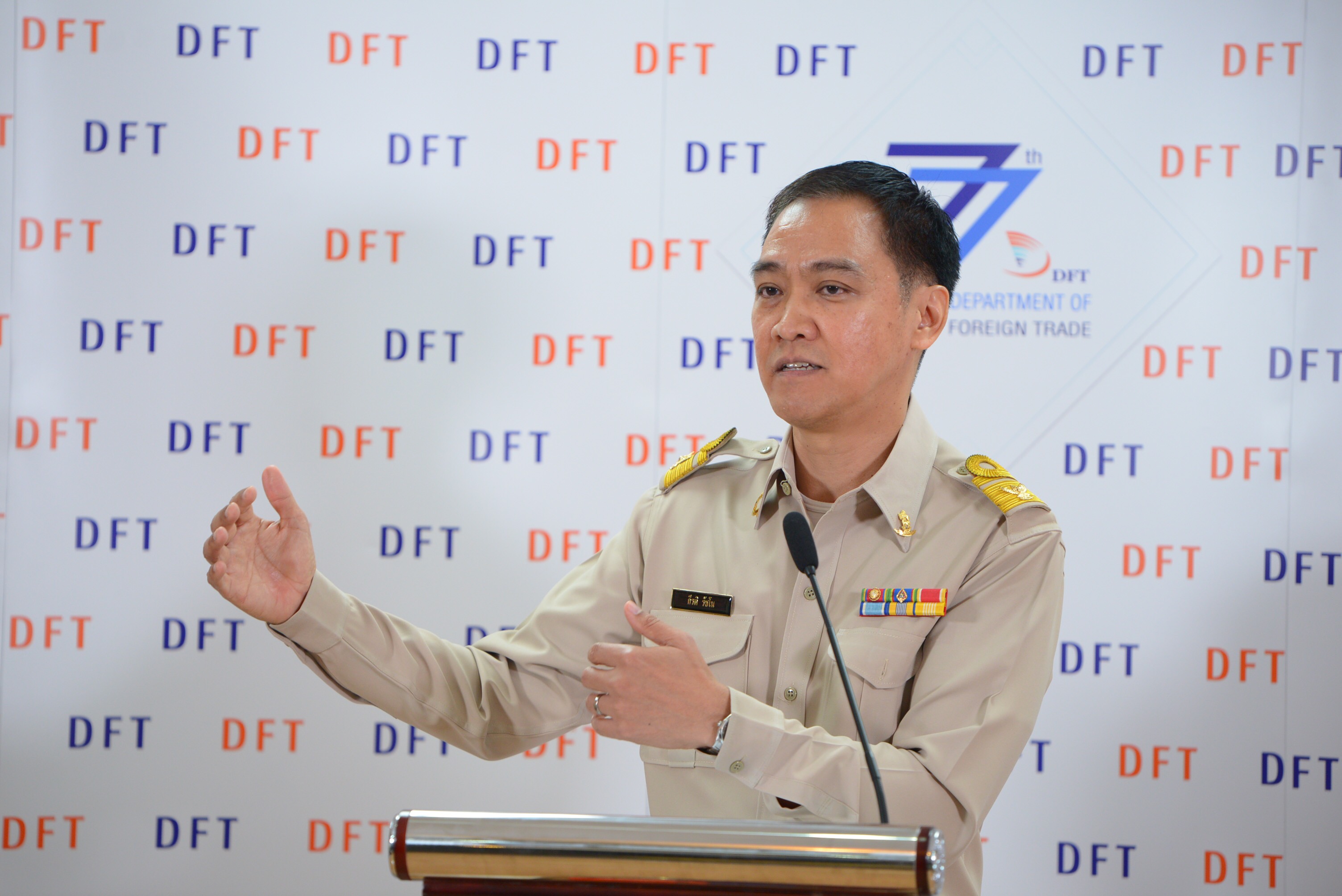
Mr. Kirati stated that the Department of Foreign Trade has been in discussions with operators for a long time and is well aware that GSP is a privilege granted unilaterally, which may eventually be revoked. Therefore, adjustments must be made, such as improving product quality and adding value to products, not just competing on price. Another point that operators recognize is the need to reduce risks by diversifying markets and seeking new markets, which must be pursued vigorously, especially in ten targeted markets to mitigate risks, such as the Middle East, Eastern Europe, and Africa. The private sector can express their interest in which markets they wish to enter, and the government will provide support.
Additionally, he advised operators to take advantage of Thailand's free trade agreements (FTAs) with 13 frameworks from ASEAN, China, Japan, India, Australia, New Zealand, Chile, and Peru, which allow operators to import raw materials and export goods using tax privileges from the FTA agreements, as well as expand investments to countries that still receive GSP rights from the U.S., particularly neighboring countries like Cambodia, Indonesia, and the Philippines, which enjoy more favorable tax rates than Thailand.
Mr. Kirati stated that Thailand will negotiate through every available channel with the U.S. and has coordinated with the commercial office in Washington, which indicates that the U.S. Trade Representative is willing to listen. However, the timing for discussions has not yet been determined, and there are many forums where Thailand can engage with the U.S.
The government will expedite negotiations for rights restoration as soon as possible, expecting to submit a request for negotiations with the U.S. after the East Asia Summit during the ASEAN Summit in Thailand scheduled for November, as well as discussions under the Trade and Investment Framework Agreement Joint Council (TIFA-JC).
“The earliest possibility for Thailand to meet with the U.S. is during the 35th ASEAN Summit, which will have representatives from the U.S. attending,” Mr. Kirati stated.
Mr. Kirati mentioned that the GSP rights decision this time is a temporary suspension, allowing six months for negotiations and clarifications on various issues. The Ministry of Commerce and relevant agencies will strive to do their best, as there are many dimensions to consider, not just labor issues. This announcement is not only about Thailand but also involves several countries, such as Bolivia, Iraq, Ukraine, and Uzbekistan, which are undergoing GSP reviews. Thailand's issue pertains to labor rights, while Ukraine and Uzbekistan have intellectual property issues. Thailand has previously faced GSP revocation due to intellectual property concerns.
Mr. Kirati added that the GSP revocation for Thailand is not a trade barrier; it is a process that has been ongoing to align with U.S. guidelines and laws. Thailand is an exporter with the U.S. as a customer, so it must operate under the rules set by the U.S., which is a matter of mutual benefit for both parties.
“I cannot say that we accept the U.S. labor rights rationale for this GSP revocation, as we have not yet seen the details and must discuss it with the Ministry of Labor first. However, we need to seek new markets,”
Jurin Confirms No Link to Chemical Ban
Yesterday (October 27, 2019), Deputy Prime Minister and Minister of Commerce Jurin Laksanawisit commented on the U.S. GSP revocation, stating that currently, the U.S. grants preferential tariff treatment or GSP for Thai exports to the U.S. totaling $1.8 billion, but Thailand has not fully utilized the granted rights, using only $1.3 billion.
“The GSP cut means that from now on, Thai products exported to the U.S. with total sales of $1.3 billion will incur import tariffs, which were previously exempt. The tax burden is approximately 4-5%. This means that Thai products sold to the U.S. will now have a tax burden instead of being tax-exempt, which each year amounts to about 1.5 to 1.8 billion baht,” Jurin stated.
Jurin explained that the reason for the U.S. using this as a condition for revocation is related to labor issues. The U.S. wants Thailand to allow foreign workers in Thailand to form labor unions, which is one of the key issues.
Jurin further stated that this is the annual review period for the U.S., but Thailand can appeal or request a review. In previous years, such as last year, Thailand had seven items reinstated, and this year, Thailand will submit another request for review. If the U.S. does not review, it is within their unilateral power to grant or deny rights to any country.
Regarding Thailand's ban on the use of three hazardous chemicals in agriculture—paraquat, chlorpyrifos, and glyphosate—Jurin noted that this has not been a condition for this revocation. What is officially known is that it relates to labor issues.
USTR Opens for Rights Review
A press release from the Office of the United States Trade Representative published on October 25, 2019, stated that President Donald Trump announced the suspension of GSP privileges granted to Thailand for exports under the program, totaling $1.3 billion, due to failure to address international labor rights.
The Office of the United States Trade Representative also indicated that President Trump's announcement results from actions in three areas: 1) consideration of the ongoing GSP rights review, 2) assessment of developing countries benefiting from normal trade relations, along with public comments to determine whether to review rights anew, and 3) annual review of GSP products.
For Thailand, despite having taken action for six years, it has not been able to manage labor rights according to international standards in several important areas as requested by the AFL-CIO, such as allowing freedom of association and bargaining. Therefore, the GSP rights are suspended for six months for one-third of the exports under the GSP program, which had a total export value of $4.4 billion in 2018 from the date of this announcement.
The items affected by the GSP revocation focus on products that Thailand exports significantly to the U.S., while the U.S. has a minimal market share in Thailand. Additionally, due to longstanding labor rights issues in the seafood and shipping industries, the GSP rights for all seafood products from Thailand have been suspended, but the U.S. still allows for the review of Thailand's GSP rights.
Thank you for the information from thaipublica.org
The products affected by the GSP suspension will take effect on April 25, 2020, including: