Lalin Property Confident in Demand for Horizontal Housing, Boosting Sales in the First Half of 2022 - Urges New Government to Promote Real Estate Policies to Unlock Conditions and Increase Purchasing Power
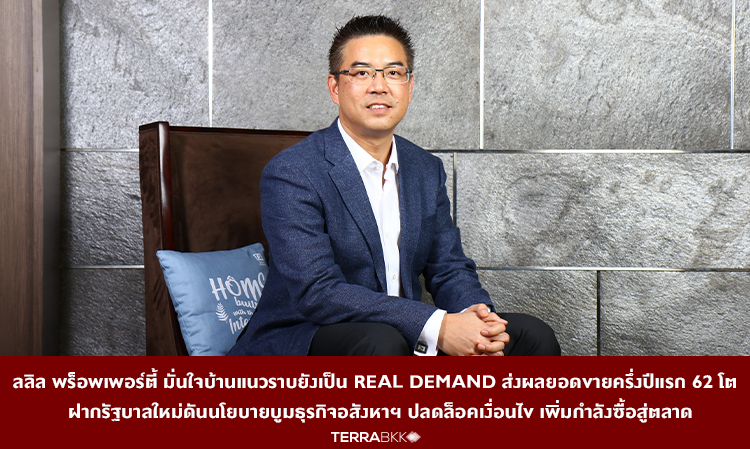
Mr. Chaiyanan Chakrakul, CEO of Lalin Property Public Company Limited (LALIN), a real estate developer under the concept of "Homes Built on Good Intentions," shared his views on the overall Thai real estate market in the first half of 2022. He noted that the market for residential buyers continues to experience slow growth, particularly in the condominium sector, which has seen a significant decline. Most of the stable demand comes from first-time homebuyers in the horizontal housing segment. Meanwhile, the investment buyer market, primarily in condominiums, has also shown a clear slowdown due to the Bank of Thailand's real estate credit regulations that took effect on April 1, 2022, leading to a decrease in property purchases for investment. Additionally, some consumers have delayed their purchasing decisions due to uncertainty about their ability to secure loans.

Lalin Property continues to achieve growth as most buyers are first-time homebuyers. The company's sales in the first half of 2022 reached 3.1 billion baht, equivalent to 58% of the annual target for 2022. This sales growth confirms the successful performance in the first half of 2022, aligning with the strategic plans and operational directions set forth. Regarding the overall outlook for the Thai real estate market after the government formation, Mr. Chaiyanan commented that if we look back at the policies of various leading parties, such as the Palang Pracharath Party and the Democrat Party, they all have policies related to the real estate sector, both directly and indirectly. The Palang Pracharath Party has announced the continuation of the One Million Homes project, which has allowed the public to reserve loan rights amounting to 127 billion baht, with an additional 100 billion baht to be released in phase two. There are also plans for public housing projects and initiatives to enhance income for those struggling to pay for their homes. Furthermore, there are plans to develop condominiums for the elderly in urban areas, promote reverse mortgages to turn homes into pensions for seniors, and use the EEC model as a template to distribute prosperity to other regions, creating livable cities with job opportunities in major and secondary provinces, accelerating infrastructure development, and fostering business and innovation districts to create smart green cities, with plans to develop Bangkok into Bangkok 5.0.

Reflecting on the success of the previous government's first phase, which only managed to lend a few billion baht from over 100 billion baht reserved, it was noted that homes priced at 1 million baht are nearly nonexistent in the market. Therefore, the new government should reconsider whether the conditions for 1 million baht homes should be made more flexible, similar to measures to reduce transfer and mortgage fees to support low-income individuals in owning homes priced at 1 million baht, as well as tax relief measures for homes not exceeding 5 million baht. Another impactful issue is the housing loan control measures that have currently slowed down the real estate market. If some conditions can be relaxed to align with reality, it would have a more positive impact, Mr. Chaiyanan added. Positive factors for the real estate sector include a downward trend in interest rates due to an economic slowdown and the U.S. reducing interest rates. Additionally, the supply of condominiums entering the market has decreased as many companies adjust their strategies to delay project launches, helping the market move towards greater balance and easing rapid land price increases. Furthermore, the trade war is expected to lead to an increase in production relocation from China to Thailand, and the new government's EEC strategy is likely to continue, improving business opportunities in the EEC. However, it may take 1-2 years, and it is believed that the new government will recognize the need to stimulate the economy to compensate for the slowdown in exports and tourism, as well as expedite budget disbursement for large-scale investment projects to restore confidence in private investment and consumer spending quickly. Stimulating consumption through the real estate sector is one approach to aid economic recovery, and temporary measures to lower LTV ratios should be pushed forward during this economic slowdown to maintain economic balance and promote growth.
Regarding competition in the real estate business after the government formation, it is expected to remain intense due to the rapid clearance of completed housing stock and new housing entering the market in the second half of the year. Operators must be cautious with new investments, focusing on the market for genuine buyers as the primary market, and strive to maintain a safe debt-to-equity ratio while ensuring financial liquidity remains at a secure level. Consumers also need to plan their finances when purchasing homes to avoid issues when applying for loans with banks, Mr. Chaiyanan concluded.
According to the latest survey of housing projects by the Real Estate Information Center, the horizontal housing market is considered a market for genuine demand, primarily for first-time homebuyers, leading to continuous demand. Thus, it is less affected by measures compared to condominiums. However, consumers still need to adjust their savings plans before purchasing housing.
Thank you for the information from www.lalinproperty.com