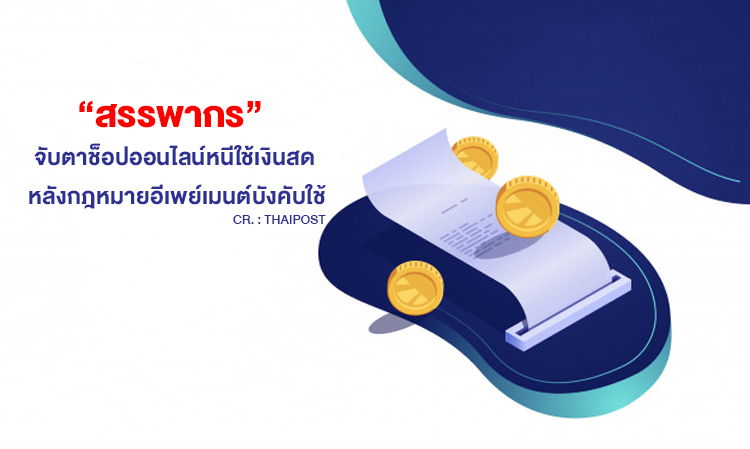
“Revenue Department” Monitors Online Shopping to Avoid Cash Payments Following E-Payment Law Implementation
On April 2, 2019, Mr. Aekniti Nitithanprapas, Director-General of the Revenue Department, revealed that there are still misunderstandings regarding the Revenue Code Amendment Act (No. 48) B.E. 2562, or the e-payment tax law, which has been officially enacted. It is believed that this law grants the Revenue Department the authority to order banks to provide transaction data for tax audits. However, even without this law, the Department already has the authority to conduct audits. The information received from banks is not used for calculating taxes but is intended for analysis to differentiate between compliant taxpayers and those evading taxes.
Additionally, there have been rumors that, following the law's implementation, individuals should avoid transferring money to banks to evade scrutiny and instead use cash more frequently. This is a misunderstanding, as the Department has a clear policy that anyone using e-payment will receive facilitation and tax benefits, as they are considered to provide complete information to the Revenue Department. Conversely, those using cash will be viewed as higher risk and subject to increased scrutiny. The Department has implemented a computerized system to categorize taxpayers based on risk, allowing for more accurate identification of tax evaders.
“From now on, anyone conducting financial transactions using e-payment will receive facilitation from the Department, as they provide complete information. Those using cash are considered high-risk. I urge you to be straightforward and avoid unnecessary risks, as it is not worth it. Those who open multiple accounts will face increased scrutiny,” said Mr. Aekniti.
Mr. Aekniti further stated that there is another misconception that the e-payment law aims to specifically target online sellers for tax collection. He emphasized that the Department has never set a special target for online tax collection and has made it clear that any transactions, especially large businesses moving to online sales, must pay taxes. It is the duty of Thai citizens to pay taxes correctly to ensure fairness for compliant taxpayers; otherwise, everyone will evade taxes by selling online.
Nevertheless, the Director-General of the Revenue Department announced at a seminar for business operators to register for a single account that this is the last opportunity for small and medium-sized enterprises (SMEs) that have not maintained accurate financial records to correct their accounts for their own benefit, especially when applying for loans from financial institutions that require accounts submitted to the Revenue Department. Those who register by June 30 will not incur additional penalties, and he reiterated that this is not a tax amnesty.
“Today (April 1) marks the first day for SMEs to register for correcting their financial statements, known as single accounting. In the past, there was no intention to have them register with the Revenue Department until June 30, 2019. I believe that single accounting will reveal the true status of the company, and do not believe that the Revenue Department is misleading you into registering for audits; rather, the Department aims to strengthen your business,”
said Mr. Aekniti.
Thank you for the information from www.thaipost.net