SCG Ceramics Announces Q4 and 2018 Financial Results, Focuses on Brand Strategy and Expanding Distribution Channels to Reach All Target Groups, While Entering International Markets
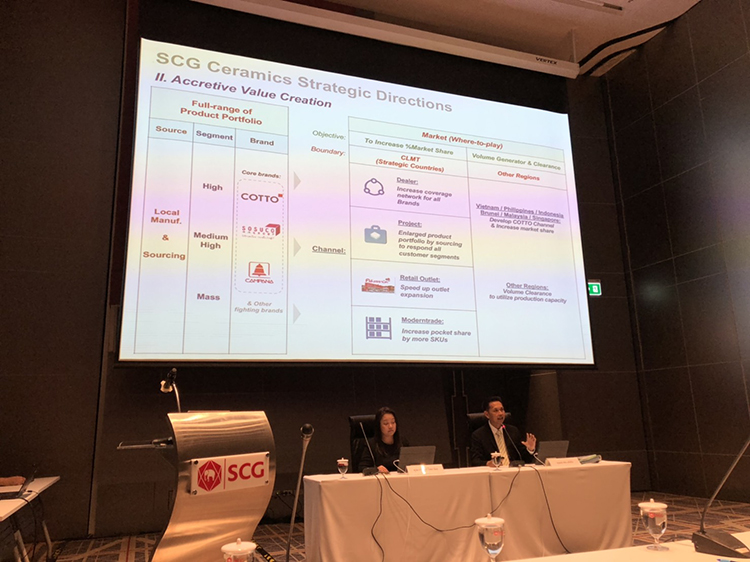
SCG Ceramics reported a decline in revenue and profit for Q4 and the year 2018 due to intense competition and rising energy costs. The company is strengthening its position with a brand management strategy, promoting three main tile brands: COTTO, CAMPANA, and SOSUCO, targeting all market segments and expanding into CLM countries.
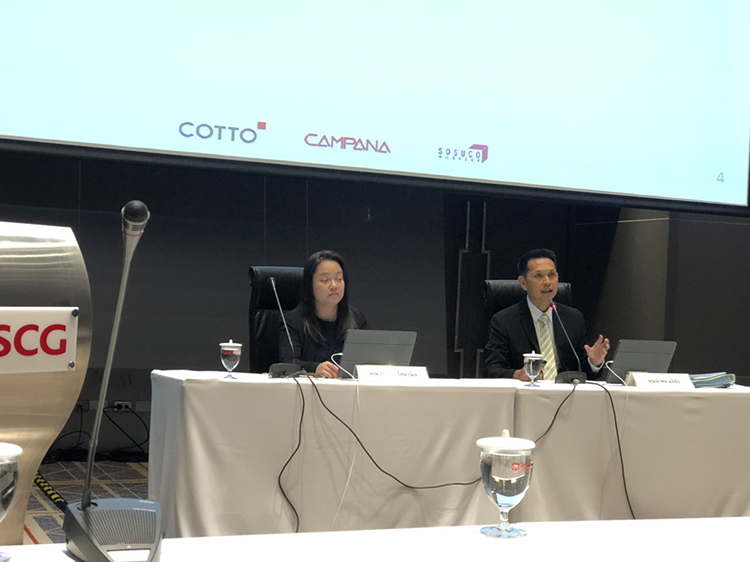
Mr. Nampol Malichai, Managing Director of SCG Ceramics Public Company Limited, the manufacturer and distributor of tiles under the brands “COTTO” (COTTO), SOSUCO (SOSUCO), and CAMPANA (CAMPANA), revealed that the preliminary consolidated financial statements for COTTO in Q4 2018 showed sales revenue of 2,713 million baht, a decrease of 3% from the same period last year and a 3% decline from the previous quarter, with a profit of 66 million baht, down 49% year-on-year but up 160% from the previous quarter.
For the 2018 fiscal year, the company reported total sales revenue of 11,557 million baht, an 11% decrease from 2017, with a net profit of 10 million baht, down from 566 million baht the previous year. Key factors included intense competition, rising energy costs, and non-recurring expenses such as costs related to voluntary retirement plans and consulting fees for management system development and operational efficiency improvements.
In 2018, the company generated export revenue of 2,534 million baht and sales revenue in the ASEAN region of 1,833 million baht. In Q4 2018, export revenue was 527 million baht, accounting for 20% of total sales, a 1% decrease from the same period last year, while sales volume in the ASEAN region represented 17% of total sales, up 4% year-on-year. As of December 31, 2018, the total assets of COTTO were valued at 11,725 million baht.
Mr. Nampol stated, “Although the market grew by 1% last quarter due to higher agricultural prices and upcoming election signals, the overall market for the year still showed a slowdown of -2%. The significant negative factor is the rising energy costs, which led to a decline in revenue for COTTO in Q4 and for the entire year of 2018.”
Therefore, to enhance competitiveness and strengthen the business, the company will focus on brand management strategies alongside raising standards and services for all brands to instill greater consumer confidence in design, aesthetics, product quality, and superior service compared to both domestic and international products, especially those competing primarily on price.
Currently, the company’s ceramic tile products are divided into three main brands: COTTO, CAMPANA, and SOSUCO, targeting distinct customer groups with different lifestyles:
- COTTO focuses on customers who value innovation and modernity, offering unique and beautiful products that reflect the user's identity.
- CAMPANA emphasizes simplicity, warmth, and natural beauty.
- SOSUCO presents a variety of patterns suitable for general living spaces, catering to customers who prefer convenience and easy-to-use products.
Regarding international market expansion, Mr. Nampol revealed that the company prioritizes the CLM countries or Cambodia, Laos, and Myanmar, focusing on establishing foundations and systems related to building a customer base and distribution networks to strengthen market expansion abroad.
Additionally, the company plans to improve efficiency and increase sales channels to cover and reach customers at all levels, with plans to expand the “Ceramic Warehouse” sales branches to 100 locations within five years, targeting customers who prefer convenience and a variety of easy-to-use products. Currently, the “Ceramic Warehouse” has 25 branches nationwide, each averaging over 1,200 square meters of sales area, enhancing the company’s distribution channels beyond sales through dealers, modern trade, and Flagship Stores at COTTO Studio, SCG Experience, and VOA Space in Khon Kaen.
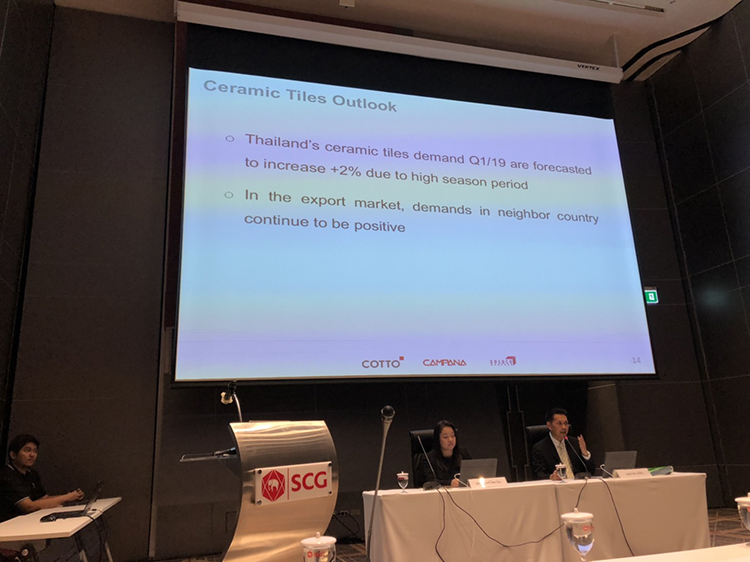
“In terms of cost management, the company has plans to reduce energy costs, which are a major production expense, by promoting the use of renewable and alternative energy to lower energy costs in factories, alongside improving machinery to enhance energy efficiency. The company is confident in its ability to adapt to the intense competition in the domestic market and maintain the strength of its operations, as we are prepared in all aspects, including short-term plans to address potential economic fluctuations and long-term plans to strengthen and find growth pathways for the business,” Mr. Nampol concluded.
For the overall market in 2019, key factors that may impact the ceramics industry include a slowdown in the global economy, which will affect foreign investment in real estate, rising interest rates, and measures to control housing loan disbursement by the Bank of Thailand, which may delay domestic investors' decisions to purchase housing.
However, the company expects that in 2019, the overall economy will grow close to last year due to increased public and private investment, leading to a slight increase in demand for ceramic tiles compared to the previous year. Positive factors present good opportunities for the construction materials business, particularly in floor and wall tiles from Mixed-use projects, which combine residential and commercial elements, with projects valued over 400 billion baht that have begun construction in Bangkok and are expected to expand to other potential urban areas. Additionally, government policies aimed at supporting low-income individuals in acquiring their own homes through loans from the Government Housing Bank for properties priced below 1 million baht, as well as loans for project development for property developers, along with transportation networks such as electric rail and motorways that facilitate travel to suburban and rural areas, will further support the expansion of real estate investment in suburban areas, metropolitan regions, and eastern provinces. The company believes that these positive factors will lead to a more vibrant construction materials market in 2019.
SCG Ceramics
Established in August 2018 from the merger of five subsidiaries within the SCG (The Siam Cement Group): (1) Thai Industrial Ceramics Co., Ltd. (“TCC”), (2) The Siam Ceramic Group Industries Co., Ltd. (“SGI”), (3) SOSUCO and Group (2008) Co., Ltd. (“SSG”), (4) Thai-German Ceramic Industry Public Company Limited, and (5) Gemaco Co., Ltd. (“GMG”) by SCG CERAMICS, making SCG Ceramics a leader in the country’s floor and wall tile industry, with a total of four production facilities located in Saraburi, with a combined maximum production capacity of 94 million square meters per year under three main brands: “COTTO” (COTTO), SOSUCO (SOSUCO), and CAMPANA (CAMPANA).
Source: www.scgceramics.com