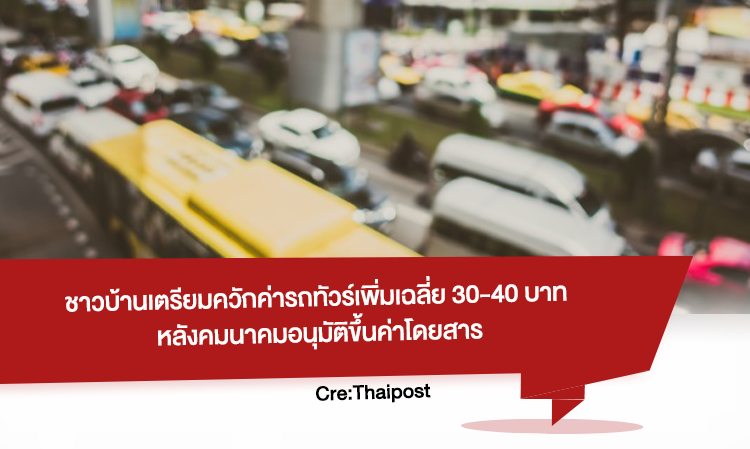
Residents Prepare to Pay an Additional 30-40 Baht for Bus Fares After Transport Ministry Approves Fare Increase
Brace for an increase of 30-40 Baht in bus fares following the fare structure adjustment. Operators are optimistic, expecting a 10% rise in annual revenue.
Mrs. Kheuwalan Wongrakmit, CEO of Nakhonchai Air Co., Ltd., revealed that after the Ministry of Transport approved a 10% fare structure adjustment, it is initially estimated that the fare for interprovincial buses (tour buses) operated by the Transport Company and its partners will increase by an average of 30-40 Baht, though this will vary by route depending on the distance.
However, as an operator, she expressed happiness that the government is prioritizing assistance this time, viewing it as a long-term upgrade to the transportation system. In the future, she hopes the government will consider further support, such as covering fuel costs, maintenance expenses, and partial tax exemptions. She believes this policy will result in operators seeing an income increase of no less than 10% per year.
Mrs. Kheuwalan further stated that currently, interprovincial public transport operators are significantly affected by high costs, leading to many shutting down and no new players entering the market. Therefore, she sees the future market direction dominated by Chinese capital and foreign companies investing. The ongoing challenge remains the intense competition with low-cost airlines that continuously open new routes in secondary cities, along with future economic issues that may reduce consumption and purchasing power. Thus, there is a need to quickly open new routes to capture potential passenger markets.
According to a report from the Ministry of Transport, the fare structure adjustment will take effect from January 21, 2019, with bus fares increasing by 10% divided into four segments: for the first 40 kilometers (km), the fare will rise from 0.49 Baht per km to 0.53 Baht per km; for 40-100 km, from 0.44 Baht per km to 0.48 Baht per km; for 100-200 km, from 0.40 Baht per km to 0.44 Baht per km; and for over 200 km, from 0.36 Baht per km to 0.39 Baht per km.
Mrs. Kheuwalan stated that the overall performance of intercity public transport (tour buses) this year has been quite good, with annual revenue returning to profitability, totaling nearly 1.8 billion Baht compared to about 1.7 billion Baht last year. This growth is primarily supported by a 3% increase in passenger volume, especially with international passengers increasing by over 10%, along with policies promoting tourism in secondary cities in the Northeast, leading to more travel by the public, such as in Nakhon Phanom, Sakon Nakhon, and Kalasin. Additionally, the number of international tourists has increased on major tourist routes such as Chiang Mai, Chiang Rai, and Rayong. Currently, the average passenger volume exceeds 300,000 people per month, totaling 3.5 million people per year, with an average load factor of over 80%. The bus service operates 360 vehicles across 37 routes.
For the business plan in the coming year, they will invest to enhance revenue, starting with a core revenue increase by investing 225 million Baht to purchase a total of 30 buses, averaging 7.5 million Baht each. This includes purchasing to replace old buses and increasing service frequency with 20 buses, and purchasing to open new routes with 10 buses. The new routes are planned for 2-3 secondary cities, in addition to the current 37 routes.
Moreover, in terms of developing commercial revenue, they plan to partner with major partners to open restaurants and retail stores within provincial bus stations to increase revenue. Initial discussions have been held with Amazon Coffee and A&W fast food. Currently, Nakhonchai Air has ample space in provincial areas with many parking lots, with several locations in mind, such as Ubon Ratchathani, Udon Thani, Khon Kaen, and Surin.
Thank you for the information from www.thaipost.net