5 Guidelines for Developing NET ZERO ENERGY BUILDING
Prabhand Sak Raksaiwan
Managing Director of LWSS Wisdom and Solutions Co., Ltd.
As we enter the month of love in 2025, how is everyone doing? We have completed one month of 2025 and are starting the year of the Golden Snake with enthusiasm. How is everyone? Please share your experiences!
This month, the LWS team has conducted research on the Entertainment Complex project, which is one of the current government's policies to drive Thailand's economy. It is becoming increasingly clear that this project will indeed move forward, with Klong Toey Port being the most viable location at the moment. Although the project has not yet begun, many private sectors are interested in investing in its development. Besides Klong Toey, there are several locations in other provinces that the government aims to use as tools to stimulate the economy.
Writing about the Entertainment Complex, which involves large-scale construction, makes me think about the environmental impacts during the construction phase, including resource management for the project's utilities, such as water systems, energy systems, and waste management within the project.
This leads me to want to discuss the design and construction concepts of the Entertainment Complex under the idea of Green Building, which should be an essential part of the project's development to ensure it is environmentally friendly and promotes well-being.
Under this concept, there are currently various development guidelines available for the government and private sectors to consider, whether it be development under LEED (Leadership in Energy and Environmental Design), WELL Certification, or Fitwel standards, which focus on health and environmental considerations, as well as EDGE (Excellence in Design for Greater Efficiencies) and Thailand's green building standard known as TREES. I have previously written about these standards in this column last year, and such developments align with the government's policy to reduce greenhouse gas emissions and the concept of Net Zero Energy Building (NZEB) applied to large buildings.
What Does It Take to Achieve a Net Zero Energy Building?
The criteria for developing a project under the Net Zero Energy Building concept include several guidelines that can be applied. However, the simplest and most cost-effective approach for developers and property managers is to use the 5 principles of green building design according to Thailand's TREES standards, which have been tailored to fit the construction and usage context of Thailand, with the primary goal of sustainability in energy and the environment, incorporating improvements from LEED and WELL standards.
5 Guidelines to Follow
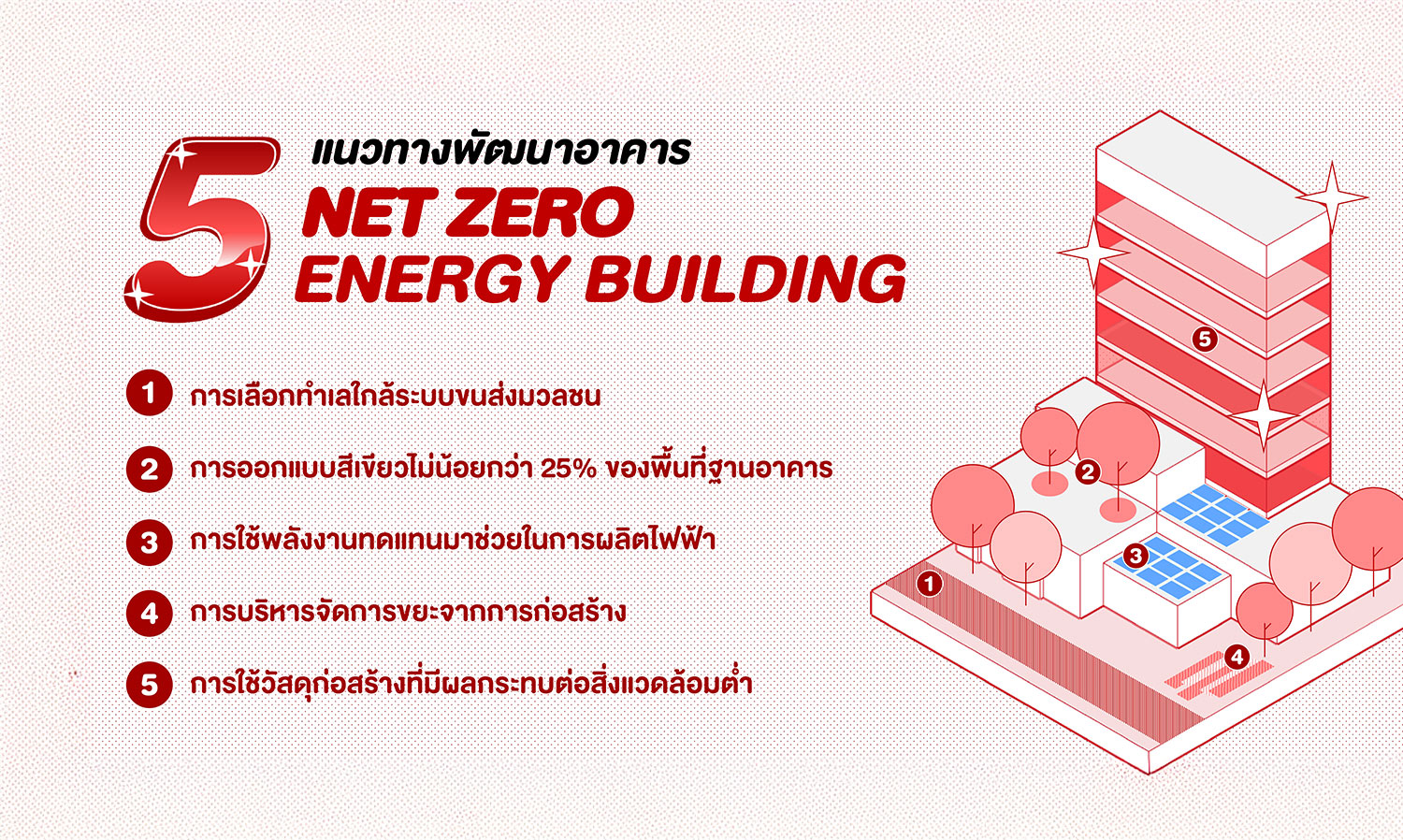
The first guideline is site selection for the project, which should support the use of public transportation or bicycles while reducing the use of personal vehicles such as cars and motorcycles to decrease pollution and carbon dioxide emissions from personal vehicles.
If the project is located far from public transportation, it should establish a transportation system for the project, such as providing shuttle services from hotels to the project or to key locations, using vehicles that minimize air pollution, like eco-cars or electric vehicles (EVs).
Additionally, the project should provide sufficient bicycle parking to encourage building users to opt for cycling.
The next guideline is landscape design. The project should have at least 25% green space of the building's footprint, which will help reduce urban heat, improve air quality, and promote public activities outside the building.
The third guideline is using renewable energy for electricity generation. The project should avoid fossil fuel energy and instead install renewable energy systems, such as solar, wind, or biomass energy, which will significantly reduce environmental impacts and nearly eliminate carbon emissions.
Waste management from construction is the fourth aspect that real estate developers must prioritize from the initial site preparation to the construction phase. The project design should include strategies for managing construction waste to enable recycling, such as using it as a component in road surfaces or walls within the project.
Moreover, the infrastructure within the project should consider resource conservation and pollution reduction, such as designing wastewater treatment systems within the project and promoting water reuse.
Lastly, the fifth guideline is using environmentally friendly construction materials. This can be identified through materials that have green labels and carbon labels from Thailand, which guarantee that these materials have low or negligible carbon and toxin emissions during production.
So, what do you think? These 5 simple guidelines may have higher initial construction costs compared to conventional building methods, but in the long run, they benefit users in terms of health, reduced electricity bills, and creating a better environment for the project and surrounding community.
In addition to applying these principles to large projects like the Entertainment Complex, I believe we can also implement them in smaller projects or buildings. I encourage the government to consider green building criteria as part of the selection process for developers of the Entertainment Complex for long-term benefits. For more details on green building development, you can read more at www.lws.co.th.
See you next month, and may you have a joyful month of love!