"ActiveScore": A Standard for Building Development to Enhance Sustainable Quality of Life
By Mr. Praphansak Raksaiwan
Managing Director
LW Wisdom and Solutions Co., Ltd.
How has everyone been after the Songkran festival? It's time to switch back to work mode in May. The weather in Thailand is still hot, and with PM 2.5 dust, many people are facing health issues, so let's take care of our health. Writing about health reminds me of the building development standard aimed at enhancing sustainable quality of life, known as ActiveScore. This standard focuses on promoting active travel, which encourages movement through activities like walking or cycling. It includes details on various types of bicycles, basic human travel modes such as walking and running, and new travel forms like scooters, electric scooters, and Segways, while emphasizing sustainability and minimizing environmental pollution.
The concept behind developing projects under ActiveScore prioritizes the design and development of buildings with the quality of life of users in mind, encouraging physical activity to promote good health and reduce the incidence of non-communicable diseases (NCDs), which are the leading cause of death among Thais, including heart disease, stroke, hypertension, diabetes, and various cancers. Notably, 27.1% of these diseases are attributed to insufficient physical activity.
The ActiveScore building assessment concept was first established in the UK in 2017 and has gained global recognition. Currently, there are over 450 projects in 15 countries worldwide undergoing ActiveScore assessment. Developing projects under the ActiveScore concept provides a pathway to address issues related to buildings as components of urban planning. Additionally, the certification allows access to sustainability-related loans, reduced interest rates, and government funding, aligning with Thailand's policy to push towards the Net Zero Emission goal. The ActiveScore criteria offer different assessment approaches based on building types, categorized as follows:
- Commercial/Office Buildings
- Residential Buildings
- Retail
- Public Cycle Hubs
- Large Scale Developments
- Hotels
- Educational Institutions
The ActiveScore building assessment focuses on three main areas:
- Infrastructure: 70%
Factors related to facilities accessible to building users, such as bike racks, storage, showers, and navigation systems.
- Occupier Engagement Service / Soft Measure: 20%
Services for building users, such as laundry or equipment maintenance, and travel assistance.
- Future Proofing: 10%
Factors related to preparedness and strategies for future needs.
ActiveScore assessment includes 18 criteria:
- Location of occupant active travel parking
- Location of visitor cycle parking
- Proportion of cycle parking to floor area
- Proportion of cycle parking to occupancy
- Variety of Active Travel support
- Access, Routes, and Wayfinding
- Security and Lighting
- Look and Feel
- Locker and Storage
- Showers
- Changing rooms and amenities
- Drying/Airing provision
- Maintenance and repair station
- Hire and pool bicycle/scooter schemes
- Occupier Engagement Service
- Information and communication
- Community Building
- Future Proofing
Each criterion has a different scoring weight, and the ActiveScore criteria are divided into several levels, with the highest level being 100 points at Platinum 100.
Benefits of the ActiveScore Assessment
The ActiveScore assessment benefits not only building users but also creates surrounding advantages, starting with improved quality of life for users and reduced public transport costs. This allows developers to increase the value of their buildings through certification and sustainability. For operators, it promotes better employee health, lower sickness rates, and serves as a positive benefit. Ultimately, these advantages contribute to a higher quality of community life, both physically and mentally, leading to cleaner air through reduced harmful travel.
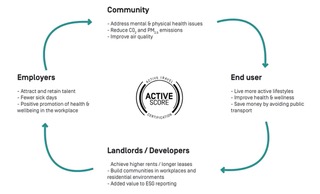
Image showing the benefits of the ActiveScore assessment
Opportunities for Developing ActiveScore in Thailand
The ActiveScore building assessment projects in the country present a great opportunity to help alleviate infrastructure issues such as traffic congestion and air pollution. Supporting active travel will reduce reliance on private cars and public transport. Additionally, Thailand's hot and humid climate is conducive to walking, running, and cycling, with fewer severe disasters compared to other countries. However, Thailand still faces challenges in developing under the ActiveScore criteria due to inadequate infrastructure for active travel, particularly concerning road safety, which needs improvement to support active travel and align with the country's development as a destination for activity-based tourism, such as cycling and marathons. According to a 2021 Booking Holding Sustainability survey, over 73% of tourists prefer sustainable accommodations, and 66% believe sustainability positively impacts surrounding communities, especially in activity-based tourism.
Therefore, implementing the ActiveScore building assessment criteria will contribute to enhancing Thailand's infrastructure, supporting the development of health-oriented projects, reducing carbon emissions from transportation, and fostering sustainability in social, economic, and environmental aspects. This is another approach to development that I believe each province in Thailand can adopt under the ActiveScore standard, requiring collaboration from both the public and private sectors to create communities that support healthy living for people in society.
See you again in June!