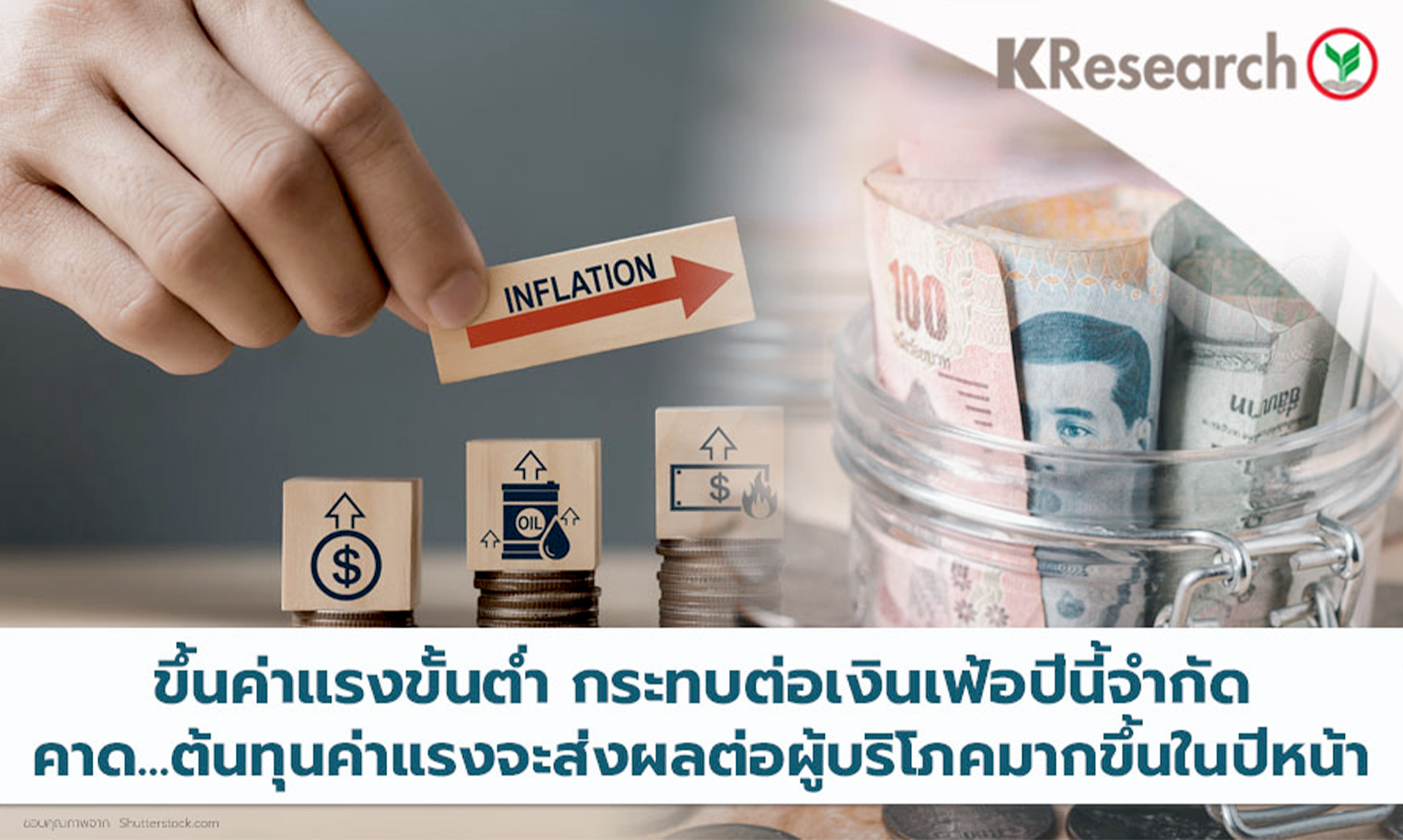
The First Minimum Wage Increase in Two Years Amid a Different Economic Environment: Limited Cost Pass-Through from Businesses in 2022 (Kasikorn Research Center)
- The Wage Committee has decided to raise the minimum wage for the year 2022 and will present the matter to the Cabinet (Cabinet) for approval, with implementation starting on October 1, 2022. The increase is divided into 9 tiers, with the minimum wage set at 328 baht and the maximum at 354 baht (previously ranging from 313-336 baht), representing an increase of 3-7%, marking the first minimum wage adjustment in two years.
- Looking back, the last significant nationwide minimum wage increase in Thailand occurred in 2012-2013, when it was raised to a uniform rate of 300 baht per day across the country. Subsequent adjustments were made province by province in 2017, with the latest increase occurring in 2019, after which there was no adjustment for two years. Over the past decade, the minimum wage in Thailand has increased by 13-36 baht, or 4-12%, while the inflation index has risen by 6.3% (2012-2021), with the index for prepared food (both at home and outside) increasing by 14%.

- The environment for this minimum wage increase is different from previous instances in many ways, presenting challenges for both labor and businesses.
- The current economic and employment conditions differ significantly from those during the minimum wage increase in 2012. In 2012, Thailand's economy grew by 6.4% with an inflation rate of 3.02%. In contrast, in 2022, the Thai economy is still recovering from the COVID-19 pandemic and facing high global inflation due to ongoing impacts from the Russia-Ukraine conflict. Prices have been rising since late 2021, with the latest inflation rate in July at 7.61%. This situation pressures producers, especially businesses in recovery, who cannot fully pass on costs to consumers. Additionally, it affects real income, putting pressure on the purchasing power of the public and labor.
- Since the minimum wage increase will take effect in the fourth quarter of 2022, producers are unlikely to pass on all costs to consumers immediately. Therefore, the impact of the minimum wage increase on inflation this year is expected to be limited, with the Kasikorn Research Center maintaining its inflation forecast for Thailand at 6.0%, which includes the effects of the minimum wage adjustment. However, the Kasikorn Research Center anticipates that we will see more cost pass-through from producers to consumers next year, particularly in labor-intensive industries such as agriculture, retail, hotels, restaurants, and construction. Thus, inflation levels next year are not expected to decrease rapidly. The Kasikorn Research Center predicts that inflation in the coming year will be in the range of 2.5-3.0%, assuming that the average price of Dubai crude oil next year is 95 dollars per barrel and that the minimum wage increase follows the resolution without further changes or increases next year. The minimum wage increase is expected to raise inflation by about 0.4-0.5% compared to a scenario without the wage increase, under the assumption that other factors remain constant.
Discussion
Follow breaking news Investment property articles on Facebook, click here.