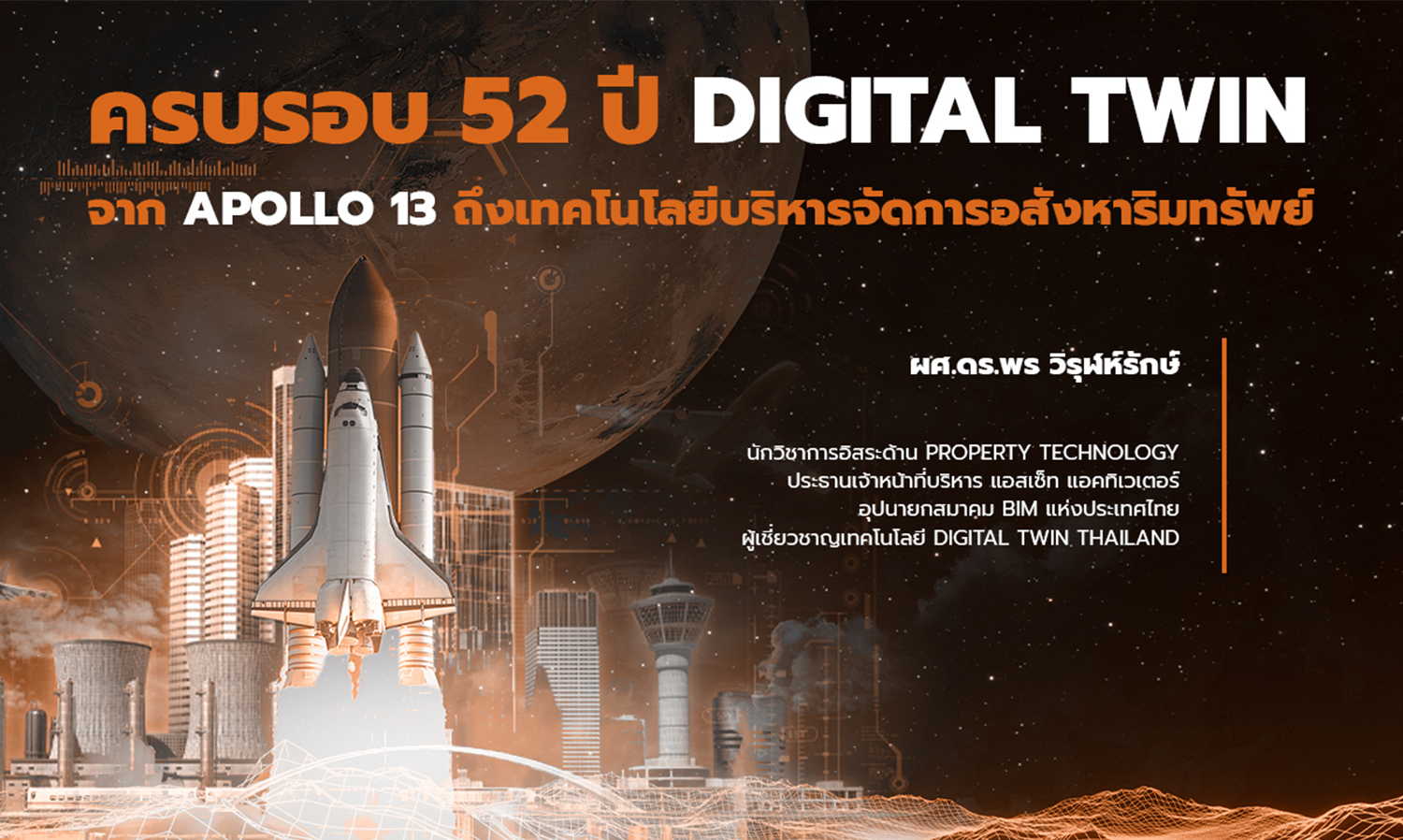
52nd Anniversary of Digital Twin: From Apollo 13 to Real Estate Management Technology
Article by: Assoc. Prof. Dr. Porn Virulrak
Independent scholar in Property Technology
CEO of Asset Activator
Vice President of the BIM Association of Thailand
Expert in Digital Twin Technology in Thailand
Most people may not know that 2022 marks the 52nd anniversary of the Digital Twin technology. If you've seen the movie Apollo 13 (1995), a famous film based on the true story of the NASA spacecraft accident of the same name, which had a mission to the moon but failed to reach it due to an explosion en route, starring Tom Hanks and a host of talented Hollywood actors, you might find it interesting. This film was released in 1995, and it has been 30 years since then, but the actual event occurred in 1970, making it 52 years ago.
So, what does Apollo 13 and NASA have to do with Digital Twin technology?
As an organization closely working with Digital Twin, Asset Activator would like to take a moment to reflect on this historical journey of humanity.
The incident with Apollo 13 occurred when the spacecraft, 330,000 kilometers from Earth, suddenly experienced an explosion outside the vehicle. An alarm went off, but the astronauts could not see or go outside.
What the astronauts did not know was that the explosion affected the spacecraft's main engine, causing a gradual oxygen leak. It goes without saying what would happen to the astronauts inside... Sending a spacecraft to the moon involves a combination of 'natural propulsion' and 'engine' working together. The problem was the damage to this engine. Although it allowed the spacecraft to loop around the moon and head back toward Earth (naturally), the thrust could not bring this engine back to Earth, leaving it suspended in space. If that happened, all astronauts would eventually suffocate.
And that was the challenge: how would you resolve an emergency situation to save people over 300,000 kilometers away?
The only way to help them was to design a solution on Earth by clearly 'hypothesizing' the limitations present in space and finding a way to solve it under those constraints, then guiding the astronauts on the spacecraft to execute the plan.
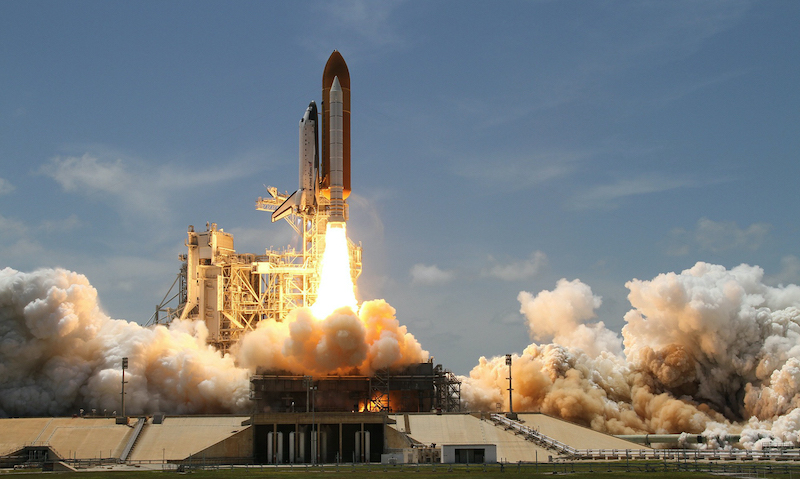
The creation of a 'virtually realistic' reflection of the situation occurred for the first time on Earth with 15 types of flight simulators for the spacecraft, including emergency scenarios. All these simulators were repurposed to understand what the astronauts were experiencing up there as much as possible.
This was the birth of Digital Twin technology, which began with life-saving missions and maintenance, as stated by a key witness of the event.
“The simulators were some of the most complex technology of the entire space program: the only real things in the simulation training were the crew, cockpit, and the mission control consoles; everything else was make-believe created by a bunch of computers, lots of formulas, and skilled technicians.” Gene Kranz, NASA Chief Flight Director for Apollo 13
“The simulation (Simulator) is the most complex technology in the entire space program. The only real elements in the simulation were the crew, the control panel, and the operation control panels; everything else was simulated using numerous computers and many equations, with scientists collaborating.” Before delving deeper, we must understand that the simulation system prevented damage to both Apollo 11 and Apollo 13 before they even went into space.
Before the Apollo 13 incident
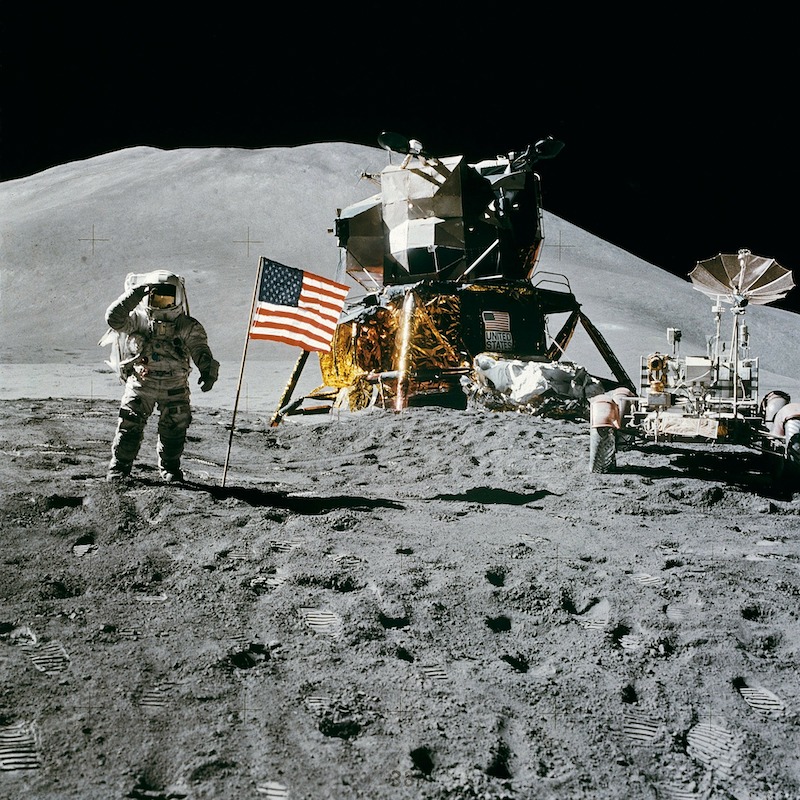
Prior to the Apollo 13 event, NASA had simulated scenarios for astronauts to train, especially unexpected emergency situations, allowing astronauts to practice real-time problem-solving without a manual to see how they would respond. This can be compared to playing a game, but there are no correct answers—only survival! Astronauts had to find solutions and be creative quickly. This simulation system was used in Apollo 10, 11, and 12.
For the astronauts, the goal was to become accustomed to crisis situations that could arise at any time. When alarms went off, astronauts needed to maintain a calm mental state and solve problems with focus and concentration. This was about pushing the limits of the astronauts' potential. On the other hand, if there were scenarios that the astronauts could not resolve no matter how many times they tried, the design engineers would need to reconsider how to enhance the spacecraft's capabilities to prevent those issues. One redesign concept that emerged from the failure to solve problems was the idea of using the spacecraft as a lifeboat to return to Earth.
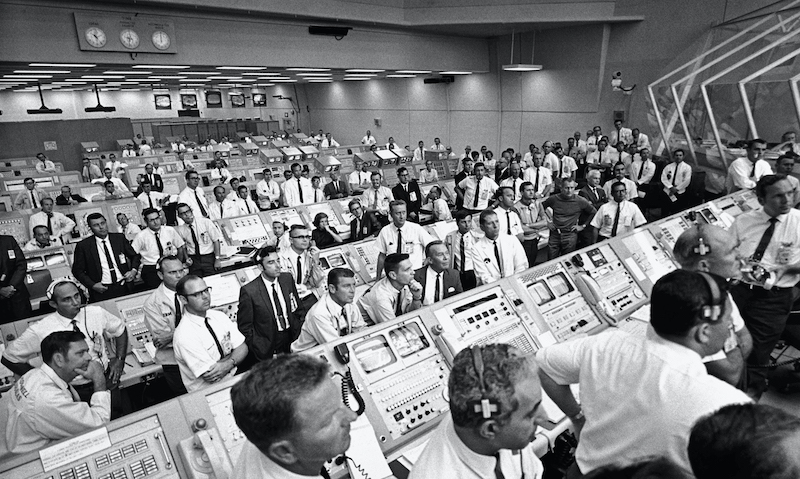
To bring the astronauts back, the ground support team had to deeply understand the situation occurring in space. What were the limitations of controlling the spacecraft? What were the energy constraints? What were the limitations regarding drinking water?
And most importantly, they had to find a way to restart the command system in space, which had never been designed to be restarted because it was never anticipated!
All these problem-solving efforts represent the true application of Digital Twin.
The use of all these simulators was crucial in assisting the astronauts during this mission, and it was indeed a situation where 'time was of the essence' and 'one of the most critical situations'. Of course, the computer simulation system (Simulation) is not Digital Twin in the theoretical sense, as it is not that there was a 'crisis' that needed to be 'understood' in real-time to create a 'Twin' on Earth; otherwise, there would be no need to do so.
This simulation had to be conducted in a short time frame and under conditions that were 'exactly the same' as what the astronauts were experiencing. Let's not forget... that was 1970s technology.
From Space Technology to Data Management Tools in Industry
In academic terms, Digital Twin refers to simulating scenarios to closely resemble real events (Simulation). This is about testing assets, systems, and processes, and can be adjusted to create any scenario cost-effectively, without needing to experiment in real life (especially in the case of spacecraft).
We don't need to be NASA to build spacecraft, but with advanced technology today, humans have widely adopted Digital Twin technology in industries that require high precision and complexity to improve quality of life, whether in healthcare, construction, manufacturing, or managing buildings, cities, and factories.
At this point, I would like to pay tribute and thank NASA for giving birth to the concept and technology of Digital Twin, allowing future generations to adapt and develop its application to this day.
For those who have never seen the legendary film Apollo 13 (1995), I encourage you to find it and watch it. It will help you understand the situation and digest the significance of this technology more easily, while also providing an exhilarating cinematic experience.
Source: Some information from blogs.sw.siemens.com/simcenter/apollo-13-the-first-digital-twin/
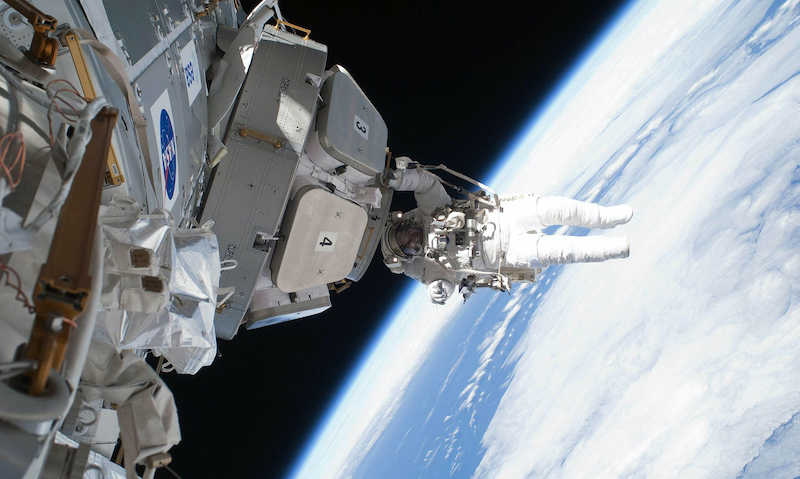
Images: Illustrative images are not related to the content.