Case Study of Mingtee Factory: Digital Twin Technology as a Fundamental Safety Measure for 21st Century Real Estate
Article by Asst. Prof. Dr. Porn Virulrak
Independent Scholar in Property Technology
CEO of Asset Activator
Vice President of the BIM Association of Thailand, Expert in Digital Twin Technology Thailand
Industrial factories are inherently high-risk real estate, especially those dealing with flammable materials, which pose explosion risks. Such facilities require the highest level of safety measures, typically located in industrial estates and distanced from residential areas.
However, the severe explosion and fire incident at Mingtee Chemicals in mid-July (2021) is a stark reminder of the risks involved. The factory was established in 1989, long before the Samut Prakan provincial master plan was announced in 2001, which designated the area as industrial. Over time, numerous residential communities have developed around it due to urban expansion, making the incident unexpected and a significant tragedy.

It is evident that the Mingtee factory has been around since 1989, and as various villages have encircled it, it has become a highly dangerous situation.
This incident highlights several key points:
1. Thailand's urban planning is outdated and does not keep pace with urban growth.
As a result, suburban areas that have begun to urbanize often have factories that were established decades prior to the urban plans, leading to residential communities surrounding them.
2. Although Mingtee factory has maintained its licenses, there are no regulations requiring the adoption of modern technology to enhance safety systems in line with contemporary standards.
Consequently, while the factory met basic safety standards, when an emergency occurred requiring mass evacuation and coordination among various agencies, the response was neither timely nor effective, taking over three days to resolve the crisis.
It's time for technology to step in.
If factories or industrial estates similar to Mingtee had upgraded their safety systems with modern technologies, the chances of effectively managing such situations would undoubtedly improve.
But what should the focus be for achieving this effectiveness?
(1) Access to accurate, rapid, real-time building data: This issue is a long-standing problem in building and property management, not just for firefighting but also for managing various emergencies. Typically, building plans are continuously updated, especially for factories or large commercial buildings that undergo constant changes.
Failure to update the 'building plans' to reflect reality often results in these plans being located within the incident site, making them inaccessible. Consequently, when rescue teams arrive, they must guess how to enter the building, where the emergency equipment is located, and which areas contain hazardous materials, leading to delays and significant damage.
(2) The need for easily accessible and understandable data: In emergency situations, is it feasible to carry a paper blueprint to consult? How can one be sure that the blueprint comes from the same data source and is not a different version? This can lead to further confusion.
(3) Utilizing Remote Control technology: In the case of Mingtee, if Remote Control technology had been employed to manage machinery, it could have controlled valves or systems used to contain chemicals or other liquids, allowing personnel to work safely and efficiently.
These are just a few examples of potential solutions if government agencies encourage the private sector to adopt such technologies.
Technologies to consider to prevent history from repeating itself:
As property owners and building management stakeholders, as well as relevant government agencies, what factors should be prioritized or which basic technologies should be adopted to enhance safety and optimize property data management?
Key factors to consider include:
1. Cloud-based building data management technology:
This is a fundamental technology for updating all construction and renovation plans accurately, stored digitally in the Cloud, ensuring that building plans are never lost and can be accessed by multiple stakeholders.
2. Mandating updates to Cloud-based plans to reflect actual conditions:
Adjusting plans to match reality requires mechanisms in both technology and regulatory oversight, necessitating collaboration among various parties. The government must invest in developing personnel capable of verifying actual construction against the plans in the Cloud, while the private sector should be able to request permits for renovations and update plans directly in the Cloud (for renovations not requiring permits).
3. Using Digital Twin technology as a safety standard:
A Digital Twin is defined as a digital representation that consistently reflects reality in terms of shape and accompanying data.
Today, leading global organizations and major industries continuously use Digital Twin technology to track data and analyze changes, enabling predictions and simulations to study impacts, especially in complex industries requiring high precision, such as Oil & Gas, healthcare, and aerospace manufacturing.
Currently, the hardware, software, and skilled personnel for Digital Twin technology are becoming increasingly evident in Thailand, and the technology is more accessible and affordable than ever. This presents an opportunity for businesses and government agencies to implement these technologies as safety measures for industrial facilities, benefiting the public and users of industrial spaces.
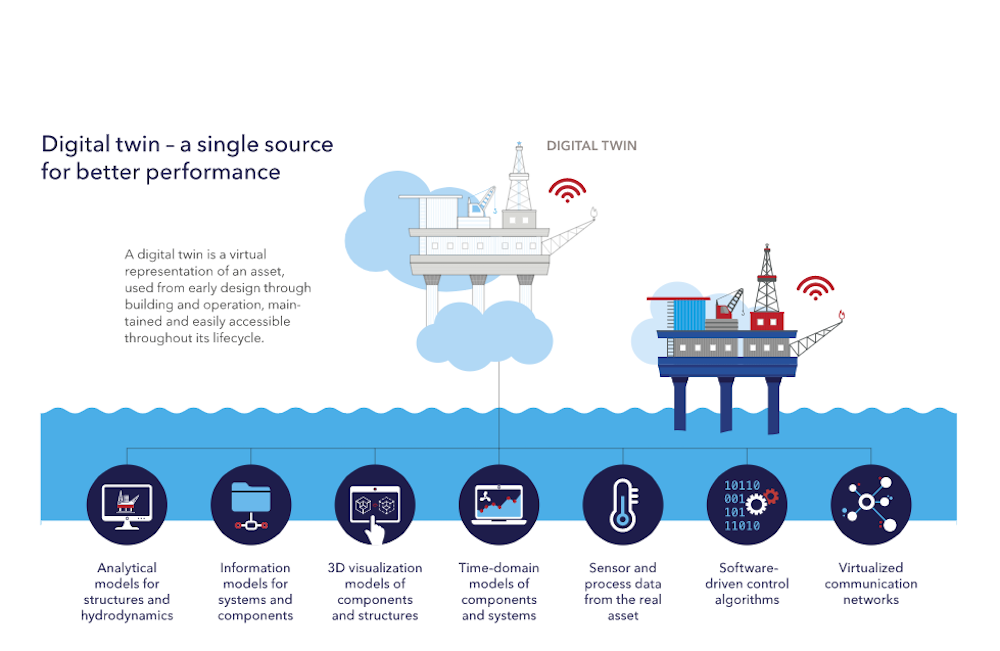
Image of Digital Twin application in the oil & gas sector by DNV (dnv.com)
3 Components for Establishing a Digital Twin are Simpler than You Think:
To lay the foundation for developing a Digital Twin, operators must invest in data creation, similar to hiring architects and engineers to design the industrial facility. Meanwhile, the responsible government agencies must invest in creating a platform to store and manage that data to establish a Digital Twin for all factories under the Ministry of Industry's oversight.
The 3 key technologies that will enable the creation of a Digital Twin include:
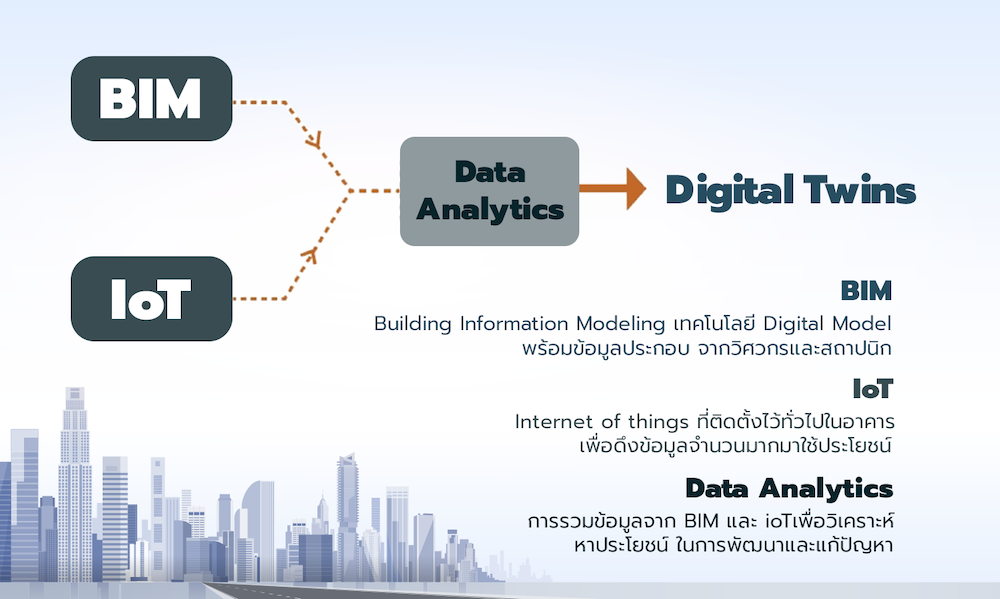
Technology 1: Building Information Modeling (BIM)
BIM is a 3D construction model that serves as a database, capable of linking with other databases and can be rapidly updated. The state of BIM is a Single Source of Truth, meaning there is only one version stored in the Cloud, eliminating the confusion of 'whose plan' or which version it is.
Currently, the use of BIM Technology in Thailand's building design industry is widespread among architects and engineers, becoming a primary mission of the Association of Siamese Architects under Royal Patronage and the Engineering Institute of Thailand, as well as the recently established BIM Association of Thailand in 2019.
Submitting complex industrial factory plans for approval should be done in BIM format as a database and in 3D, as traditional formats like CAD or PDF are only 2D and difficult to analyze further.

Plant Design using BIM Technology (Image from AutoDesk)
Technology 2: Internet of Things (IoT)
Once the BIM Model is established and continuously managed, real-time monitoring of various safety-related equipment in the building or factory, such as pressure or temperature, must be implemented.
The Internet of Things (IoT) will play a role in continuously transmitting this data, with the device locations linked to positions on the BIM Model. When incidents occur, those viewing the data can immediately and easily understand the situation, allowing for prompt problem-solving.
The continuous data reflected from IoT enables operators to analyze or predict situations before they occur, preventing potential losses.
Currently, the cost of IoT devices has significantly decreased, with various manufacturers available both domestically and internationally. The technology meets the needs of industrial equipment deeply, making it feasible for operators to invest in these technologies to enhance safety and production efficiency, leading to substantial savings in maintenance and energy costs.
Technology 3: Data Analytics
With the BIM Model and IoT in place, data processing must occur using Data Analytics technology to analyze safety risks.
Today, Data Analytics technology is more accessible, sometimes even integrated into software packages used in factory operations. Additionally, Thailand has programming experts capable of developing specialized programs to meet specific needs.
The crucial aspect is that the analyses must reach operators (or responsible personnel) and government officials before disasters occur, connecting the analyzed data to government systems that must implement mandatory measures for real-world application.
For example, SCG Chemical REPCO NEX operates according to global standards, with factories in Thailand meeting all three technological standards and strict safety measures, continuously storing data on the Cloud. SCG REPCO Nex or SCG Chemical, which has been in this business for a long time, serves as a model organization for high-standard technology use in safety management for public benefit.
If the implementation of these technologies can be achieved, not only will data flow directly to authorities and disaster relief officials, but it will also enhance remote control capabilities.
All of this may sound like a massive transformation and investment from both the public and private sectors, but believe me, this phenomenon will occur sooner than you think. With technology becoming more accessible and affordable every day, what once seemed like science fiction is now becoming a reality. Just as telephones evolved from simple communication devices to smartphones capable of countless functions in less than a decade, the Digital Twin phenomenon will similarly transform the real estate sector in our country.