Cloud As-Built Document: It's Time to Journey into the Future of Digital Twin and Its Role in Driving Digital Transformation in Building Asset Management (Continued)
By Assoc. Prof. Dr. Porn Virulrak, Independent Scholar in Property Technology [email protected]
CEO of Asset Activator
Vice President of the BIM Association of Thailand
Expert in Digital Twin Technology in Thailand
In the previous discussion, we talked about the challenges that lead to a sense of "fatigue" among building managers or employees driving commercial real estate projects in managing building data (Asset Information) regarding the "As-Built" documents and "supporting data" (manuals or material specifications) to ensure accuracy at all times. This is nearly impossible because
(1) Buildings or properties undergo continuous changes during construction.
(2) The creation of As-Built Documents by some contractors or supervisors lacks professionalism.
(3) There is no one to verify the documents.
(4) The format of building data storage is difficult to access and understand.
(5) The documents keep piling up endlessly.
(6) The documents are not updatable.
(7) The documents are not connected to ERP systems.
Due to these obstacles, building owners resign themselves to the disaster of having outdated building documents.
How does Digital Twin address Asset Information Management?
However, all these issues can be permanently resolved by choosing the 'right tools' and 'right technology.'
Today, we have technology that can completely solve all 7 issues at a surprisingly affordable price, and it is now available for ownership.
One of these technologies is the Digital Twin, which creates a digital twin in the digital world or a database of a building that accurately reflects the actual constructed building. The impact of Digital Twin in property asset management can be illustrated simply by looking at this image.
This shows the perspectives of two groups of people working in very different ways.
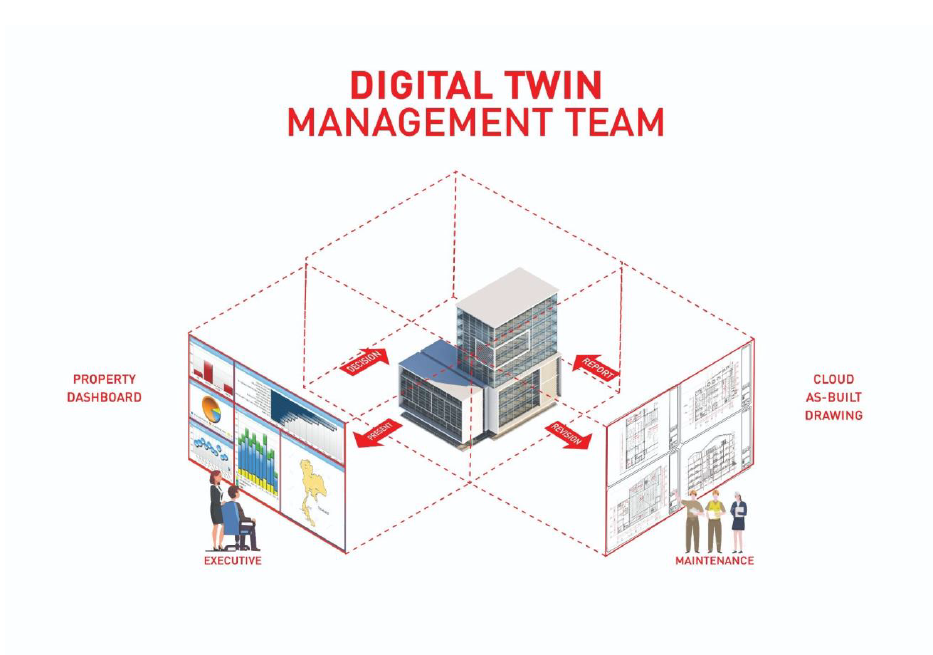
On the left are executives, who look at the overall picture and business direction. What this group wants to see are opportunities for revenue generation and cost reduction. On the right are building technicians who want to view technical data and 2D construction documents they are familiar with. What they need to see are engineering solutions for building issues.
These two groups have different data consumption needs for different purposes, thus requiring "different displays." However, in reality, they are looking at the same underlying data related to the same asset, just presented in different formats.
In actual work, there are not just these two groups monitoring building movements through their respective "screens"; there are also departments such as sales, accounting, security, and cleaning, among others.
The difference between the old world and the new world is that there has never been a Digital Twin in the middle before.
If we remove the Digital Twin from the center, what we see are two separate screens with no connection, causing everyone to use the available data independently, leading to discrepancies and returning to the original problems.
But today, delivering work as a Digital Twin is already happening and becoming the norm in design and construction.
Working with a Model (which is at the center of the image) allows everyone to collaborate as one by linking two things together: (1) Document (2) Cloud
Nowadays, whether it's Google or Microsoft, there are Cloud Documents available for us to use, allowing multiple people to open the same document file and work together simultaneously. If there are conflicts, they can be seen immediately in Real Time.
The concept of Digital Twin is simply about transitioning from Document to Digital Property Model.
Having a Digital Model as a "central data" will help everyone connect. Let me explain how it addresses each of the 7 issues as follows:
(1) Continuous changes during construction: The Digital Twin Model is a leap in construction technology that contractors may need to train in, but leading construction companies, especially those listed on the stock exchange, are already using it to facilitate rapid adjustments to constantly changing designs, significantly reducing construction costs. Therefore, many construction companies are beginning to transform to use the Digital Twin Model, as it makes continuous modifications much easier, reducing work time by over 40-60% compared to traditional AutoCAD methods.
(2) The issue of creating As-Built Documents by some contractors or supervisors lacking professionalism: Similar to point (1), reducing time burdens greatly benefits cost reduction, making many companies willing to implement it to facilitate building management and cost control.
(3) The issue of no one verifying the Digital Twin Model: Currently, many forward-thinking project owners are starting to set requirements for delivering Digital Twin Models (or As-Built Models using BIM Technology) to building owners along with the building handover. The verification process is becoming increasingly systematic, such as requirements for placing the Digital Twin Model on the owner's organization's Cloud, specifications for the database format related to the Model, and requirements for linking to the organization's Enterprise Resource Planning (ERP). Thus, connectivity is becoming a standard practice moving forward.
(4) The issue of difficult-to-access and understand building data storage: Currently, there are outsourced services with both personnel and software ready to support property or building management (Asset Information Management) through Digital Twin, allowing owners to avoid training personnel or making investments, operating as an As-a-Service model.
(5) The issue of documents piling up endlessly: If it's a Digital File, everything is on the computer, or better yet, on the Cloud. Some may think that CAD or PDF files are on the computer, but in reality, CAD or PDF is merely paper on a computer, not Digital Information that can be linked or analyzed further. However, the Digital Twin is the only Model that logs changes at every step, allowing one to look back at the building as it was three years ago or three months ago.
(6) The issue of documents being unupdateable: Digital Files are designed to be flexible and ready to be updated as mentioned in point 5, as they maintain logs and the Model is in an editable file format, not a printed file or exported format.
(7) The issue of documents not being connected to ERP: The Digital Model is inherently linked to ERP because it is also a database.
This is the new world that has arrived... in the design and construction of buildings.
This means that for executives or owners of real estate empires, the journey into the world of Digital Twin has already begun today.