Success Factors in Real Estate Projects
Asst. Prof. Dr. Sukulpath Khumpaisal (Phat)
Master of Science in Real Estate Development Innovation (MIRED)
Faculty of Architecture, Thammasat University
As real estate developers and the general public well know, location is one of the most critical factors in real estate development. It is a tangible physical factor that can be objectively assessed. A well-chosen location can make a real estate project known to consumers, leading to usage and cash flow into the project. Conversely, choosing the wrong location poses the greatest risk for developers, as real estate projects cannot be relocated. Additionally, the price or value of real estate varies according to its location (Price depending on location) and is also affected by the surrounding environment (Surrounding environmental affected).
Since real estate is static, investors, developers, or buyers must approach it directly. Location significantly influences investment decisions and real estate transactions. Khumpaisal (2011) summarized interviews with 13 Thai developers, finding that all emphasized the importance of location selection. A poor choice can lead to mistakes in project development, reduced expected returns, and legal regulations that may hinder optimal land use (Highest and Best Use-HBU), as well as competition with existing rivals.
To select an appropriate location for any real estate project, readers can apply the PACET Model (P – Public Utility, A – Accessibility, C – Community, E – Environment, and T – Transportation) previously mentioned by the author to aid in decision-making.
In addition to the physical characteristics of real estate, there are three key economic characteristics:
- The property itself has a high intrinsic value, providing value to consumers both physically and emotionally.
- Real estate projects typically require longer development times than other products, making them susceptible to government policies and economic conditions throughout the development period. This leads to the concept of Time Value of Money (the longer the time, the lower the value of money – in this case, the project's value).
- Real estate development adds value to land and buildings, enhancing economic and social value. However, excessive development (Over development) may not always increase the project's value.
Given the economic characteristics of real estate mentioned above, it is evident that real estate generates income through rental or sales and requires long-term project development. Therefore, in addition to selecting a suitable location, the author has compiled key factors that support the success of real estate projects for easier understanding:
Marketing Factors: In consumer product markets, the marketing or sales team may consider the marketing mix (Marketing Mixes - 4Ps) to assess what the product is, its unique selling points (P - Product), pricing (P - Price), distribution channels (P – Place), and promotional strategies (P – Promotion).
However, for real estate businesses, using 4Ps may not be sufficient, as real estate is a high-value asset requiring buyers to take time to decide and save money for purchase or rental. Furthermore, the real estate market is perfectly competitive (Perfectly Competitive Market), with many buyers and sellers competing to sell their products quickly and in large quantities. Therefore, if developers want buyers to make repeat purchases in other projects or the same project, and sometimes refer friends or acquaintances to buy as well, the author suggests adding three more marketing mix elements:
1) Service Process (P- Process): If developers focus on customer service and establish a good customer service system, buyers may be impressed by the quality of service, leading to repeat purchases or referrals.
2) Physical Evidence (Physical Evidence): Besides the product itself, such as buildings or even location (P – Product), the decoration of common areas that customers will share, like gardens and swimming pools for residential projects, or walkways and elevator lobbies for commercial projects, can influence customers' decisions to choose that project more quickly.
3) Service Providers (P – People): If project developers hire quality personnel who are willing to serve and knowledgeable about the products, it can instill confidence in customers when purchasing those products. Given the high prices of various real estate types, some customers may only have the opportunity to buy real estate once in their lives. Therefore, customers should feel as comfortable as possible when purchasing that property. As a developer, you would want your customers to feel happy and at ease when buying or renting your project.
As an example, the author considered two condominium projects located directly across from each other at a major intersection in Bangkok. Both projects are priced the same at 120,000 THB per square meter and are low-rise fully furnished buildings (less than 23 meters high), referred to as Condo A and Condo B. The author surveyed the units for potential investment. Despite similar locations near a BTS station, convenient transportation, equal pricing, and comparable room sizes and views,
upon entering Condo A, the author felt relaxed and comfortable due to the beautifully designed sales office and common areas. The staff could answer all questions and provided various after-sales services. However, upon crossing the street to Condo B, the author found the quality of the common areas unsatisfactory, and the sales staff could not even provide basic information about their project. In this case, the author was confident that if purchasing a unit, it would be Condo A over Condo B due to the factors of quality in common area decoration, staff competence, and service, which enhanced the author's confidence.
The final factor the author believes is related to the success of your project is Timing. The term Timing does not refer to the duration of activities related to real estate project development but rather the timing of events, such as when is the right time to expand operations, when to start selling a project, or even when to halt or terminate a project. As readers may already know, in feasibility studies for real estate development projects, researchers use market and financial data from the past or present.
However, developing any real estate project takes a long time, beyond the current data's ability to forecast the future. For example, a real estate development company A wants to develop a 30-story condominium project with 500 units targeting middle to upper-class customers, which will take no less than three years for development and construction. Company A began its feasibility study at the beginning of 2017, using current market data (2017) for unit types, sizes, amenities, and initial selling prices of 120,000 THB per square meter, along with current financial data such as interest rates for prime customers (MRR) and discount rates.
However, when the condominium project reached the beginning of 2020, which was set as the sales launch period, Thailand and the world were affected by the COVID-19 pandemic, impacting Company A's condominium project. Most of the target customers could not make payments due to financial institutions denying loans, and many of the customers' companies had to close. This illustrates that timing is a challenging factor to predict, as unforeseen events or phenomena can occur at any time during project development, whether external factors (economic, social, political conditions, etc.) or internal factors (project liquidity, company's financial status, etc.).
The examples provided illustrate that, in addition to considering location (Locational risk) in real estate development, developers must also consider marketing factors (Marketing risk) and the timing of project execution (Timing risk).
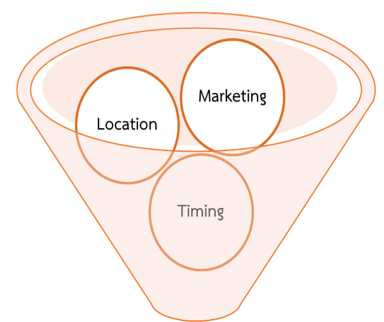
Project Success Factors
The author hopes that the factors of Location, Marketing, and Timing discussed in this article will provide real estate developers with guidance to enhance project quality to better meet customer needs and increase sales or rentals. If readers wish to receive more technical information or tips on real estate project development,
they can contact the Master of Science in Real Estate Development Innovation (MIRED) program at the Faculty of Architecture, Thammasat University. Furthermore, during the Thai New Year Songkran Festival in 2021, the program wishes for the blessings of the Triple Gem and all sacred beings in the universe to bring happiness, prosperity, good health, and safety from COVID-19 to all readers, regardless of the wave.