Building Food Security and Connecting with Nature to Combat COVID-19 in a Thai Way
Dr. Prasert Pinngam (Ph.D., TREES-A NC)
B.Sc. in Public Health, Mahidol University
Last week, I had the opportunity to travel to the northeastern region of Thailand to help design agricultural plots aimed at creating food security for disadvantaged groups. This experience allowed me to witness the determination of various Thai communities striving to establish food security in a uniquely Thai manner. Thailand is fortunate to have abundant natural resources that can serve as a model for other countries in many aspects. One exemplary project is the development of a system for growing organic vegetables, fruits, and rice to provide lunch for schoolchildren in the Chom Phra district of Surin province, led by Dr. Jinda Phromtha. In the initial phase of the project, Dr. Jinda campaigned to reduce candy and sweet consumption among students to address dental issues. As the project deepened, it became clear that it did not fully address all related issues, leading to an expansion of the project to include safe and hygienic food consumption. Parents of the students were invited to participate as producers of safe food for their children. This initiative benefits and serves as a model in various dimensions, including health, social aspects, and sustainable economic participation. If this project can be expanded to cover the entire province or country, Thailand could quickly become a model for participatory organic agriculture from the grassroots level. If achieved, future Thai children will have access to clean, safe, and hygienic food throughout their education. It all starts simply by establishing genuine food security at the grassroots level.
What is Food Security?
Food security refers to a state where everyone has sufficient access to clean and safe food, appropriate to their local context. The Food and Agriculture Organization (FAO) has established criteria for assessing food security to guide policy promotion and support in various regions, which include:
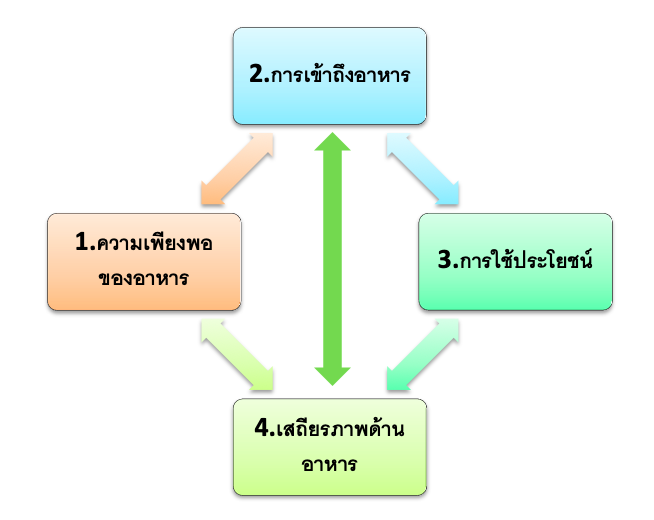
- Food sufficiency means having quality food in adequate and appropriate quantities, both from domestic production and imports.
- Food accessibility means having access to nutritious food, including access to resources that provide food, such as community forests.
- Food utilization means consuming food correctly and utilizing various knowledge to benefit from all activities related to food production, such as employing local wisdom.
- Food stability means that individuals, households, or communities must have consistent access to food without risk of shortages, even during sudden crises, such as the COVID-19 pandemic, where food availability remains sufficient.
When applying these criteria, it is noted that countries lacking food security often become major food exporters. Thailand ranks 52nd out of 113 countries in the 2019 food security assessment. Notably, the areas where Thailand falls below the criteria present interesting opportunities for improvement:
- Government spending on agricultural research scored 5.9/100
- Gross Domestic Product (GDP) per capita scored 14.6/100
- Corruption scored 25/100
- Food protein quality scored 26.6/100
- Nutrition value of micronutrients scored 38/100
From these five areas, it is evident that Thailand still places insufficient emphasis on developing agricultural knowledge. While improving GDP and addressing corruption may take time, enhancing food quality is something we can tackle immediately, as exemplified by the previously mentioned school lunch project.
In addition to broad food security assessments, a detailed comparative study by Nisa Porn Watthanasep and Darunee Somsri in 2017 evaluated the food and energy security status of communities near the Sirikit Dam in Uttaradit province, comparing three neighboring villages, as shown in the following table:
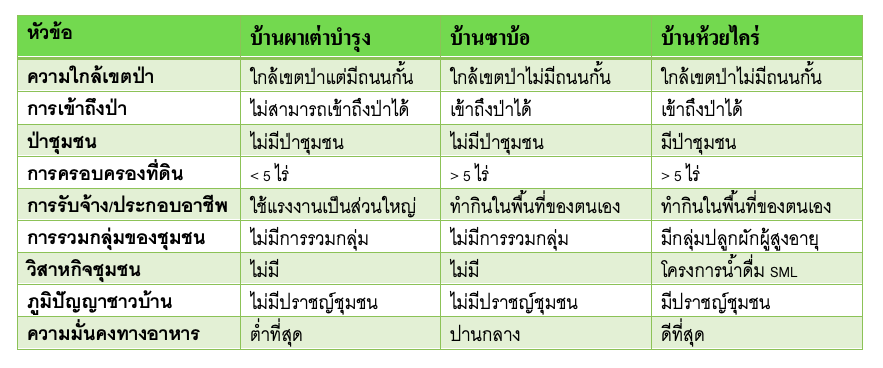
From the comparative data of the three villages, applying the FAO principles of sufficiency, accessibility, utilization, and stability can provide valuable lessons for designing food security systems for communities:
- Land ownership directly affects food security, as having sufficient land allows for adequate food production and potential income generation. This relates to the use of local wisdom in management.
- Occupational choices and labor use indicate that limited land leads to labor outsourcing, which prevents long-term land development.
- Community forests and access to forests are crucial for food security, as community forests provide various benefits, including food sources and fuel for household energy.
- Community group formation enables participation, such as elderly vegetable-growing groups, which not only produce food but also enhance mental health and connect with younger generations. The community drinking water project in Huai Khrai is another good example, providing hygienic drinking water at low cost without relying on external plastic.
- Local wisdom and traditional knowledge facilitate knowledge transfer for practical implementation.
- Community grouping is a key factor in creating added value from local resources.
- Utilizing local wisdom and having community leaders can help find appropriate and correct living methods for the community, including maximizing the use of local resources.
- Food stability is evident during the COVID-19 situation, where laborers or casual workers showed clear food instability, while those in rural areas with their own agricultural land maintained higher food security.
From the above research examples, we can design a community with food security encompassing four aspects:

Four Fundamental Principles for Creating a Model Community with Food Security
- Production factors, including land, labor, and capital, are basic elements that can involve collaboration with relevant public or private sectors. Additionally, if the community can effectively organize, communal land can be utilized for community benefit.
- Innovation and local wisdom, guided by Thailand's sufficiency economy principles, can integrate innovations with local wisdom to create sustainable practices tailored to local contexts.
- Community participation, as seen in small activities like the elderly vegetable-growing group in Huai Khrai or the school lunch project in Chom Thong Hospital, exemplifies community involvement, fostering a network that serves as a learning hub for other communities.
- Consideration for nature and the environment is fundamental across all areas, as natural resources and the environment are communal assets that must be preserved for future generations.
If all four components can be established, it will create mechanisms for overseeing and ensuring sustainable food security.
Connecting with Nature to Combat COVID-19 through Community Forests
Research shows that all three villages highly value community forests. Numerous studies highlight the benefits of forests. For instance, research by Morimoto and colleagues studied how forest bathing enhances human natural killer (NK) activity and the expression of anti-cancer proteins. Participants were divided into two groups: one stayed in a city hotel, while the other spent three days and two nights in the forest. Health assessments revealed that the first group showed no change in NK cell counts, while the second group experienced a significant increase of over 50%. The researchers explained that prolonged exposure to forests, known as forest bathing, provides three immune-boosting benefits:
- Beneficial microorganisms that aid respiratory and digestive systems.
- Volatile organic compounds that promote relaxation and hormone balance.
- Negative ions from nature or pure oxygen that combat free radicals.
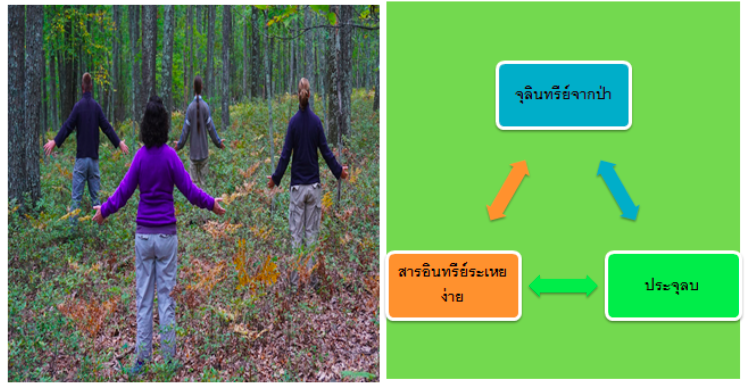
Community forests or natural forests serve not only as sources of food and energy but also as vital areas for disease prevention and treatment. It can be said that true and sustainable food security design must prioritize the conservation and maintenance of community forests as much as possible.
Steps to Establish Food Security
Based on the foundational data for creating food security and the FAO guidelines, along with research in Thailand, we can summarize the steps to establish food security at the household level as follows:
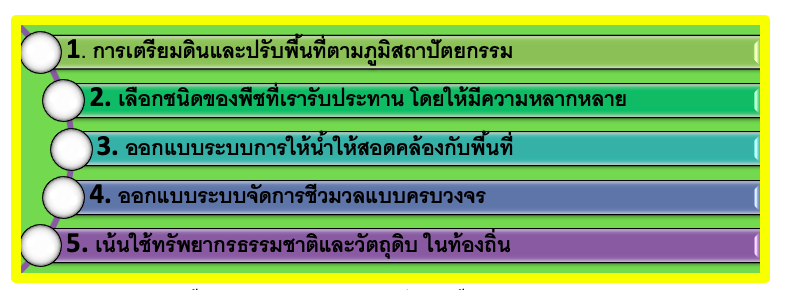
- Prepare the soil and adjust the area according to landscape architecture, checking soil quality at different depths, especially root-level properties, and adjusting surface slope to match actual landscape characteristics.
- Select diverse plant types for consumption, adhering to nutritional principles of 350 grams of vegetables per person per day and a variety of 30 types per week. Planning with neighbors for diverse crops is also beneficial, ensuring seed preservation for future planting.
- Design a water supply system that aligns with the area, ensuring a complete cycle of water circulation both above and below ground, using various methods such as ditches, drip irrigation, or misting based on environmental factors suitable for each plant and soil type.
- Design a comprehensive biomass management system, planning to create organic fertilizer from all biomass materials, ensuring that hard-to-decompose materials are chopped and used as ground cover to maintain soil temperature below 37 °C, as higher temperatures can kill soil microorganisms.
- Emphasize the use of local natural resources and materials, promoting sustainability through resource exchange within the community, adjusting proportions based on the digestibility of various organic materials.
Try it out and learn! There are no fixed rules; learning through experience will enhance expertise. Building true grassroots resilience in Thailand will emerge from engaging in food production or agriculture for ourselves, which connects us with nature and strengthens our immunity.
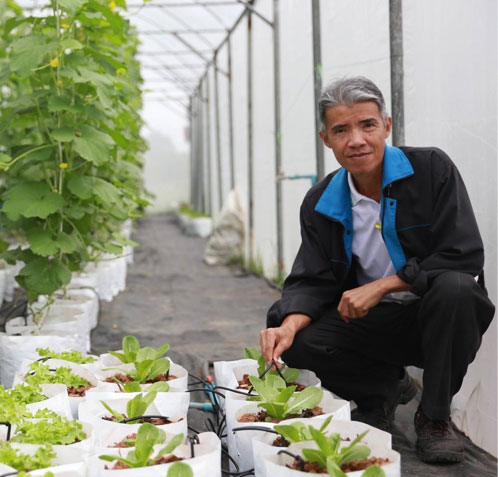
ABOUT THE AUTHOR
ดร.ประเสริฐ ปิ่นงาม (Ph.D., TREES-A NC) วท.บ. สาธารณสุขศาสตร์ ม.มหิดล