The Birth of Tiny Creatures: A World-Altering Theory in Evolution
Dr. Prasert Pin-ngam (Ph.D., TREES-A NC)
B.Sc. Public Health, Mahidol University
The biodiversity of microorganisms, which serves as the cornerstone of disease resistance in humans, animals, and plants, has shown us that the true driving force behind the existence of life on this planet is these tiny microorganisms. If the diversity of microorganisms is maintained, the ecosystem can coexist peacefully. However, if this diversity is lost, it can lead to imbalance or disease within that ecosystem. Therefore, preserving the biodiversity of microorganisms is crucial for sustainable living. Yet, humans have only recently begun to understand the world of microorganisms. Evidence of this is that we can cultivate only about 5% of the microorganisms on Earth in laboratories; over 95% are known to exist but cannot be isolated for in-depth study. This limitation has led us to rely on the principle of diversity as a guideline for practice.
Lynn Margulis is the Albert Einstein of Biology
Since Louis Pasteur successfully developed the vaccine in 1881, advancements in microbiology seem to lag behind those in physics or chemistry, particularly in areas impacting global knowledge. The most significant discovery in physics that awakened the world was Albert Einstein's theory of relativity. In 1915, Einstein predicted that light would bend according to the gravitational forces of the universe. The person behind Einstein's fame is Sir Arthur Stanley Eddington, who proved Einstein's theory during the solar eclipse of 1919. This test made Einstein a household name and was seen as a complete overthrow of Sir Isaac Newton's laws of gravity. A similar event occurred in biology with Lynn Margulis.
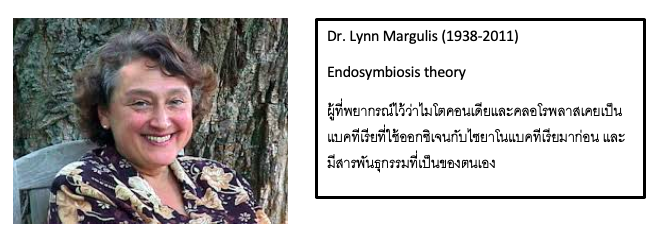
Lynn Margulis was an American woman of Jewish descent, born on March 15, 1938. In 1967, while working as a professor in Boston, she proposed to publish an article titled “On the origin of mitosing cells”, which attempted to explain that mitochondria and chloroplasts within prokaryotic cells have their own DNA or genetic material. This process originated from endosymbiosis, where different species coexist together, leading to mitochondria and chloroplasts becoming integral components of multicellular organisms, including animals and plants. Initially, her proposal was rejected by 15 publishers, deemed unreliable and met with various forms of ridicule. However, it was eventually published in the Journal of Theoretical Biology, where it faced heavy criticism from mainstream theorists. It wasn't until 1978 that Robert Schwartz and Margaret Dayhoff proved Margulis's work to be true by discovering that both mitochondria and chloroplasts possess their own DNA, distinct from that of their host. This discovery earned Margulis numerous awards, with historians comparing Charles Darwin as the representative of evolution and Lynn Margulis as the representative of symbiosis. The significance of the endosymbiosis theory is well understood among biologists as a transformative shift in the knowledge they had learned. While Einstein took four years to prove his theory, Margulis fought for 11 years due to the challenges faced as a woman in science, making her a pioneering figure in the fields of biology and microbiology. Her discoveries have propelled advancements in related research to this day.
Endosymbiosis: Sustainable Coexistence
Charles Darwin's theory successfully explained the process of evolution through external cellular changes. However, the emergence of new species remained unclear. Darwin suggested that new species arise from gradual random genetic mutations, a concept that lacks formal evidence and has been a topic of ongoing debate. Lynn Margulis's endosymbiosis theory provides a clear answer to this question, tracing back to the origins of the Earth.

Timeline of Significant Events from Earth's Formation to the Emergence of Multicellular Life
Based on the timeline of significant events related to life from the beginning, we can categorize them according to fossil evidence as follows:
Era of Anaerobic Bacteria: Scientific evidence shows fossils dating back 3.8 billion years, during which the Earth's atmosphere lacked oxygen, resulting in the emergence of only anaerobic bacteria.
Era of Photosynthetic Bacteria: Evidence suggests that photosynthetic bacteria, specifically cyanobacteria, emerged around 3.2 billion years ago. These bacteria utilized sunlight to produce sugars and released oxygen as a byproduct, leading to an accumulation of oxygen in the atmosphere. This oxygen was toxic to anaerobic bacteria, causing a significant die-off and leading to a major adaptation process.
Era of Aerobic Bacteria: Evidence indicates that aerobic bacteria emerged around 2.5 billion years ago, after the atmosphere became rich in oxygen, allowing these bacteria to thrive and persist to this day.
The changes across these three eras illustrate the differences between various cell types:
Table Showing Differences Between Prokaryotes, Eukaryotes, Mitochondria, and Chloroplasts
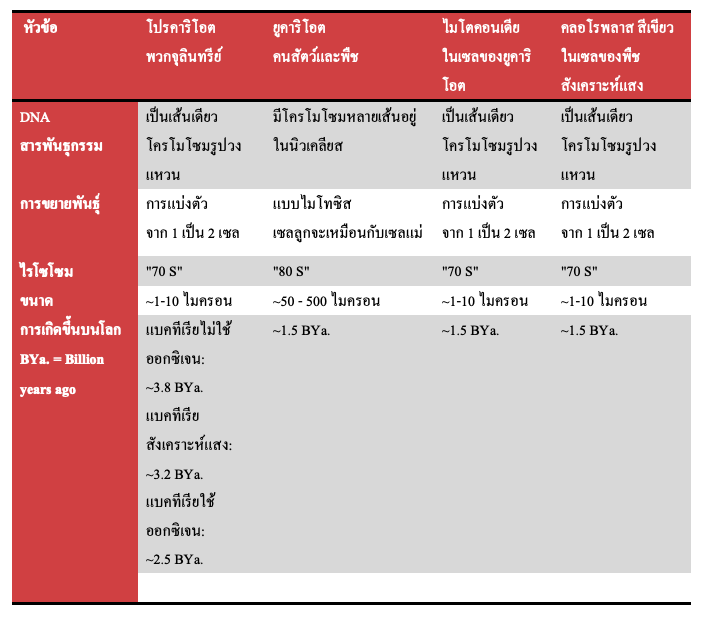
From the table, it is evident that the period from 2.5 billion to 1.5 billion years ago was a time of evolution according to the endosymbiosis theory, which can be illustrated as follows:
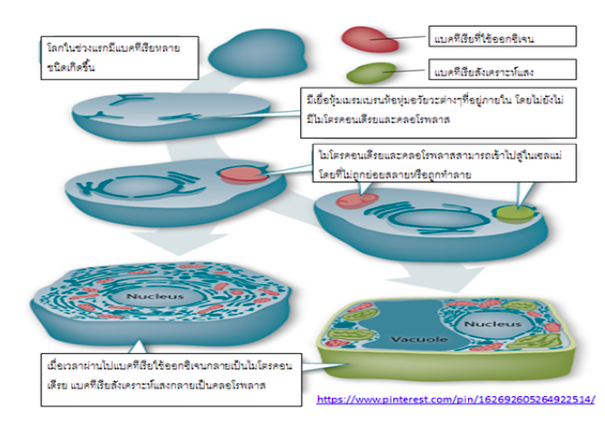
Illustration of Mitochondria and Chloroplasts Entering Cells
After the formation of the Earth, it took approximately 800 million years for the first life forms, anaerobic bacteria, to emerge. Another 600 million years later, photosynthetic bacteria appeared, producing sugars and oxygen, the latter being a catalyst for the emergence of the third type of life, aerobic bacteria, with a gap of 700 million years.
Following the emergence of aerobic bacteria, the endosymbiosis theory explains how the second group, photosynthetic bacteria, evolved into chloroplasts (where chlorophyll is located) within larger prokaryotic cells, leading to the development of multicellular organisms such as algae and plants. Similarly, aerobic bacteria evolved into mitochondria within larger prokaryotic cells, giving rise to multicellular organisms in both plant and animal kingdoms. This process was driven by external factors, allowing single-celled organisms to combine strengths from different species and coexist for long-term survival. This theory has provided substantial evidence that has transformed the study of evolution and biology. Furthermore, scientists have utilized genetic changes in human mitochondria to trace the migration patterns of humans since ancient times, leading to a more precise understanding of migration. Thus, Lynn Margulis's theory is one that everyone should remember, as it can accurately explain diseases arising from modern dietary habits. By understanding certain principles, we can apply them in our daily lives to build our immune systems effectively.
Lessons from the Endosymbiosis Theory
The integration of different species into cells, as proposed by Dr. Lynn Margulis, occurred over 2.5 billion years ago and continues today. Research by Zhiqing Li and colleagues, published in 2018, titled MicroRNAs from plants to animals, do they define a new messenger for communication?, describes similar events occurring in animal cells where microRNAs from consumed plants or food are incorporated into the host's DNA permanently.
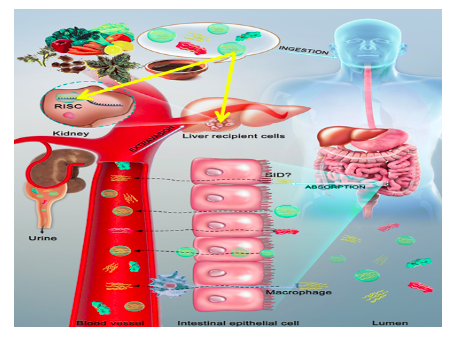
Illustration of miRNAs from Consumed Food Integrating into Host DNA
There are many related studies that demonstrate that the events of 2.5 billion years ago continue to unfold today.
The first important lesson from this is about food consumption. Due to modern agricultural practices and food production processes, there is extensive use of chemicals, pesticides, and herbicides, which inevitably contaminate our food. Ultimately, these substances can integrate into our genes. Therefore, if we do not want future generations of Homo sapiens to evolve into chemically altered beings like us, we should strive to consume as much natural food as possible.
The second important lesson is the principle of coexistence. It is clear that we do not exist in isolation; we host numerous beneficial microorganisms. Since we control the type of food we consume, the endosymbiosis theory prompts us to reconsider how our food benefits or harms us. It is akin to a mother nursing her child. If we can manage this, we can build the best immunity without worrying about the 95% of microorganisms we do not yet know about. If we can adjust our behaviors in line with this theory, the findings of Dr. Lynn Margulis have proven that we can continue to thrive for over 1.5 billion more years.
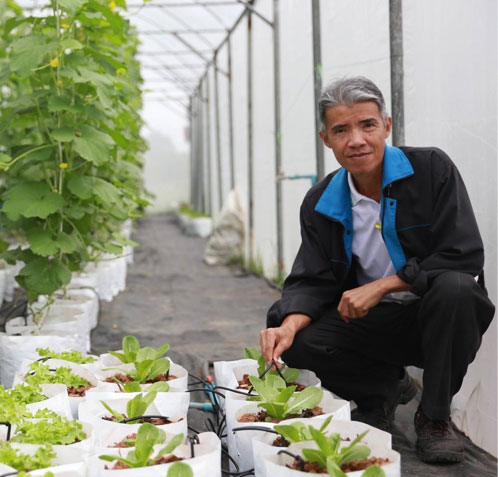
ABOUT THE AUTHOR
ดร.ประเสริฐ ปิ่นงาม (Ph.D., TREES-A NC) วท.บ. สาธารณสุขศาสตร์ ม.มหิดล