
The Intelligence of Plants: A Truth Humans Refuse to Accept (Plant Knowing vs Human Knowledge)
Dr. Prasert Pin-ngam (Ph.D., TREES-A NC)
B.Sc. in Public Health, Mahidol University
As the world currently faces the COVID-19 pandemic, there has been a scramble for medical supplies among powerful nations. Whether this is due to security concerns or business interests, it is believed that there are certainly underlying reasons. Humans have long been experts in rationalizing their actions, which brings to mind Jared Diamond's book, "Collapse: How Societies Choose to Fail or Succeed," which explains why once-thriving civilizations have fallen. The problem often begins with groups of people who cannot foresee issues, and when problems do arise, they fail to recognize them. Even when they are aware, they may not attempt to solve them collectively. Ultimately, when the problems escalate and they do try to address them, they often find themselves unable to do so. This perspective is enlightening, as our living planet has never been as divided as we are.
We have long used knowledge as a rationale for not cooperating to address problems collectively. This is what we refer to as human intelligence, a level of intellect that divides the foolish from the wise, the poor from the rich, and developed countries from developing ones. Little do we realize that the rationale derived from the knowledge we have been taught can ultimately harm us without our awareness. This raises the question: Is the accumulated knowledge that humans have taught each other entirely correct for ensuring the sustainability of our species?
The Definition of Life: Overlooking Plant Populations
Approximately 13,000 years ago, humans began practicing agriculture, living in harmony with nature and the environment. A significant change began about 500 years ago with the advent of scientific knowledge, which focused solely on what can be seen and proven to exist. Anything beyond human sensory perception was often overlooked or deemed unimportant. One significant example is the definition of an organism, which refers to entities that can move, require food, need shelter, and can reproduce, thus requiring energy to sustain life. Following this definition, plants are often excluded from being considered living organisms because they do not move. We have been taught that the blue whale is the largest living creature on Earth, despite the fact that plants can be much larger.

The key issue is not whether the definition is right or wrong, but rather the lack of importance placed on the existence of plants. This has led to a limited understanding of plants, with serious studies primarily focusing on their utility. The use of fertilizers or chemicals produced by humans represents a development from a human perspective alone. We have never genuinely considered the appropriate living conditions for plants, even though, in reality, plants can move, albeit at a speed that maximizes their benefit. For example, the Brambles plant, which grows beneath larger trees, initially sways its tips to assess where food sources are before deciding to move in that direction at a rate of three inches per day, which is sufficient since sunlight and nutrients are not far away.
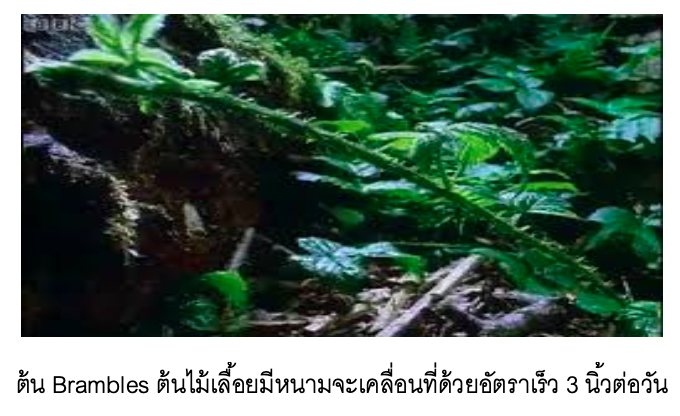
(https://www.youtube.com/watch?v=aNjR4rVA8to)
Human understanding of the true capabilities of plants is currently minimal. Plants are viewed as lowly developed life forms, which is a significant oversight on our part.
The Theory of Evolution Based on Scientific Limitations
Early studies of evolution focused primarily on physical changes and mutations. As understanding of genes and genetics advanced, this evolved into the modern synthesis theory. Today, we have a much more advanced understanding of changes and mutations, to the point where we can predict future changes. Importantly, changes at the gene level and beyond (gene and epigenetics) are ongoing. Environmental changes, air pollution, sugar or chemical consumption, and emotional states directly affect genetic changes. We are increasingly aware of these factors, all of which are confirmed and measured through scientific principles. However, our intelligence in this area has led us to disregard the intangible, viewing it as nonsense that does not exist because it cannot be proven. Anthropologist Jeremy Narby, Ph.D., who has a direct Ph.D. in this field, has explored the evolution of nature's mysteries and published two books: "The Cosmic Serpent: DNA and the Origins of Knowledge" and "Intelligence in Nature: An Inquiry into Knowledge." Dr. Narby spent over ten years studying with tribes and shamans in the Amazon, revealing that in our pursuit of human advancement, we have overlooked the secrets of nature, especially regarding the intelligence and capabilities of plants, simply because they lack a nervous system and brain as we expect.
Solving Problems with Slime Mold
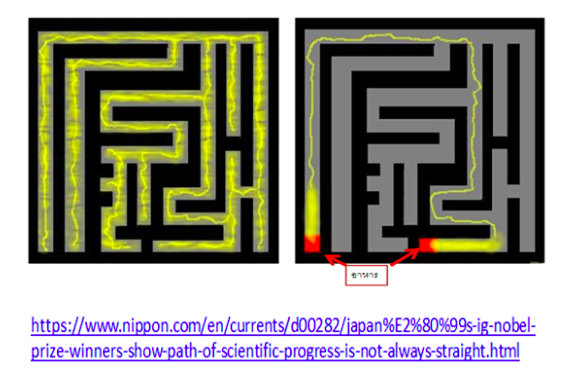
Our hypothesis about intelligence begins with the belief that a central nervous system or brain is essential for intelligence. However, recent discoveries may prompt us to reconsider this. Nakagaki and his team studied the capabilities of slime mold, allowing it to grow in a maze without food. Initially, the slime mold spread out, but when food was introduced, it moved its growth toward the shortest path between the two food sources. This experiment demonstrates that intelligence can exist without the mechanisms of a nervous system or brain.
Plant Intelligence and Wisdom
According to OSHO, human awareness is divided into three levels: instinct, wisdom, and intuition. Awareness that does not pass through the nervous system or brain is termed intuitive awareness. Zen masters often say that true thinking occurs when one stops thinking. This is an experience that cannot be easily conveyed. The level at which plants exist in this context requires further study. Research on this topic has been ongoing for a long time, starting with Charles Darwin's "The Power of Movement in Plants," published over two hundred years ago, which laid clear foundational principles. The latest work on this subject by Anthony Trewavas, Ph.D., published "The Foundations of Plant Intelligence" in 2017, compiling various aspects of plant intelligence and capabilities, including responses to environmental conditions, communication between cells within a single plant or among groups, and expressions of pain using calcium as a neurotransmitter. Regarding communication, Richard Karban, Ph.D., proposed that plants use volatile organic chemicals as a language to communicate with each other, both above and below ground. Different plant species release different types of chemicals, and in varying situations, they emit different chemicals for alerts, environmental responses, or even to combat insect attacks.
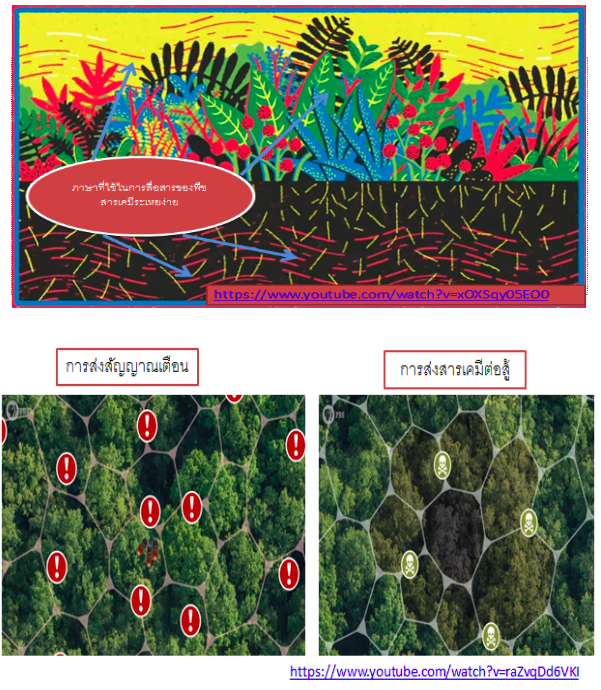
In summary, plants certainly communicate with each other. Additionally, studies on plant learning abilities by Monica Gagliano, Ph.D., have modeled learning stimulation similar to that of dogs. In dog experiments, the dog sees food and salivates, and then a bell is rung before feeding. After training, the dog salivates upon hearing the bell, having learned that the sound precedes food. For plants, similar experiments were conducted, replacing food with light and the bell with a fan. The dog's salivation is akin to the plant bending toward the light. The result showed that when the wind blew, the plant, having learned previously that light would follow, bent its stem toward the direction where light would appear.
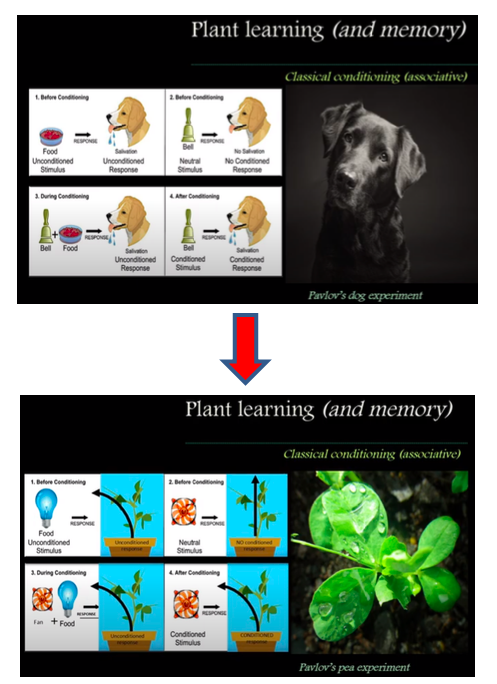
https://www.youtube.com/watch?v=90BUQoLu_Hg
The results indicate that plants possess learning systems and memory similar to ordinary dogs. This demonstrates that the learning processes of plants exist without the need for a nervous system or brain to control them.
Lesson Two from Plants: Unconditional Giving
From the previous article, which illustrated the coexistence of plants sharing equally regardless of species, this principle is crucial for true coexistence. For this second lesson, we start from the premise that even though we do not regard plants as living beings, we have never cared for their well-being or been taught to nurture them as we should. Our development of knowledge about plants is limited, yet plants continue to provide us with various benefits unconditionally. This may be because plants have evolved differently from us; while humans have physically evolved to the pinnacle of the food chain, plants may have evolved mentally to a level that Jeremy Narby is exploring. We know that humans consist of both body and mind. The scientific world has led us to believe primarily in physical evolution, but it is possible that when the lineages of plants and animals diverged, it marked a choice between evolving physically (wisdom) or mentally (intuitive awareness). Given the way plants exist today, they truly embody the role of creators and givers.
The second lesson humans must learn from plants is unconditional giving. No matter how much we belittle plants, they fulfill their role in photosynthesis and food production for all living beings on this planet without any conditions. If humans were to adopt this principle, the competition for resources or even medical supplies would undoubtedly cease to exist. See you in the next episode!
ABOUT THE AUTHOR
ดร.ประเสริฐ ปิ่นงาม (Ph.D., TREES-A NC) วท.บ. สาธารณสุขศาสตร์ ม.มหิดล