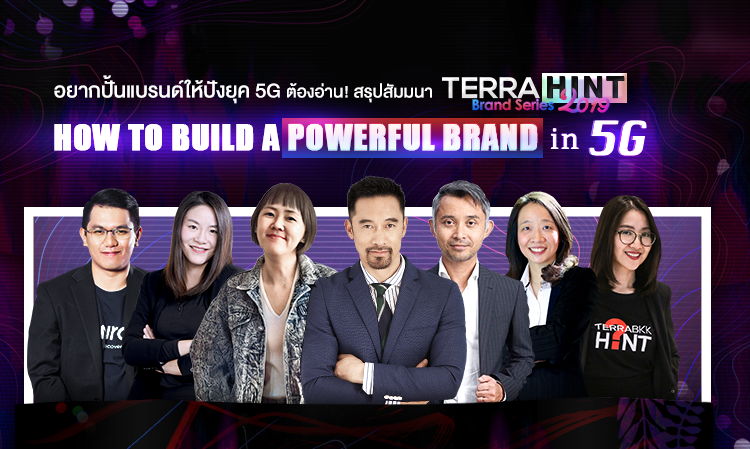
Want to Build a Powerful Brand in the 5G Era? Read This! Summary of the Terra HINT BRAND Series 2019: HOW TO BUILD A POWERFUL BRAND IN 5G
Want to Build a Powerful Brand in the 5G Era? Read This! Summary of the Terra HINT BRAND Series 2019: HOW TO BUILD A POWERFUL BRAND IN 5G
If you don't read this, you're missing out, especially if you're in the branding field, particularly in real estate. The Terra HINT BRAND Series seminar is held annually, and as we know, Thailand is fully entering the 5G era. The competitive landscape is about to transform, and whether you are a business owner, entrepreneur, marketer, or brand creator, everyone is preparing to tackle this phenomenon. TerraBKK seizes this opportunity to update branding strategies for the 5G era during the seminar Terra HINT BRAND Series 2019: HOW TO BUILD A POWERFUL BRAND IN 5G
Terra believes that building a good brand requires not only market presence but also a clear identity and sustainable value to thrive amidst the dynamics of social change and consumer behavior. Given the current unpredictable economic climate, the real estate business is beginning to slow down, making brand recognition a crucial strategy for survival in any situation.
Key Highlights: Main Topics of the Seminar Include
- Research findings on THE MOST POWERFUL REAL ESTATE BRANDS 2019 and GEN X & Y CUSTOMER INSIGHT FOR REAL ESTATE by Sumitra Wongphakdee, Managing Director of TerraBKK.com
- Powerful brands across generations: "THE POWERFUL BRANDS FROM EACH GENERATION" by Udomsak Donkhampai, Chief Technology Officer of Zanroo CO.,LTD.
- GROUP TALK “HOW TO BUILD A POWERFUL BRAND IN 5G” hosted by Atichart Wongwuthiwat, TV host of TNN24, featuring discussions with:
- Pinnya Likhapoon, CEO & Strategic Planner of UNDERDUCK CO.,LTD.
- Niramol Thanyathiraphong, Co-founder & Strategic Planning Director of Showroom111, LTD.
- Suthep Sakkrawat, Senior Executive Vice President of Marketing at Siam Commercial Bank.
- Nopparat Ingtanawut, Senior Marketing Director at Visa Thailand and Myanmar, Visa International.
- Representatives from the award-winning real estate brands of 2019.
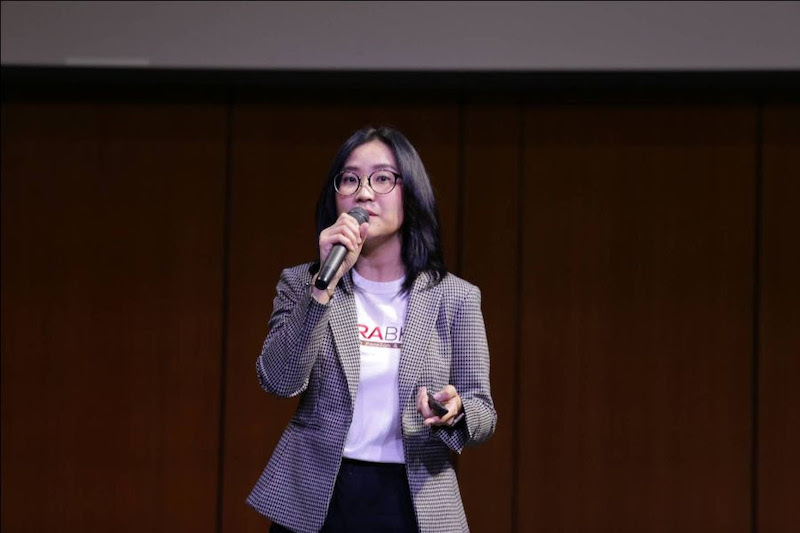
The research findings on GEN X & Y CUSTOMER INSIGHT FOR REAL ESTATE reflect the differing home-buying behaviors across generations. Developers need to understand and adapt accordingly. This year's research collected over 1,400 samples, with the majority being:
- More than 50% have an income exceeding 50,000 THB.
- 38% have an income between 20,000-30,000 THB.
- 56% are company employees.
- 55% are Gen Y.
- 23% are Baby Boomers.
- 17% are Gen Z.
This sample group aligns with the demographic structure (from the National Statistics Office Thailand research).
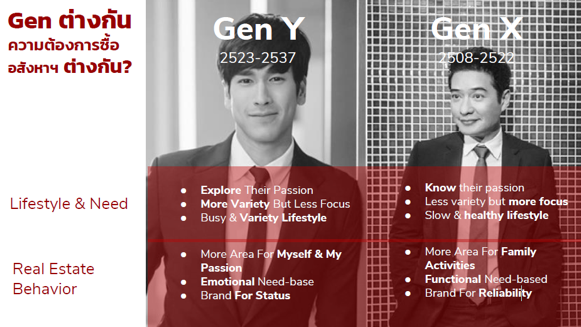
Different Generations Have Different Real Estate Buying Preferences
From the sample group, we can summarize home-buying behaviors into two main groups: Gen Y (born 1980-1994) and Gen X (born 1965-1982). These generations have different real estate buying preferences due to their distinct lifestyles and life philosophies.
- Gen Y: This generation is in a phase of self-discovery and passion-seeking, enjoying trying new things. Their lifestyle is highly varied, and their real estate purchasing behavior focuses on spaces that fulfill their passions and lifestyles, making decisions based more on feelings and emotions, seeking brands that enhance their status.
- Gen X: This generation knows their needs and passions, leading a more settled lifestyle with an interest in health. Their real estate purchasing behavior emphasizes spaces that facilitate family activities, making decisions based more on functionality and preferring trustworthy brands.
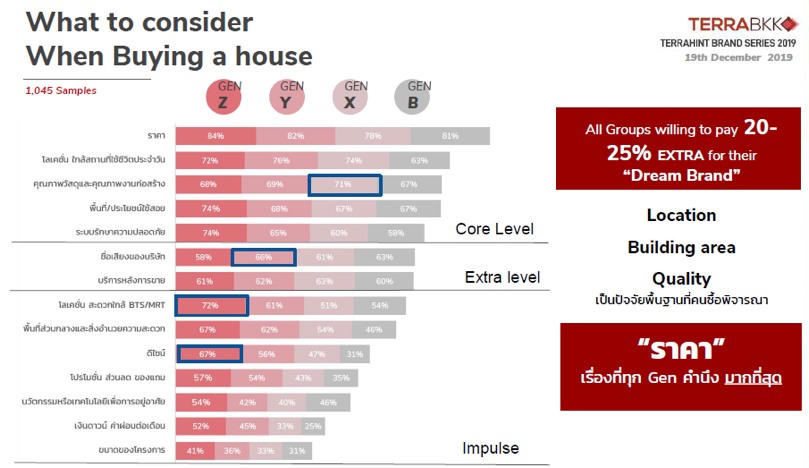
Factors to Consider When Buying a Home: While price is the top priority, other factors are also important
According to the survey results, the fundamental factors that buyers consider when purchasing a home remain: 1. Location 2. Space 3. Quality. The factor of 'price' is the most significant consideration across all generations. However, the importance of each factor varies among generations:
- Gen X: 71% prioritize the quality of materials and construction.
- Gen Y: 66% prioritize the company's reputation.
- Gen Z: 72% prioritize convenient locations near BTS/MRT and 67% prioritize design.
Regardless of the generation, they are willing to pay 20-25% more to own their dream brand.
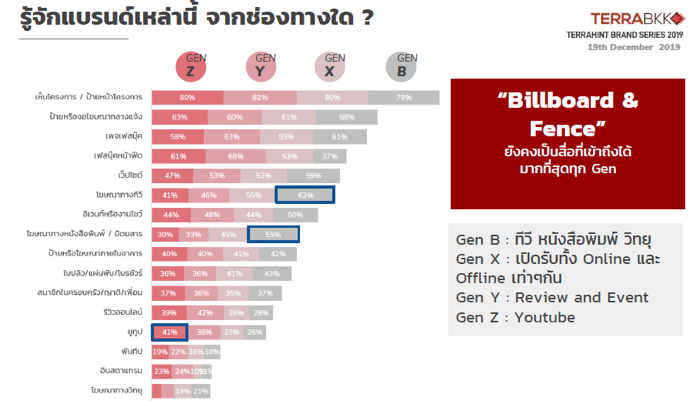
Brand Awareness Channels: Traditional Media is Not Dead, but Reviews are Essential
Naturally, a common question among marketers is how the choice of media to reach target audiences will change in the 5G era. The research from TerraBKK provides answers, revealing that for real estate brand awareness, traditional media, particularly print media, still plays a significant role alongside online media. However, each medium influences different groups:
- Baby Boomers: Traditional media still works, including TV, newspapers, and radio.
- Gen X: Equal engagement with both online and offline media.
- Gen Y: They need to check 'reviews' for reassurance and attend 'events' to stay updated.
- Gen Z: YouTube is essential.
The Key to Decision-Making When Buying Real Estate
Looking at the overall housing market, we can categorize housing types and needs into:
- Houses/Townhomes: Need parking space and areas for family activities.
- Condominiums: Require convenient transportation, proximity to public transport hubs, and easily maintainable living spaces.
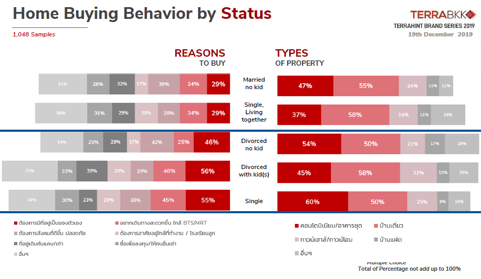
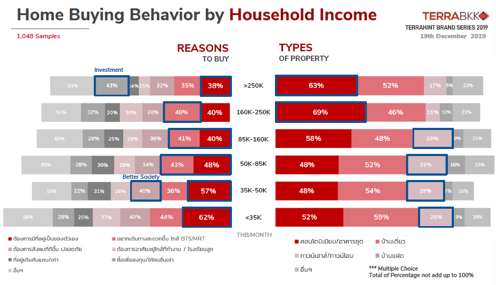
Additionally, decision-making factors can vary based on individual status, income, and personal characteristics. For instance, single, married, divorced, or married with children will have different housing needs. Interestingly, statistics show that divorced individuals tend to seek housing similar to singles again, and income levels also lead to different objectives:
- Those with an income above 50,000 THB tend to buy for investment, favoring high-rise properties.
- Those with an income between 30,000-50,000 THB seek residences in good communities.
- Those with lower incomes prefer horizontal housing.
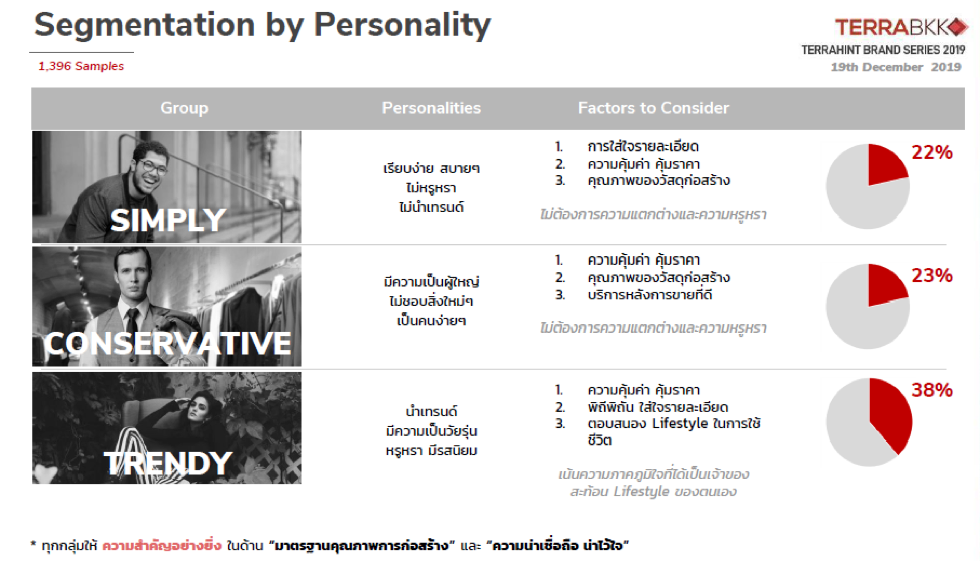
Survey results segmented by character traits show that the Trendy group is the largest.
Top of Mind & Brand Powerful Band 2019
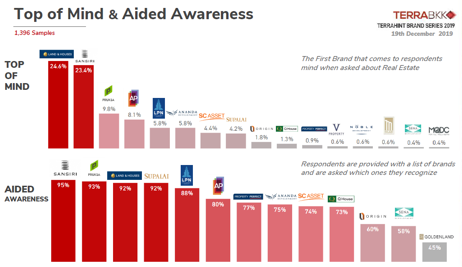
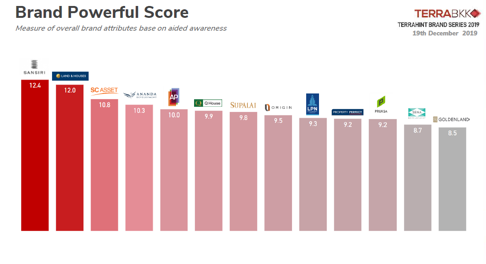
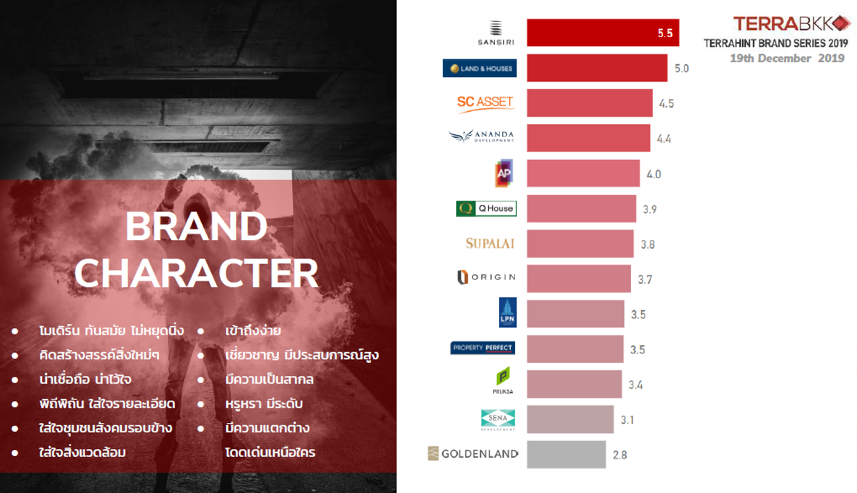
As is customary every year, a survey of Top of Mind real estate brands was conducted. This year, the brand voted as Top of Mind 2019 is Land & House, while the Brand Powerful Band 2019 title goes to Sansiri for the second consecutive year. Notably, this year, all real estate brands showed improvement in all areas, indicating their efforts to enhance their brands despite facing numerous challenges in the real estate sector.
What Makes a Good Real Estate Brand?
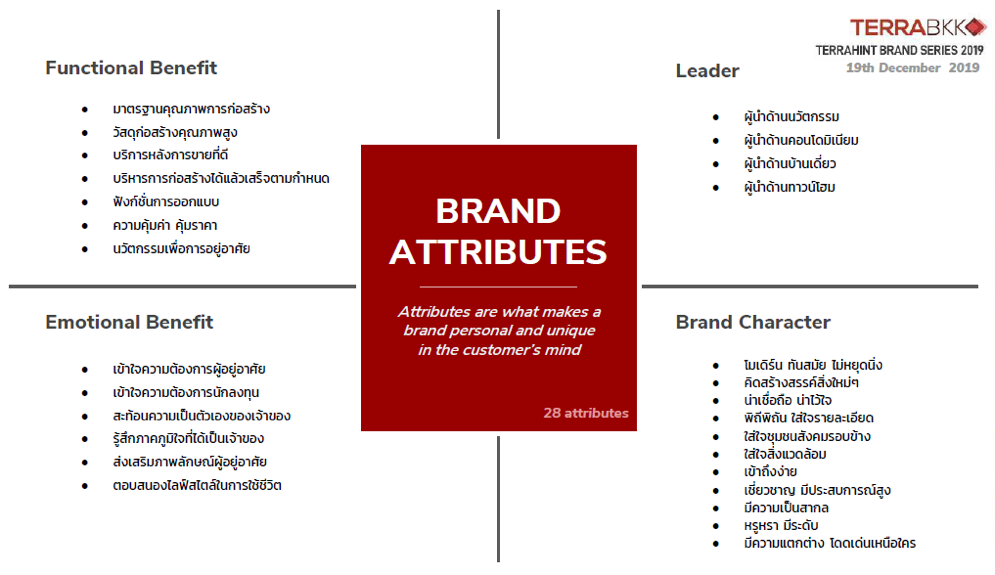
Whether we refer to it as a 'dream brand', 'Top of Mind' brand, or 'influential brand', ultimately, building a good real estate brand is not determined by the brand itself but by what consumers want from these brands and how well the brands can meet those needs.
Based on survey results regarding the characteristics of desirable real estate brands, TerraBKK summarized them into four main topics (as shown in the table below).
Brand Image: Real Estate vs. Cars
Finally, the most anticipated survey results each year are the perspectives of home buyers comparing various Thai real estate brands with the brand images of different car brands. This year, the results are similar to last year but with clearer distinctions. Let's take a look at who stands where below.
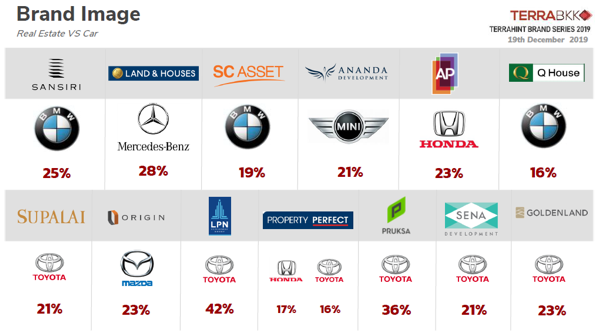
2019
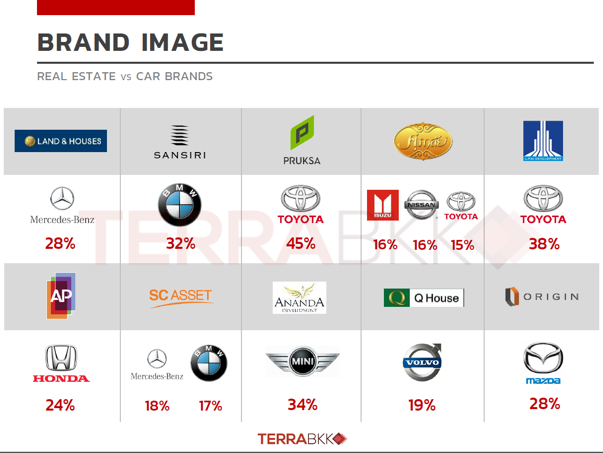
2018
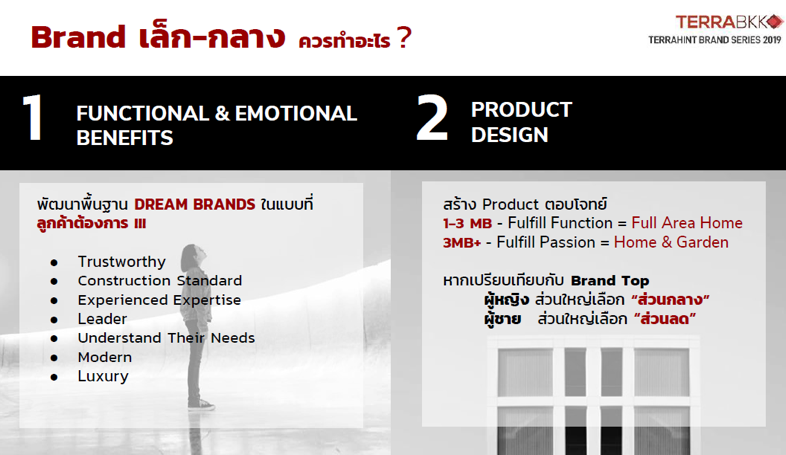
4 Solutions for Small-Medium Brands
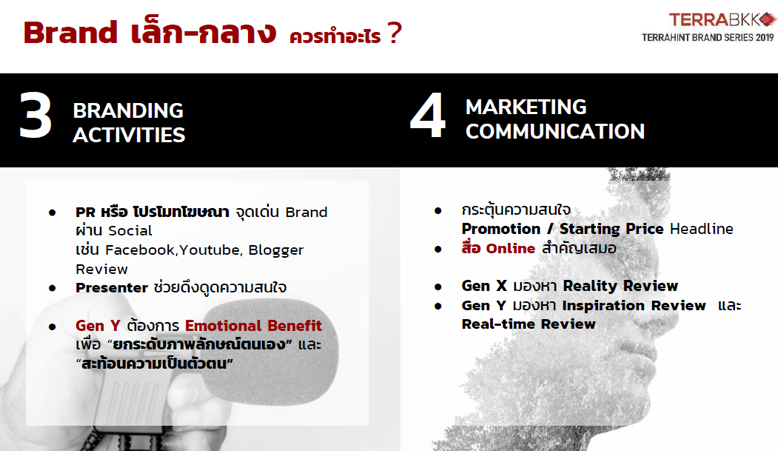
After a lengthy discussion filled with large brands, smaller brands may feel disheartened. However, don't lose hope, as there are still paths forward. TerraBKK summarized a checklist for small to medium brands to develop their own brands, divided into four dimensions:
1. Functional & Emotional Benefits: Develop the foundational dream brand that meets customer desires.
2. Product Design: Create products that meet needs.
3. Brand Activities: Promote brand highlights through social media/use presenters to attract attention.
4. Marketing Communication: Stimulate interest through promotions/use starting prices in headlines.
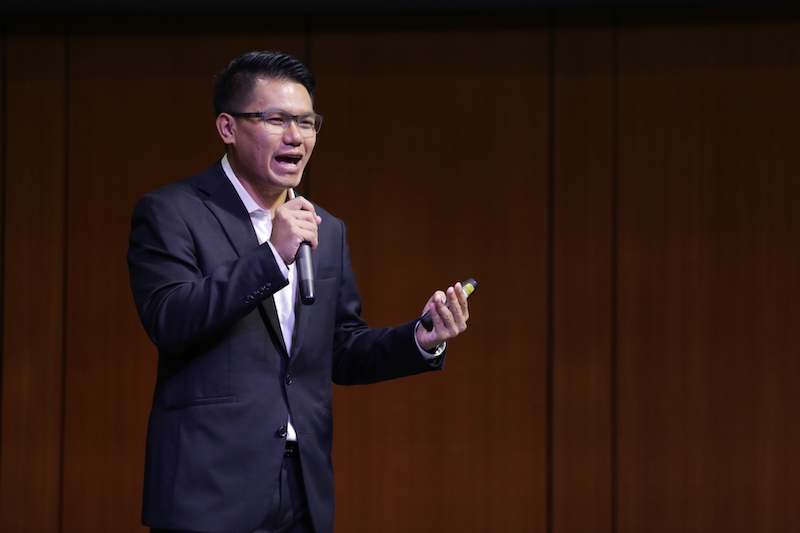
Udomsak Donkhampai Chief Technology Officer of Zanroo CO.,LTD. Powerful Brands Across Generations: "THE POWERFUL BRANDS FROM EACH GENERATION"
Once we understand buyer behaviors, the next step is to communicate effectively with each generation. We were honored to have Udomsak Donkhampai, Chief Technology Officer of Zanroo CO.,LTD., a marketing research expert specializing in Social Listening, share principles for online marketing tailored to each generation. This information is applicable not only in real estate but can be adapted for all products worldwide.
“Why should we focus on 5 generations for marketing? Because each generation has different needs and media consumption behaviors. Understanding these behaviors allows us to design campaigns that effectively reach target audiences. Today's marketing is not just about shooting ads; the key to marketing lies in the campaign itself.”
“In the past, we were accustomed to shooting ads for engagement, which didn't yield real purchasing results. However, abroad, the mindset has shifted to measuring results based on conversion, using data to redesign and adjust campaigns to better fit target audience behaviors. The focus is on behavior as a foundation for crafting the right campaigns.”
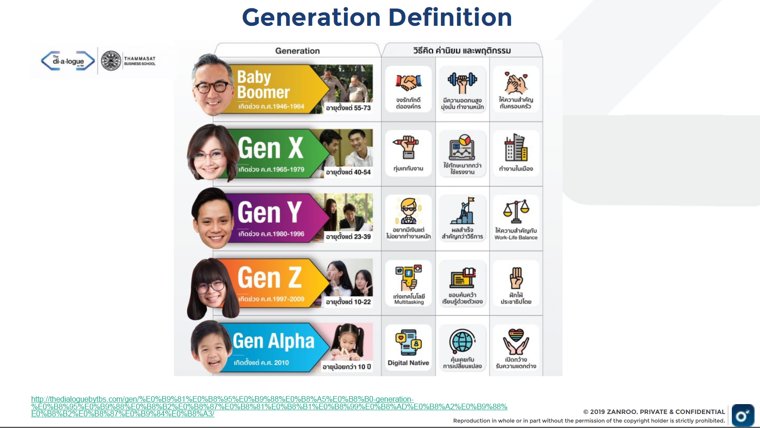
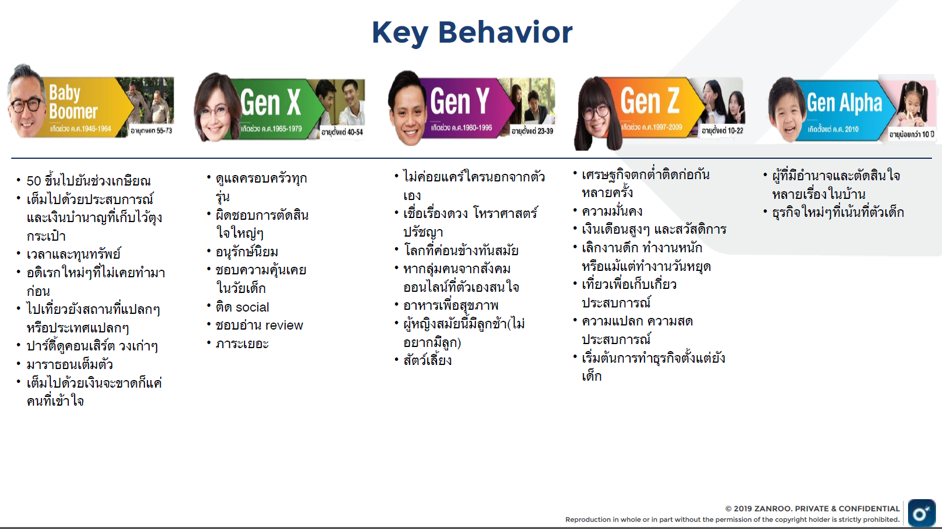
Based on the lifestyle and behaviors of each generation (as shown in the table above), Udomsak summarized key marketing principles for each age group, effectively condensing global demographics into one place:
- Gen Baby Boom: Age 55 and above
- Avoid slang in communication.
- This group is heavily engaged with Facebook.
- They understand technology.
- 'Price' is the most important factor: This age group is often retired and concerned about pricing when making purchasing decisions.
- They respond best to video media.
- Everything is accessed via mobile screens.
- They prefer to be called 'elderly'.
- Use large buttons and fonts in communication.
- Gen X: Age 40-54
- They research thoroughly before making decisions, requiring ample information to support purchasing choices.
- This group uses the internet for work and business, making email a suitable marketing communication channel.
- They enjoy collecting coupons and are interested in discounts.
- They value privacy, so online communication should mention their real names to make them feel special.
- They exhibit high brand loyalty.
- Gen Y: Age 23-39
- This generation defines itself as 'Gen Me', enjoying participation and wanting to be asked for their opinions on campaigns. They should be engaged in creating change.
- They dislike being kept in the dark.
- Time is everything; thus, online transactions must be immediate—'slow means lost'.
- Gen Z: Age 10-22 (recent graduates)
- Sell experiences, not products: This group cares less about the product itself and more about the experiences it offers. For instance, when selling co-working spaces, it's not just about the functions or the famous coffee served but about the community it fosters for like-minded professionals.
- Their world revolves around video, video, video.
- They are interested in participation and small influencers, making Micro Influencers impactful in their decision-making.
- Gen Alpha: Under 10 years old
- This generation presents significant challenges for marketers.
- They cannot imagine a world without social media.
- While they may not have direct purchasing power, they influence many household decisions, such as where their Gen X or Y parents choose to buy homes, considering environments suitable for their generation.
- YouTubers/Bloggers/Vloggers/E-sports are the media they consume daily.
To maximize the effectiveness of using this information for marketing, a new definition in marketing has emerged: Hyper-Personalization. But what is it?
Hyper-personalization refers to the use of artificial intelligence (AI) and real-time data to deliver relevant product and service information to individual users. In simpler terms, it involves using technology to tailor product information to meet user needs as closely as possible, akin to a more advanced version of micro-lifestyle marketing.
For example, in an online shopping platform, while you are browsing green sneakers, a pop-up advertisement appears offering discounts on those specific green sneakers, ensuring it is a product you are interested in, leading to a purchase.
This marketing approach will become more prevalent and closer to people in the upcoming 5G era. Udomsak further revealed that for effective Hyper-personalization, marketers need to understand that having vast amounts of data is not necessary; preparation is key:
1. Prepare appropriate data.
2. Prepare diverse offers.
3. Present the right content through the right channels at the right time.
4. Analyze results to adjust campaigns or offers for your business.
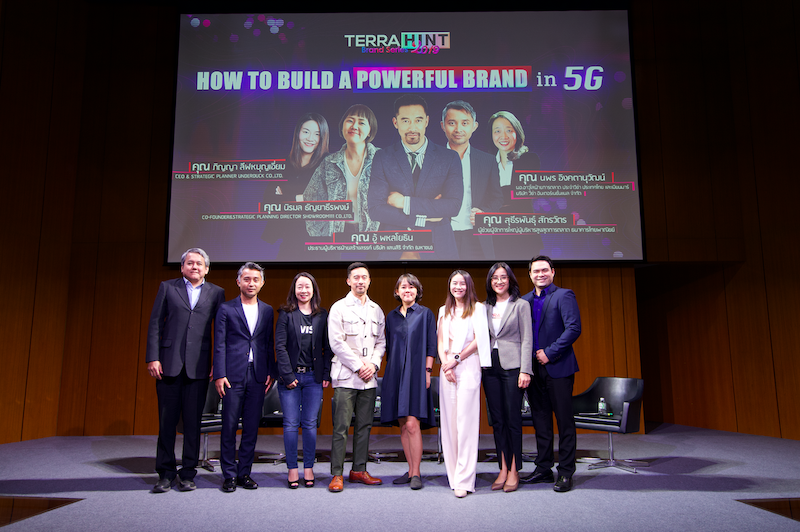
GROUP TALK “HOW TO BUILD A POWERFUL BRAND IN 5G” hosted by Atichart Wongwuthiwat, TV host of TNN24
The seminar concluded with a GROUP TALK featuring five experts from various fields involved in brand creation, sharing ideas and perspectives on building brands in the 5G era. TerraBKK highlighted key takeaways to remember.
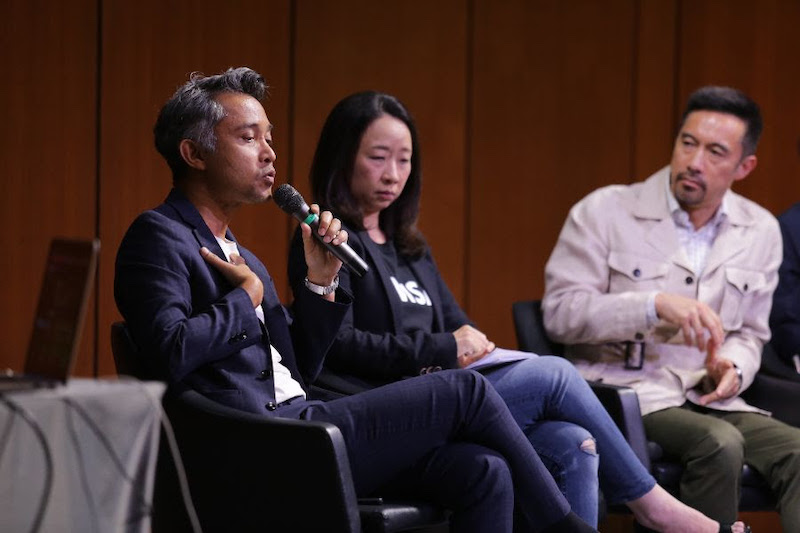
Suthep Sakkrawat, Senior Executive Vice President of Marketing at Siam Commercial Bank
He painted a picture of the 5G world and how much it will leap forward, and how organizations and brand creators should prepare.
“The 5G system will significantly influence products in terms of data management and real-time accounting systems. In the future, all devices will have chips, and the 5G system will assist in monitoring and collecting data from devices. Everything will be controllable via remote or mobile, similar to how we order taxis through our phones. It sounds like science fiction, but it's coming faster than we think.”
“Branding today is no longer in the hands of the owners; the direction is determined by the customers. Today, customers want brands that resonate with them and speak their language. Chatbots are increasingly playing a role in online transactions, meaning brands are no longer just logos or identities but must communicate in dialogue and the same language as their customers.”
“For example, SCB in the past did not have the data collection capabilities we have today, so we lacked insights into our customers. With digital data systems, we learned about customer spending behaviors. SCB has 12 product groups and 12 customer segments, so we must adapt our communication to 12 different languages to offer tailored solutions based on the digital data we collect or provide credit limits that match customer groups.”

Pinnya Likhapoon, CEO & Strategic Planner of UNDERDUCK CO.,LTD.
“Brand building is becoming increasingly important. In the past, people bought based on functionality and quality guarantees, but as the target audience gets younger, they make purchasing decisions more based on emotions and passions.”
“Building a brand is about creating a relationship between the brand and customers over time. What we need to do is listen to and understand our target audience. There is no longer a one-size-fits-all content approach; we must adapt content to different platforms and target groups.”
“Today, we have machine learning technology that can understand human emotions, helping to answer questions on online platforms and apply it in various formats. However, it may not be very creative, but at least it helps meet customer objectives better.”
“Do not cling to past successes; for instance, the real estate business may focus on selling functional aspects, but the emotional aspects are what drive purchases. For example, Sansiri creates communal spaces for residents to use as co-working spaces to showcase their products, which helps them grow their businesses. This shows that Sansiri understands and listens to their target audience's needs, focusing not just on selling functions but highlighting the experiences they will gain.”

Niramol Thanyathiraphong, Co-founder & Strategic Planning Director of Showroom111 CO.,LTD.
“Every brand must answer the question of its purpose: Why does our brand exist in this world? Answering this question will clarify the brand's direction before developing strategies. For instance, Brand A aims to elevate quality of life, while Brand B merely wants to provide first homes for residents. Just these two brands already indicate where we can position them and the direction for strategy development.”
“In this era, branding must start with self-reflection and then look at the customer: Who is our customer? Both points must progress together. We must view this realistically, not just from our perspective. Often, we tend to see things through our own understanding. We must accept changes based on reality. For example, when we established our brand, we had strategies to go in one direction without considering that our customers might be heading in another direction. This means we must adapt to changes more effectively.”
“Data-Driven Content is something that will never die. If you have a brand, you must have content because it is what we use to communicate with customers. We are often asked what content to create, and we must reflect on what customers want. The principle of content creation often starts with 'what' but we should first answer 'why'. Good content leads to action, creating impressions and purchases.”
Nopparat Ingtanawut, Senior Marketing Director at Visa Thailand and Myanmar, Visa International.
He discussed the new era of brand building, emphasizing the need to shift mindsets from the past and view everything as a collaboration, sharing Visa's experience in leveraging vast data into smart marketing strategies.
“We do not see anyone as a competitor but view it as collaboration. Today, everything is paid through digital payments, which must go through Visa, whether it’s Netflix or Sportify. We see these brands as partners in growth.”
“Today, Visa does not see itself merely as a credit card but as a payment network. In one second, we conduct over 1,700 transactions. Visa sees transactions from every bank and every Visa user worldwide. The question is how we can utilize this data effectively. Thus, we believe that the rare profession is that of a Data Scientist.”
For example, we have analyzed spending data showing that Thais travel more than five times a year, with Japan being a popular destination. There are expectation moments in travel, but the memorable moments are often the unexpected ones, such as losing a wallet with no cash on hand. Visa steps in to assist in these situations, leading to the creation of memorable advertising campaigns lasting over 13 minutes, as it would be boring to simply state that Visa can be used anywhere in the world.

Noppadol Phaholyothin, the first Chief Creative Officer of Sansiri Public Company Limited, as a representative of the award-winning real estate brand of 2019.
“Sansiri has been building its brand for over 35 years. I have only been here for 2 years, helping to enhance its image. The challenge is that Sansiri has various brand segments. How do we communicate and present the image to each target group without causing confusion? For instance, the launch of the Sansiri Luxury Collection clarifies the top line of Sansiri, ensuring that customers purchasing this product line do not feel like they are buying D-Condo.”
“The approach Sansiri uses is to create exclusive experiences and collaborations. For example, traditional co-working spaces may no longer meet needs, but adding co-working areas where residents can take photos and set up lighting like a small studio caters to online sellers. This provides an enhanced experience. Additionally, designing communal areas with master chefs or spaces for residents to host personal galleries are functions developed from understanding what our target audience desires.”
Even collaborations between Sansiri and The Coffee Club aim to elevate niche markets, leading to the creation of Siri House, a social club for music, art, culture, and food lovers, located in a preserved historic house on Soi Somkid. All these initiatives are creative efforts to provide experiences rooted in a genuine understanding of the target audience.
With the wealth of content and diverse ideas packed into that day, it is believed that this information will serve as excellent preparation for the challenges of 2020. Terra HINT BRAND Series is committed to continuously curating valuable insights to help businesses thrive in future opportunities.
TERRABKK
Article by TERRABKK
TERRA HINT
HOW TO BUILD A POWERFUL BRAND IN 5G