"Dividend Stocks" Better than "Non-Dividend Stocks"?
Article by Dr. Tanapoom Damraks, CFA.
However, investing in dividend stocks has its advantages and precautions as follows:
Advantages
- Companies that pay dividends are often profitable and have positive cash flow.
- Companies that consistently pay dividends, especially those that increase their dividends over time, tend to demonstrate strength and stability.
Precautions include whether a high dividend yield can be sustained in the long term, which can be observed from:
- If the company has consistent profits that are not overly volatile.
- If the dividend payout ratio is low compared to net profits, meaning that even after paying dividends, there is still a portion left that can be retained for shareholders or reinvested for business expansion. This remaining cash allows the company to maintain dividend payments even if profits occasionally decline.
- If the company has a strong balance sheet, with low debt-to-equity or debt-to-income ratios, and ample cash, ensuring high liquidity for dividend payments.
- If the company does not have plans for large investments requiring significant funds in the near future.
If a company possesses these four characteristics, it is likely to maintain its dividend payments.
Does this mean that a company without a dividend policy is a bad company?
The answer is that it depends on what the company does with the retained earnings that are not paid out as dividends.
There are many leading global companies that have never paid dividends, such as Google. In fact, receiving dividends has its downsides, as investors must pay personal income tax in addition to the corporate income tax that the company pays on its annual profits.
Therefore, if a company retains earnings instead of paying dividends and invests them in projects that yield returns, it can increase shareholder wealth. For example, if Company A and Company B both have post-tax profits of 100 baht, Company A decides to pay out all 100 baht as dividends. Assuming shareholders of Company A face a 20% income tax, they will have 80 baht left. If they deposit that money in a bank at a 3% interest rate, after one year, they will have 82.40 baht. Meanwhile, Company B does not pay dividends but reinvests the 100 baht. Assuming Company B achieves a 20% return on equity, in the following year, the company will have 120 baht, and shareholders will not have to pay personal income tax as long as the company does not distribute dividends. This shows that shareholders of Company B will be wealthier than those of Company A, provided that the management of Company B can find investment opportunities yielding a 20% annual return, which exceeds bank deposit interest (not accounting for taxes).
In summary, in cases where a company does not pay dividends, investors benefit only if management can reinvest profits to achieve high returns. This can be observed through the return on equity (ROE) or return on invested capital (ROIC). If these values are high, it indicates management's ability to identify good investment opportunities. Additionally, we must trust that management is honest and will not misuse company funds for personal gain or invest in projects that do not yield long-term returns for shareholders. If we lack confidence in these aspects, dividend-paying companies may be a better choice.
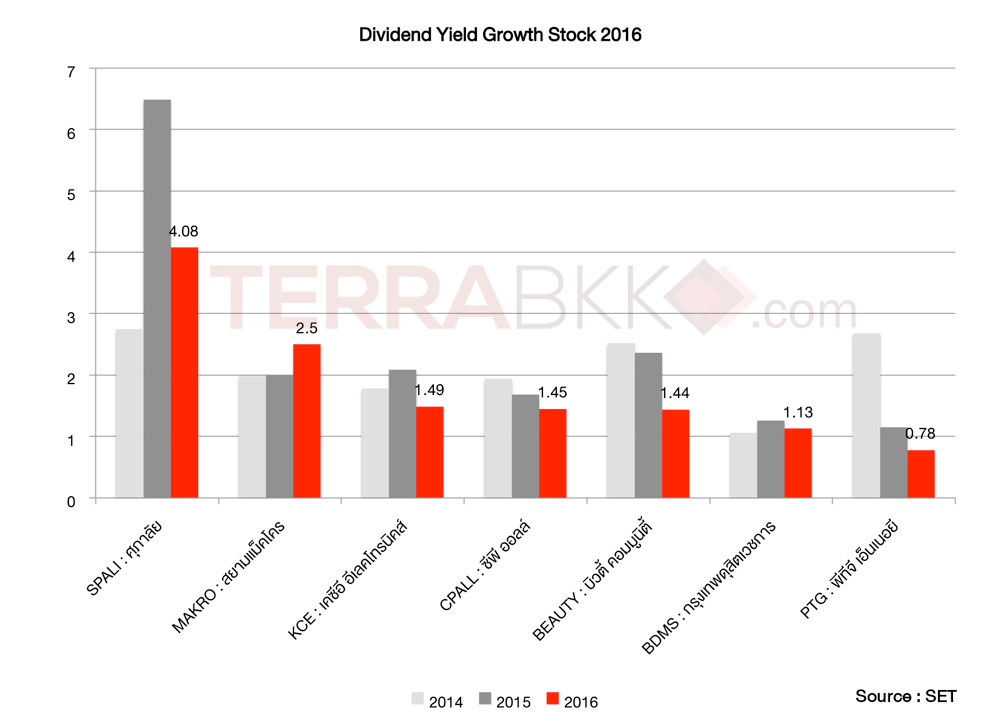
TerraBKK Research has compiled data on the highest dividend-paying companies over the past three years, but TerraBKK does not guarantee that these will provide good returns or continue to pay high dividends in the future. As of August 25, 2016, there are a total of 10 companies as follows:

Another group consists of companies with relatively high revenue growth (Growth Stocks), but they tend to pay relatively low dividends - เทอร์ร่า บีเคเค

Dr. Tanapoom Damraks, CFA.
Thanks for the information from Dr. Tanapoom Damraks, CFA. Email: [email protected] Article by TerraBKK, a knowledge repository for investment and wealth enhancement. Find good, valuable, and affordable homes.