40 Years of Thai Real Estate: What Have We Encountered? Predictions for the Future: Dr. Narongchai Akraseranee at Property Hack 2025
In an era where the global economy faces uncertainties from trade wars, energy crises, and shifts in the world order, the Thai real estate sector has inevitably been affected. At the "Property Hack 2025: Real Estate in the Era of Earthquakes - Deep Insights, Quick Adjustments, Ready to Handle Every Shock", a collaboration between the Thai Real Estate Association, the Nonthaburi Real Estate Trade Association, and Terra Media and Consulting Co., Ltd., a platform was created to present new perspectives and share in-depth information for real estate developers to adapt their businesses in a time of sudden changes in buyer behavior and market conditions.
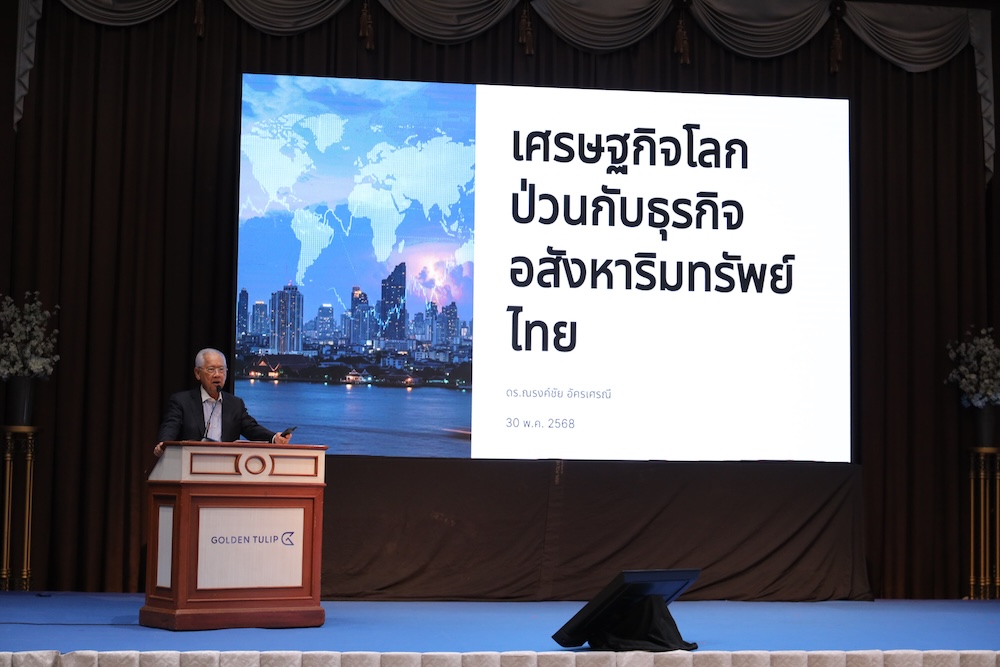
Among the various topics discussed, the session titled “The Turbulent Global Economy: Insights into Real Estate in the Era of Earthquakes” provided a broader view of the Thai real estate market. The lecture was honored to feature Dr. Narongchai Akraseranee, former Minister of Commerce and Energy and President of Khon Kaen University, who connected the dots between the global economy and the Thai real estate market, offering intriguing insights into economic factors affecting the Thai real estate business, enabling developers to analyze and predict changes in the sector.

Overview of Factors Driving the Real Estate Business
Dr. Narongchai began by outlining that the economics of real estate is driven by demand and supply, similar to other businesses. The demand factors in the real estate market are primarily based on three main aspects: 1. The need for housing, workspace, and amenities; 2. Investment opportunities from rental income and long-term value appreciation; 3. Real demand stemming from income, such as access to credit and consumers' financial stability.
The supply factors can be divided into four main categories: 1. The cost and liquidity of capital, which impact project development; 2. Land, as a limited resource, affects the quantity of real estate available in the market; 3. Skilled professionals and labor costs in the real estate industry; 4. Regulations and standards that influence the development process.
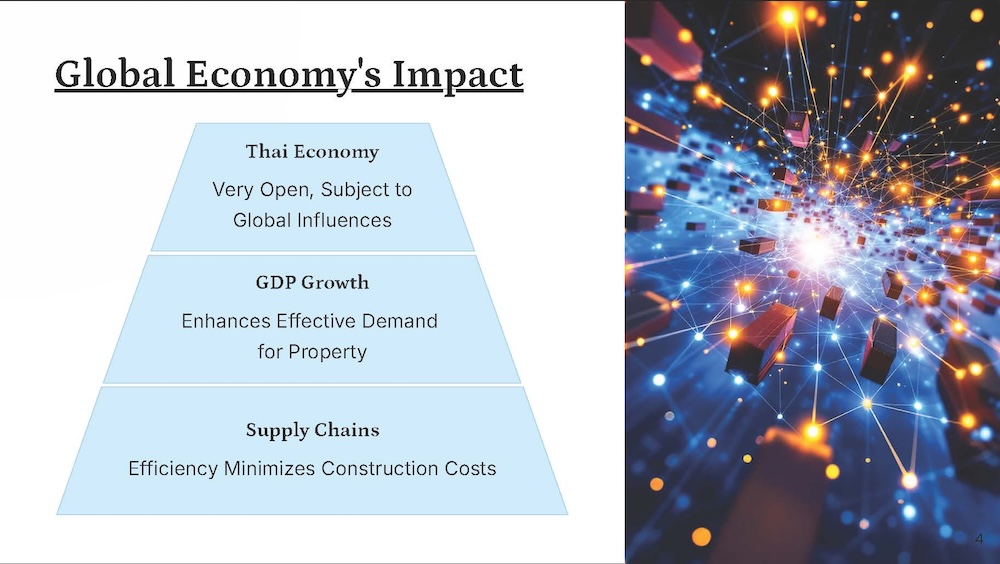
“The global economy significantly impacts the Thai economy, as Thailand is an open economy highly influenced by external factors, affecting GDP growth and the increase in real demand for real estate. Meanwhile, the efficiency of the supply chain helps reduce construction costs,” Dr. Narongchai added.
Waves Affecting the Thai Economy and Real Estate
Over the past four decades, global standards, regulations, and policies have undergone significant changes at various times, directly impacting the Thai economy and the real estate business. In summary, the period from 1946 to 2000 was the golden age of the world order, characterized by a focus on liberalism, democracy, and human rights, leading to economic liberalization that connected and unified the global market, driven by international institutions and laws. This world order benefited trade and investment globally, including significant growth in Asia over the past 40-50 years, with the Thai economy growing from exports and foreign direct investment (FDI), which directly impacted the real estate sector.
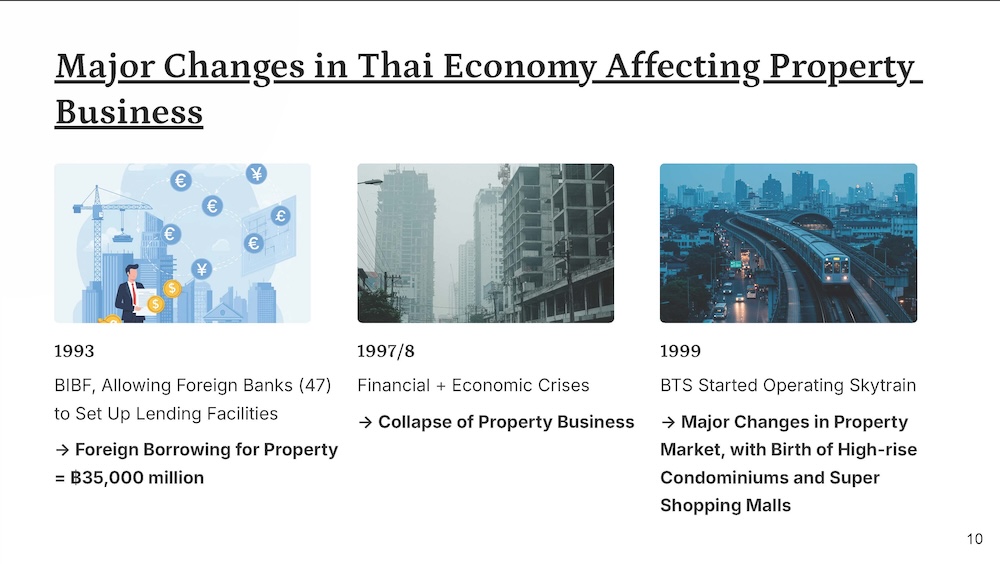
A Retrospective on the Thai Economy and Real Estate: From the Golden Age to the Adaptation Era
The global order and changes in the Thai economy that have had a significant impact on the real estate sector can be divided into four major eras.
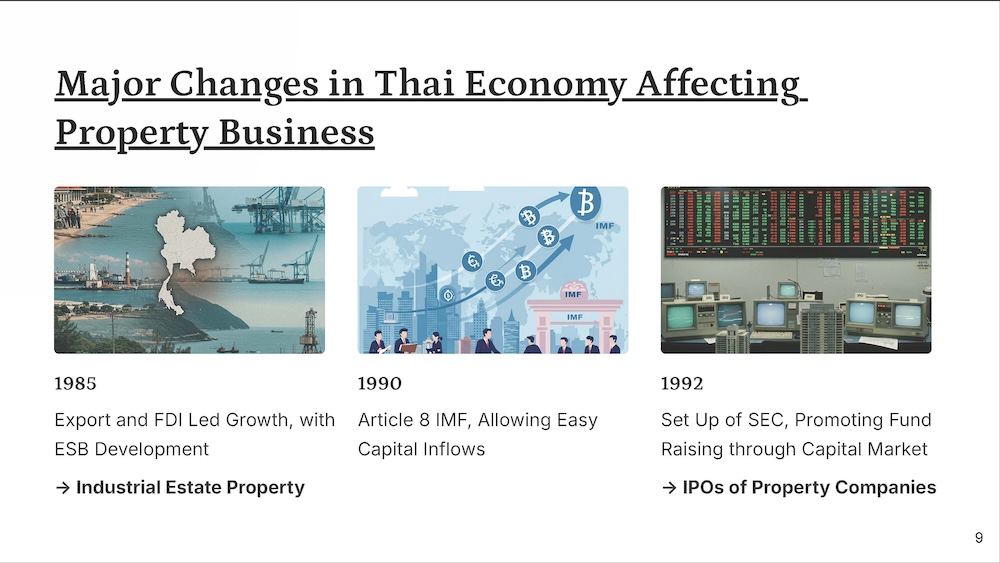
(1) The Golden Age of Real Estate (1985-1996): The growth of foreign direct investment (FDI) and exports led to increased demand for real estate in industrial estates. Financial liberalization allowed real estate companies to borrow more from foreign sources, which ultimately contributed to the 1997 Tom Yum Goong crisis. Key events during this period include:
- 1985-1990: Growth in exports and FDI, facilitated by IMF agreements allowing easy capital inflows, leading to real estate development in industrial estates.
- 1992: The establishment of the SEC in Thailand to promote fundraising through the capital market, leading to more real estate companies raising funds from external sources.
- 1993: The launch of BIBF (Bangkok International Banking Facilities), allowing foreign banks to establish funding sources for loans, resulting in increased foreign borrowing for real estate.
(2) The Tom Yum Goong Crisis (1997-1998): The financial and economic crisis led to a historic collapse of the real estate business, marked by the bursting of the real estate bubble, resulting in numerous unfinished projects and bankruptcies due to excessive reliance on foreign loans.
- 1999: The introduction of a new transportation system, with BTS starting its electric train service, marking a significant turning point in the real estate market, leading to the rise of high-rise condominiums and large shopping centers benefiting from proximity to the train lines.
(3) The Recovery and Transformation Era (2001-2015): The influx of Chinese investors dramatically increased demand for real estate for tourism and commercial purposes.
- 2001: Economic recovery, debt repayments, and the emergence of real estate funds, along with the issuance of long-term bonds supported by TRIS Rating, coinciding with the global security challenges posed by the 9/11 events.
- 2008-2009: The financial crisis in the U.S. and Europe led to high interest rates and liquidity shortages.
- 2015: The arrival of Chinese tourists and real estate investors led to increased investments in hotels and shopping centers.
- 2016-2017: AI became a crucial topic for business transformation.
- 2017: The “America First” policy during President Trump’s administration led to global changes.
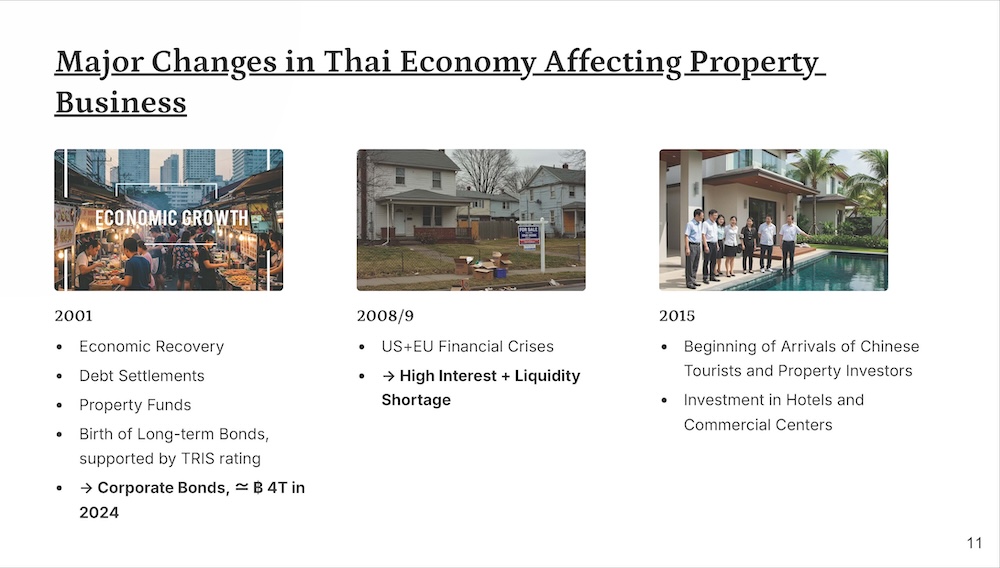
(4) The COVID-19 Era and Uncertainty (2020-2025): The COVID-19 pandemic caused the real estate market to slow down due to lockdown measures and decreased consumer confidence.
- 2022: The Russian invasion of Ukraine violated principles of sovereignty.
- 2025: The potential return of Trump may lead to changes in the world order, and the earthquake in central Bangkok on March 28 increased consumer focus on building safety.
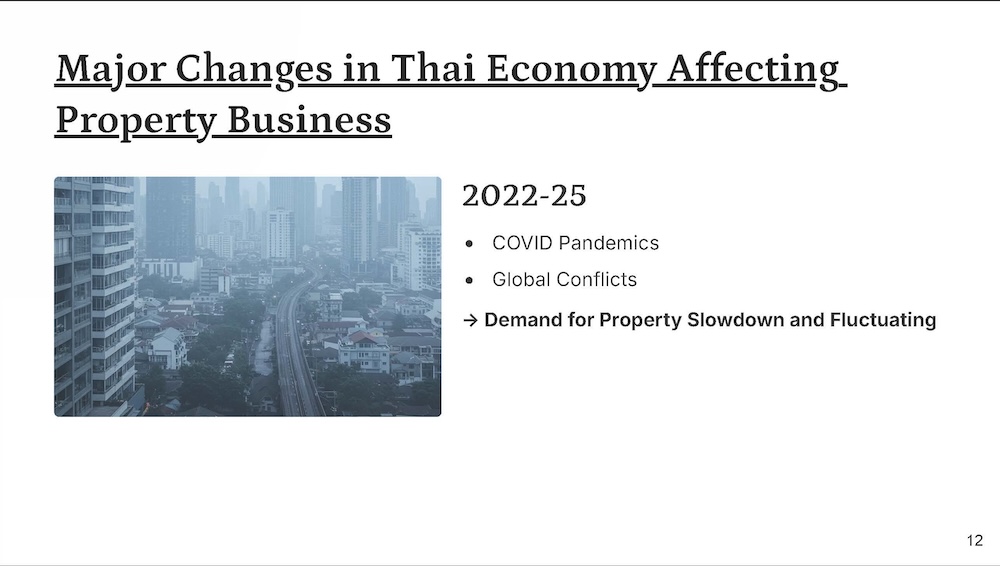
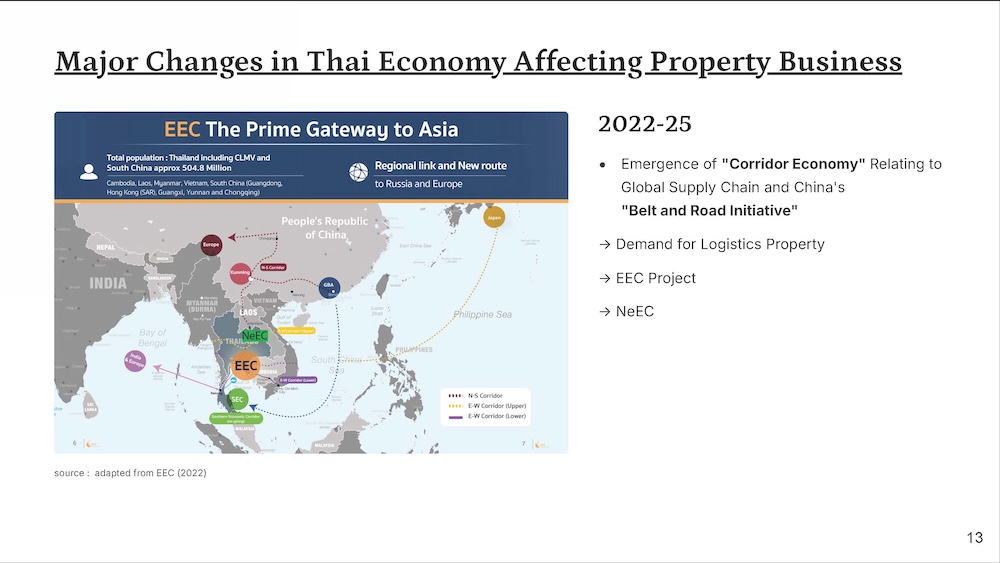
These events have led to a downward trend in GDP and increased uncertainty, causing financial volatility such as interest rates, exchange rate costs, and capital availability, particularly during the 2022-2025 period marked by the COVID-19 pandemic and global conflicts, which slowed and fluctuated real estate demand.
However, there are still positive signs for the Thai real estate sector from projects like the "Economic Corridor" and China's "Belt and Road Initiative," which have spurred demand for logistics real estate and economic connectivity through free trade, as well as the EEC (Eastern Economic Corridor) and NeEC (Northern Economic Corridor) projects that will create new pathways connecting northeastern Thailand to Laos and China, stimulating investments in related businesses such as data centers, convention centers, warehouses, and logistics-related enterprises, which will impact housing demand and the entire supply chain in the area.
In the future, the real estate business will continue to face economic challenges, and businesses must adapt to the uncertainties of the world. Understanding these factors will help Thai operators and real estate developers effectively anticipate and adjust to market changes in the near future.