Where Does Thailand Stand as Global High Net Worth Individuals (HNWIs) Move?
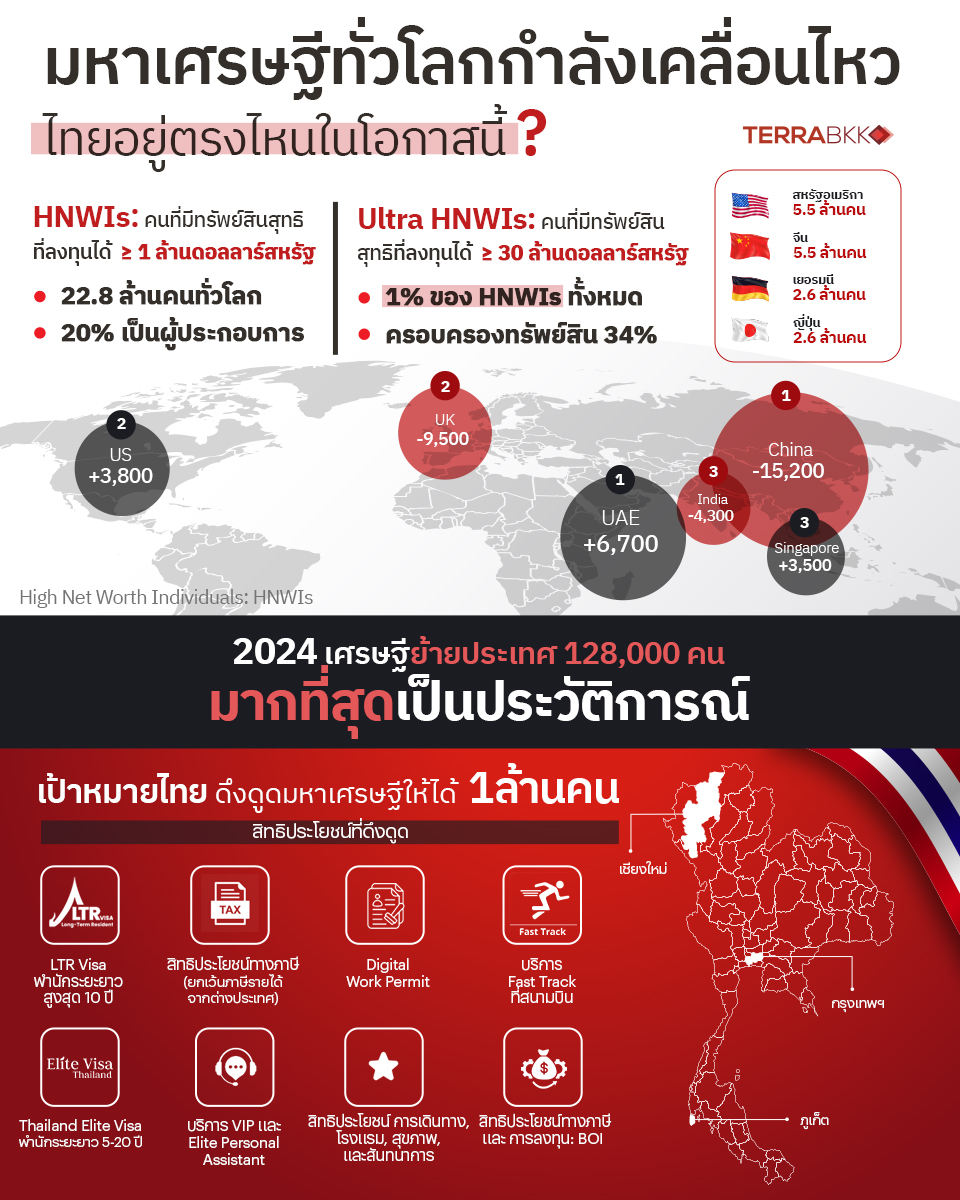
In an era of rapid global economic change and increasing political and social uncertainty, High Net Worth Individuals (HNWIs) have become a crucial group influencing investment and economic development worldwide. HNWIs not only possess a minimum net worth of $1 million but also play a significant role in job creation, investing in new businesses, and driving economic innovation. According to a recent report by Henley & Partners, it is projected that in 2024, there will be a record migration of 128,000 HNWIs globally.
Moreover, countries are intensifying their policies and measures to attract HNWIs, particularly in Asia and the Middle East, where there are tax benefits and modern infrastructure. Meanwhile, some countries that were once primary destinations for the wealthy, such as China and the United Kingdom, are facing trends of HNWI outflow due to economic and political reasons. Thailand is also making efforts to adapt with various policies aimed at attracting investors and wealthy individuals to bolster the domestic economy.

How Wealthy Do You Have to Be to Be Considered an HNWI?
High Net Worth Individuals are defined as individuals with investable assets starting from $1 million. Within this group, there are Ultra HNWIs, who typically have average asset values in the tens of millions of dollars. The growth of HNWIs over the past decade has been fueled by global economic growth, capital market expansion, and technological innovations that have increased the overall asset values of this group.
According to a recent report by Capgemini, the number of HNWIs worldwide in 2023 was approximately 22.8 million, marking continuous growth compared to the past decade. Among the highest wealth segment of HNWIs, Ultra HNWIs, who have investable assets of $30 million or more, make up about 1% of the total HNWI population but hold over 34% of the total wealth of HNWIs. Additionally, around 20% of HNWIs are entrepreneurs, and in the high-asset segment (such as centi-millionaires and billionaires), this ratio rises to 60%, reflecting the significant role of the wealthy in driving the global economy.
How Many Wealthy Individuals Are There in Each Country?
Reports such as Henley Private Wealth Migration Report 2024 and data from Capgemini show a clear distribution of HNWIs across regions. The countries with the highest number of HNWIs include:
- United States: The U.S. has the highest number of HNWIs in the world, with approximately 5.5 million individuals. On average, HNWIs in the U.S. have assets ranging from $1 to $5 million per person. The U.S. accounts for about 20-25% of the total HNWI population globally.
- China: China also has around 5.5 million HNWIs. Although the number is lower than that of the U.S., the rapid growth of the Chinese economy has significantly increased the average asset value in this group. However, there are risks related to policy and economic changes. China is considered a high-potential market for HNWI growth but faces challenges from domestic policies.
- Germany: Germany has about 2.6 million HNWIs, with stable asset values averaging around $1 to $5 million per person. Germany is a stable economic center in Europe.
- Japan: Japan also has approximately 2.6 million HNWIs, with average asset values around $1 to $5 million per person. Wealth distribution in Japan is concentrated in certain business sectors and technology.
The asset values of HNWIs in each country not only reflect the number of individuals but also indicate the quality of the economy in each nation. In countries with strong economies, HNWIs tend to have higher average assets. For instance, in the U.S., most HNWIs invest in the stock market, real estate, and high-tech businesses, which enhance the overall asset values. In contrast, while China has experienced rapid growth, policy uncertainty and risks from state intervention may impact the asset values in this group.
When Wealth is Flowing Out of Countries
In recent years, there has been a noticeable trend of HNWIs relocating, particularly in the context of economic and political uncertainty in certain countries such as China, India, and the United Kingdom, which have recorded high outflow numbers. It is projected that in 2024, 128,000 wealthy individuals will migrate globally, breaking the previous record of 120,000 in 2023. Meanwhile, countries with stable economies and politics, such as the United Arab Emirates, the United States, and Singapore, have become attractive destinations for HNWIs from other nations.
Specific Factors Making Some Countries “Attractive Lands”
- United Arab Emirates (UAE): The UAE has become the top destination for wealthy migrants, with a projected net inflow of about 6,700 HNWIs in 2024 due to no personal income tax, golden visas, a luxurious lifestyle, and a strategic location.
- United States: The U.S. is expected to attract a net inflow of 3,800 HNWIs in 2024 due to its large and stable capital market, clear legal system, and property protections.
- Singapore: Singapore is projected to have a net inflow of 3,500 HNWIs in 2024, being a major financial and trading hub with a safe, stable environment and clear regulations.
- Australia: Australia is expected to see a net inflow of 2,500 HNWIs in 2024 due to its political and economic stability, high quality of life, and investor-friendly environment.
Analysis of trends from the Henley Private Wealth Migration Report 2024 indicates that countries with the highest inflow of HNWIs typically have clear attractive factors, including economic stability, reliable legal systems, and favorable tax policies.
Push Factors
- Political Uncertainty: For example, in China, policy pushes may lead entrepreneurs and investors to seek more stable markets. In the UK, changes in tax policy may prompt many wealthy individuals to migrate to countries with more favorable tax and policy environments.
- High Taxes and Investment Restrictions: Countries with high taxes or investment restrictions can push HNWIs to seek better business environments. For instance, changes in tax policy in some European countries have led the wealthy to consider markets with lower taxes.
- Economic Instability: Economic crises in certain regions, such as public debt issues and stock market volatility, lead HNWIs to seek refuge in more stable environments.
Pull Factors
- Business-Friendly Investment Environment: Countries with transparent legal systems and strong property protections, such as the U.S. and Switzerland, instill confidence in HNWIs to invest and conduct business.
- Friendly Tax Policies: For example, certain U.S. states and Australia have flexible tax management, allowing the wealthy to reduce tax burdens and increase investment returns.
- Quality of Life and Safety: Countries with modern infrastructure and high safety levels, such as Switzerland and Singapore, attract HNWIs seeking comfort in daily life.
- Opportunities for Business Expansion in Potential Markets: Rapidly growing markets in the Asia-Pacific region attract HNWIs looking to expand their businesses into new markets.
For instance, in the UK, high inheritance taxes and complex tax laws have led many wealthy individuals to consider countries with more favorable tax policies, such as Switzerland or Australia, both of which offer transparent management systems and better tax benefits.
What Opportunities Does Thailand Have in This Situation?
Although Thailand is not currently a primary destination for HNWIs according to the Henley Private Wealth Migration Report 2024, the country has several advantages that can attract wealthy individuals and high-level investors:
- Geographical Location: Thailand is located at the center of Southeast Asia, providing good connectivity to neighboring countries and high-potential markets such as Indonesia, Malaysia, and Vietnam.
- Diverse Quality of Life: With its unique culture, famous cuisine, and warm environment, Thailand is popular among those seeking a good quality of life at reasonable prices. Major cities like Bangkok, along with world-class tourist destinations like Phuket and Chiang Mai, have the potential to be residence hubs for HNWIs looking for a balance between work and leisure.
- Modern Infrastructure: Investments in transportation, communication, and information technology infrastructure have been continuously developed in recent years. Airport development projects and urban rail systems enhance reliability and convenience for domestic travel.
- Government Policies Promoting Investment: The Thai government has implemented measures and policies to attract foreign investors, especially among HNWIs, through the Long-Term Resident Visa (LTR) program and the Thailand Elite Visa program. These policies feature tax benefits, streamlined processes, and one-stop services to facilitate visa and investment management (BOI Thailand).
Since the launch of the LTR and Thailand Elite programs in 2022, there has been interest from high-level investors both regionally and internationally. Although there are no clear figures on how many HNWIs these programs can attract, experts predict that in the next 3-5 years, Thailand could increase the number of HNWIs by 5-10% compared to the original number. Additionally, high-potential areas for HNWI settlement include Bangkok, Phuket, and Chiang Mai due to their good infrastructure, high quality of life, and business-friendly environments.
Compared to regional countries like Singapore or Dubai, which are primary destinations for HNWIs, Thailand has advantages in terms of lower living costs and unique culture. However, Thailand still needs to develop higher quality safety measures and public services to compete with premium-demand markets.
Key Policies and Support Measures for Foreign Wealthy Individuals in Thailand
The Thai government has begun implementing policies aimed at attracting foreign investors and HNWIs across various sectors. These policies are designed to reduce tax and legal barriers and provide comprehensive services in the immigration and settlement processes.
- Long-Term Resident Visa (LTR): Launched in 2022, this program offers long-term residency privileges to foreign nationals with investment potential. Benefits include work permits in Thailand, competitive tax rates, and ease of travel in and out of the country. The eligibility criteria have been made more accessible by removing income requirements for the "Wealthy Global Citizens" group and reducing income requirements for foreign companies in the "Work-from-Thailand Professionals" group.
- Thailand Elite Visa: This is another measure that enhances Thailand's image as a destination for high-net-worth individuals, providing VIP services through visa management and personalized services for maximum comfort for residents.
- Tax Benefits and Investment Support: The government has policies to exempt taxes on foreign income in certain cases and offers tax rates optimized to attract investors. Investment support through the BOI facilitates quick and efficient approval processes and access to various benefits.
According to the BOI and the Henley Private Wealth Migration Report 2024, Thailand has the potential to significantly increase the number of HNWIs in the coming years. The launch of the long-term visa policy in 2022 has led to predictions that by 2025-2026, Thailand could increase its foreign investor base by 5-10% compared to the original base. These policies also help diversify economic risks from reliance on the domestic market and expand growth opportunities in premium investment-related sectors.
Thailand's Ability to Attract Wealth
The trend of HNWI migration continues to be a topic of interest for both investors and policymakers worldwide. Influencing factors include economic uncertainty, tax policy changes, and risks from political situations in various countries.
Countries with economic and political stability, such as the United Arab Emirates, the United States, and Singapore, are expected to remain primary destinations for HNWIs. Meanwhile, countries facing internal issues, such as China and the United Kingdom, may see higher outflows of HNWIs according to the trends of the Henley Private Wealth Migration Report 2024. Thailand is likely to adapt and enhance its capacity to attract HNWIs more effectively in 2025-2026, with expectations that:
- Policy and Service Improvements: The government will focus on improving visa, tax, and investment support policies to align more closely with international standards, along with developing a One Stop Service Center to enhance speed and convenience for high-level investors.
- Infrastructure Development: Investments in modern transportation and communication systems will help assure HNWIs that Thailand can support premium business operations and living.
- Image Building and Promotion: The public and private sectors will collaborate to promote and build Thailand's image as a "land of opportunity" for investors and HNWIs through seminars and international marketing activities.
- Risk Diversification: In an era of increasing global economic uncertainty, Thailand has the opportunity to become an attractive destination for HNWIs seeking to diversify their investments away from highly volatile markets in other regions.
Trends in 2025-2026 are expected to see an increase in migration to markets with stability and clear benefits. If Thailand can improve its policies and services to be competitive on an international level, investors and HNWIs from around the world may view Thailand as one of the high-potential destinations for investment and settlement.
Looking ahead to 2025-2026, if the Thai government can enhance its policies and services to meet international standards, along with promoting the country's image as a "land of opportunity" for premium investors, Thailand could significantly attract HNWIs to stimulate the economy and investment in the country.
Sources:
- Henley Private Wealth Migration Report 2024
- Capgemini World Wealth Report
- BOI Thailand
- Information on Thailand Elite Visa from Thai Elite