
Housing Market Situation 2023-2024
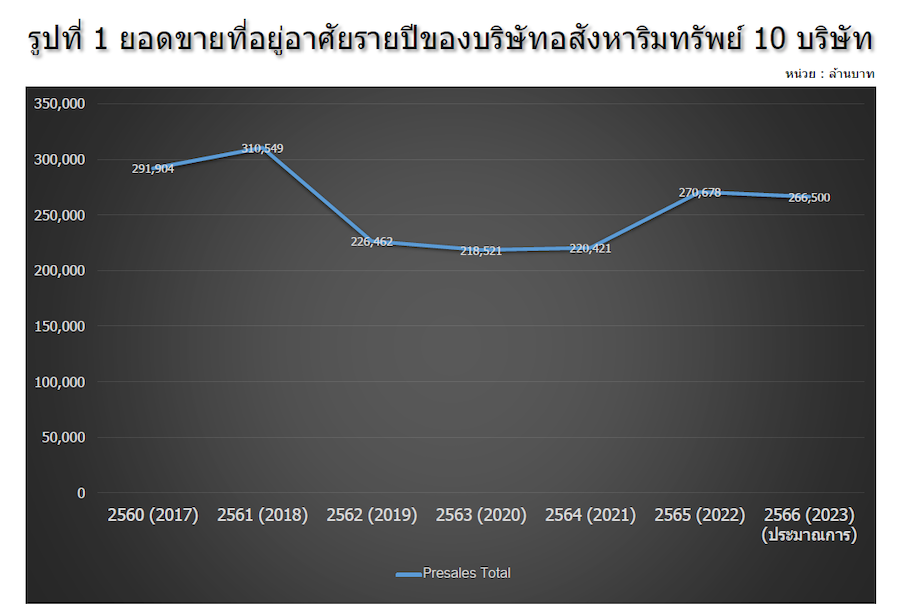
The housing business in 2017-2018 recorded high sales levels of approximately 290,000-310,000 million baht per year. The Bank of Thailand was concerned about a potential severe bubble, leading to the establishment of LTV standards the following year. Consequently, sales in 2019 dropped to around 220,000 million baht. Following that, the COVID-19 pandemic in 2020-2021 caused the number of housing units sold to decrease to 65,000-67,000, down from the usual level of about 100,000 units per year. However, the sales value did not decline and remained at 220,000 million baht, as operators merely reduced the volume of new products entering the market due to the prevailing uncertainties. The sales figures for the housing sector in monetary terms from ten real estate companies are shown in Figure 1.

In 2022, operators returned to full-scale business operations by increasing the volume of new products launched in the market from about 60,000 units in 2021 to 107,000 units in 2022, as shown in Table 1, which outlines the housing sales situation for new launches from 2021 to 2023. The products that saw significant increases included single houses and condominiums, which more than doubled from the previous year. Say's Law in economics re-emerged, stating that supply creates its own demand. When operators increased the volume of products in the market, they had to work hard to sell them, especially condominiums, which had a sales-to-new product ratio as high as 46%. While this was not the highest in history (61% in 2012), it was the highest in nearly a decade. In contrast, the overall sales ratio for the condominium market (including both new and old products) was only 37%.
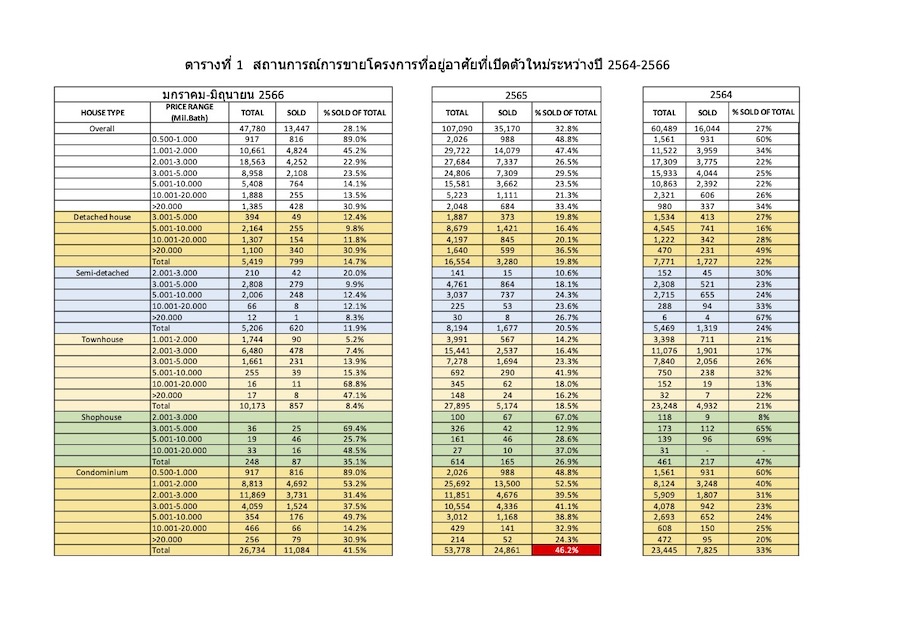
This year, 2023, has shown that the volume of new products in 2022 was excessive. All types of products, except for duplex houses, have seen a significant decrease in new product volumes, particularly single houses and townhouses, which dropped by several tens of percent from 2022. This indicates that the remaining purchasing power is insufficient to absorb the increased volume of new products. The ratio of new products sold to new products launched has clearly decreased across all product types. However, the ratio of new products sold remains equal to or higher than the overall market for each product type, except for townhouses, which is something operators should be cautious about.
Another significant issue in 2023 is that the Bank of Thailand has raised the policy interest rate in line with the U.S. Federal Reserve. Although the increase was only 2.5 percentage points, much lower than the U.S. increase of 5.5 percentage points, a 1 percentage point increase in interest rates has raised monthly installment payments by about 11%. This has negatively impacted purchasing power to some extent.
In 2023, total housing sales are expected to be around 260,000 million baht, indicating that operators are still capable of navigating the significant negative factors mentioned above, including reduced absorption capacity and purchasing power.
The implications of the housing market situation suggest that purchasing power is keeping pace with the volume of new products, which may become a significant problem for operators in 2024. Meanwhile, the economic growth rate expected for 2024, previously projected at 4.5%, is likely to decline due to negative global factors. In reality, this does not significantly impact the Thai economy, but the main negative factors stem from internal issues related to government transition, leading to a lack of continuity in public spending in both consumption and investment. Nevertheless, positive factors in 2024 may arise from consumer purchasing power remaining strong, albeit not as high as in 2022, some investments in the Eastern Economic Corridor (EEC), and, above all, the new government's populist projects that are hoped to yield positive results. Generally, interest rates are likely to decrease in line with global markets, which could be considered a positive factor.
In summary, the purchasing power for housing in 2024 is expected to be no less than 100,000 units, compared to about 94,000 units in 2023. The overall monetary purchasing power is also expected to be similar to that of 2023. However, operators may aim for even better results if they can effectively apply Say's Law again. The essence of Say's Law is to utilize various marketing strategies to attract consumer purchases. Changing product formats is considered crucial.