How STP Marketing Relates to Residential Real Estate (Part 2)
Author: Assistant Professor Dr. Wuthapong Larpjaeroen
Chair of the Master of Science Program in Innovative Real Estate Development
Faculty of Architecture and Planning, Thammasat University
The previous article discussed market segmentation (S) and the levels of market segmentation. This article will continue from the last one. Read the article Part 1
This article will start with the criteria used for market segmentation (Bases for Market Segmentation), focusing on the ultimate consumer market, which refers to those purchasing residences for personal use, also known as Real Demand. It will also explain the targeting of customer groups (Targeting or T) for easier understanding.
There are four criteria used for market segmentation as follows:
1. Demographic Criteria - This refers to general characteristics of the population. Various factors can be used for market segmentation, such as gender, age, income, family life cycle, and household size. Demographic criteria are widely used for market segmentation because they are relatively clear and easy to measure market size.
For residential properties, the commonly used factor for market segmentation is personal monthly income, as it directly affects the loan amount one can apply for to purchase a residence from financial institutions.
For example, the real estate developer AP has segmented the condominium market into four groups based on personal income, as shown in the following image:

Regarding the targeting of customer groups, AP has defined its target customers across all market segments (Full Market Coverage), meaning that AP must have marketing strategies for each of the four segments of the condominium market. For instance, the luxury market (Luxury-Premium) uses the brand name "THE ADDRESS"; the middle-high income market (Middle-High) uses the brand name "RHYTHM"; the standard income market (Standard) uses the brand name "Life"; and the lower-middle income market (Economy) uses the brand name "Aspire."
Another example that uses demographic criteria but segments the market based on gender is Chanya Property Consultant Co., Ltd., which has divided the market into three groups, as shown in the following image:

For targeting, Chanya Property Consultant Co., Ltd. focuses solely on the LGBTQ group, specifically the gay market (Single-Segment Concentration). Therefore, the company can have just one marketing strategy tailored to the needs of this group, such as the "Flower City" project on an 800-rai area in Kanchanaburi, which includes facilities specifically for gay individuals, such as a clubhouse, entertainment venues, and massage services for gay clients.
2. Geographic Criteria - This involves using the location characteristics of a project to segment the market. Some residential property developers, such as AP, have used geographic criteria to segment the townhouse market into three groups, as shown in the following image:

For targeting, AP has defined customer groups for townhouses into three segments, meaning that AP must have at least three marketing strategies to meet the needs of each group. The Best Location group uses the brand name "Bangkok Home"; the Good Location group uses the brand name "City Home"; and the Outer Location group uses the brand name "THE PLENO."
Another example of using geographic criteria is the developer Ananda, which segments the market based on distance from the BTS Skytrain, dividing it into three groups, as shown in the following image:
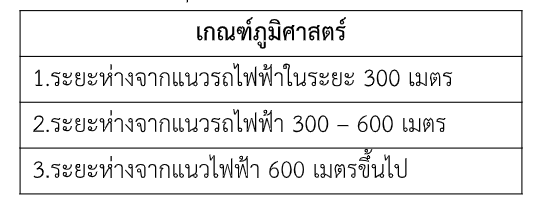
For targeting, Ananda has defined customer groups for all three segments, meaning that Ananda must have at least three marketing strategies to meet the different needs of customers. The group within 300 meters of the BTS uses the brand names "ASHTON," "Ideo," "Ideo Mobi," and "Ideo Q," featuring innovative designs such as loft-style apartments. The group between 300 to 600 meters uses the brand name "ELIO," and the group beyond 600 meters uses the brand name "UNIO," including the development of horizontal residences.
3. Psychographic Criteria - This segments the market based on personality traits, lifestyles, or values. For example, lifestyle factors can be categorized using AIO (A for Activity, I for Interest, and O for Opinion), which can be divided into five types: 1. Cultural Focus, 2. Social Focus, 3. Entertainment Focus, 4. Home and Family Focus, and 5. Sports and Outdoor Activities Focus. Developers often design functional spaces accordingly, such as creating larger multipurpose areas for family activities for the home and family-focused consumer group. However, psychographic criteria are challenging for market segmentation because they are internal factors within consumers, making them difficult to measure and observe.
4. Behavioral Criteria - This segments the market based on consumer knowledge and attitudes toward a product, including product usage characteristics and frequency of use. An example of using behavioral criteria for market segmentation is the COVID-19 pandemic, which led many people to work from home and spend more time at home, avoiding shared spaces. This change in lifestyle prompted many developers targeting this consumer group to create residences with workspaces or incorporate innovations such as touchless systems and home automation.
This article will conclude here, covering market segmentation (S) and targeting (T) comprehensively. The next article will discuss product positioning (P), completing the STP Marketing framework.
For more information on real estate marketing, please refer to the Master Program in Innovative Real Estate Development (MIRED) at the Faculty of Architecture and Planning, Thammasat University (Master's degree program), taught by qualified faculty members. Classes are held on Saturdays at the Rangsit Center, totaling 36 credits. For details, contact the MIRED Hotline at 08-1549-3333, available 24 hours, or [email protected]