5 Steps to Establishing a Digital Twin for Building Management Towards an Autonomous Building Foundation
Today, BIM Technology (Building Information Modeling) is at the core of creating a Digital Twin, serving as a tool for architecture and engineering graduates in design and construction. Soon, building owners and asset managers will receive a “Digital Asset” from contractors, marking the beginning of a Digital Twin that owners can further develop.
As the data owner with the potential to create a Digital Transformation phenomenon for your organization, how will you leverage it? It’s time to embark on your journey towards Digital Twin...
A Digital Asset is essentially a BIM Model. You might wonder, where does this BIM Model come from? This article will answer that question.
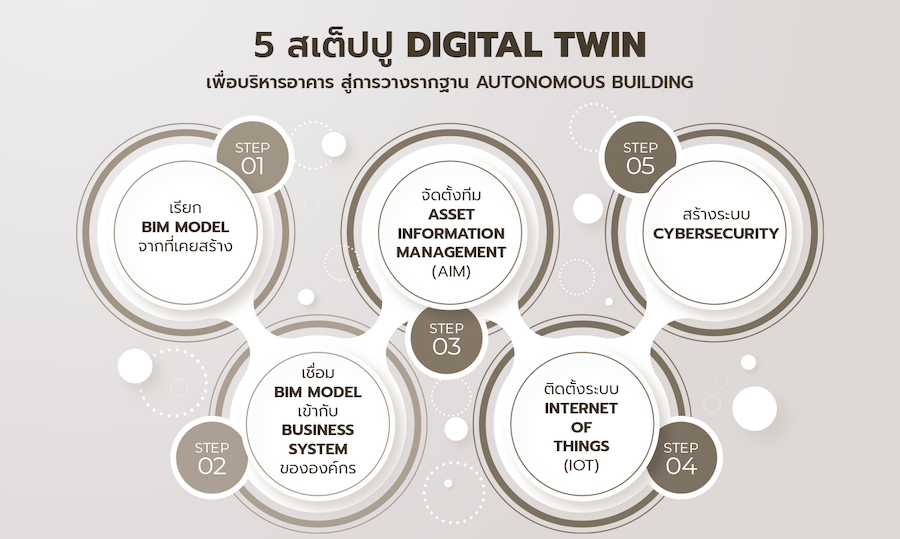
Step 1: Obtain the BIM Model from those discussing how to acquire a Digital Twin, which is not difficult in this era. First, building owners must understand their rights as clients. In developing a project, we must hire designers and builders, both of whom need to produce “plans” for the building owner, but for different purposes.
One party produces “plans” for construction, while the other produces “plans” for the building owner to manage the building or that “asset”.
The “plans” essentially contain Information. In the past, this information was in paper form, later evolving into CAD Files drawn on computers. Today, it exists as a Database known as Building Information Modeling (BIM). As the use of BIM becomes the standard in design and construction, there is a high chance that building owners will have a BIM Model somewhere in the Supply Chain.
If you specify that you want to own the BIM, simply state in the contract that you require the contractor to deliver the As-Built Document as a BIM Model.
This is the true starting point of the Digital Transformation journey for Property Asset Management, which must begin with having a BIM Model before proceeding to the next steps.
Step 2: Integrate the BIM Model with the Organization's Business System
For large organizations, there will be an ERP system for resource management. Essentially, these Business Systems are developed from financial accounting systems, which include asset recording.
In the past, real estate assets were not frequently changed, hence termed Fixed Assets. However, this was mainly because most organizations lacked the capacity to modify those Fixed Assets, despite the fact that every building undergoes renovations, repairs, and value additions continuously.
Today, the world has the capability to Track efficiently by linking the BIM Model with the organization’s Business System like ERP. This means that if there are modifications to the building plans, they will reflect in the organization’s ERP as well, providing continuous updates in a unified database without the need for manual Key-in methods.
Step 3: Establish an Asset Information Management (AIM) Team
The Asset Information Management team will manage data related to all real estate assets within your asset kingdom.
Currently, businesses with vast amounts of Data are developing Business Analytics or Data Analytics using Data Scientists or Data Engineers. The concept of the Asset Information Management (AIM) team is to do the same but focus on the Data from construction plans and reports, as well as analyze building usage to provide insights for enhancing business capabilities.
Certainly, the AIM team is still a relatively new breed in the asset management industry, as the Data in this sector is still limited and mostly consists of “Unstructured Data” that requires human analysis. However, in the future, it will evolve towards Machine Learning or utilize Artificial Intelligence (AI), but for now, ‘humans’—mainly architects and engineers—are the primary professionals.
The initial task of the Asset Information Management team is to ensure that the construction plans (in this case, the BIM Model) are updated to reflect the actual conditions of the building and that other data related to the building, such as repair reports, energy usage reports, or user conditions, are accurate and accessible. This data is often input into other systems, such as Business Systems, maintenance management systems, procurement systems, and energy or water tracking systems.
Generally, any organization that owns a significant number of real estate assets that can reach Step 3 is already quite advanced, with most Step 3 implementations often being outsourced.
Step 4: Install Internet of Things (IoT) Systems
If property owners want to lay the groundwork for “Automation” to reduce labor costs in asset management, they should start analyzing the use of “Internet of Things” technology.
The essence of Internet of Things (IoT) is devices that can send data back to the organization, allowing the organization to utilize that data for business development. Simply put, it’s a translation tool for machines.
In the past, data was generated by humans recording and reporting, but now it is created by computers monitoring everything continuously, resulting in a significant increase in data volume, sometimes so much that humans cannot process it quickly, leading to the term “Big Data”.
Today, we find Internet of Things (IoT) everywhere. Anything connected to the internet that can send data out or receive commands for control is considered to have IoT capabilities.
For buildings or Property Assets, IoT focuses on the capability to track data from critical devices, such as machinery, elevators, air conditioning systems, or even security systems, which impact various business risks.
Once a building has a BIM Model, it can be integrated with vast amounts of data from the Internet of Things, acting like numerous computers tracking the status of our assets, thereby reducing the need for human labor, especially for building technicians.
Routine tasks for technicians, such as checking machinery conditions or turning machines on and off, will no longer be necessary, as everything can be managed through IoT.
In Step 4, besides the benefits of reducing labor, project owners will gain real-time insights into their property kingdom through dashboards that receive data from IoT integrated with the BIM Model. Generally, using Data Analytics at this level will lead to reduced resource consumption in buildings, such as energy.
Step 5: Cybersecurity
When IoT is installed to gather data and allow direct control of building systems via the internet, it is crucial to always be aware that your asset is no longer just a “building”, but has undergone a “Digital Transformation” to become a “Device” with complex internet connectivity that can be commanded to operate as you desire, whenever you need.
The benefit is that your organization will leap into enhanced operational efficiency and responsiveness to external changes.
The new risk you must face is “cyber attacks.” When everything is interconnected, if one point is breached, you could be compromised by a “thief” or, as they are stylishly referred to, a “Hacker.”
Cybersecurity is a critical step in “Digital Transformation.” It may seem like the final step, but in reality, cybersecurity must be considered alongside system improvements throughout the entire process.
If we compare your organization to a ‘object’, Digital Transformation is like ‘light’ (in this case, regarding Digital Twin), while Cybersecurity is the ‘shadow’ that must accompany that light forever.
The Path to an Autonomous Environment
Anyone who has seen the movie Minority Report starring Tom Cruise in 2002, which is nearly 20 years old, will find that many elements from that film have become reality.
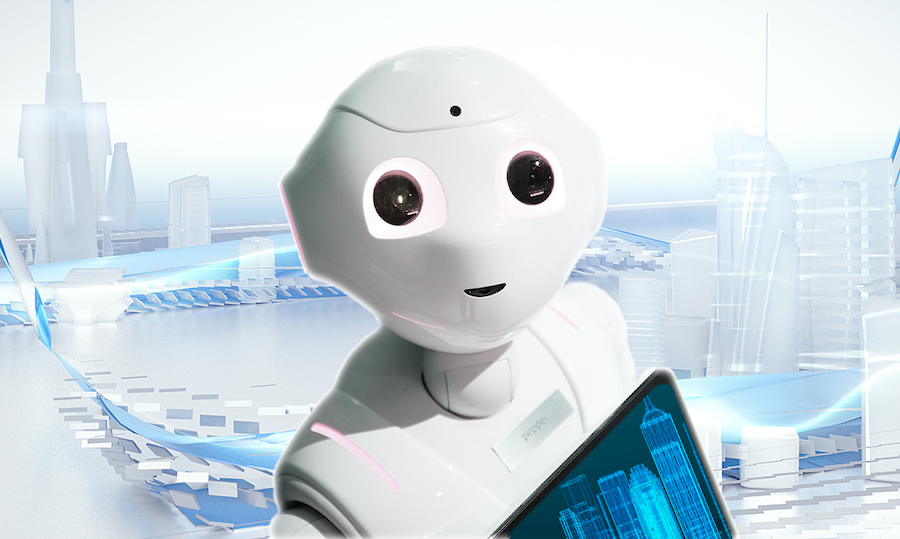
One standout aspect of the film is the building or environment that interacts with users as if the building itself is a living entity.
The building can communicate and understand what humans need by identifying individuals and processing data about them to create appropriate conversations, waiting for responses based on their needs. This is the Autonomous Environment that humanity will reach in the future—buildings that can take care of themselves, knowing when to call for repairs, how to conserve energy, and how to ensure the happiness of those using the building.
All of this is fundamentally based on the core technology of Digital Twin, starting from the BIM Model, moving to Asset Information Management, IoT, and other aspects that need to be incorporated further.
For those wishing to embark on this technological journey, let’s move towards the future starting from today with the Digital Twin.