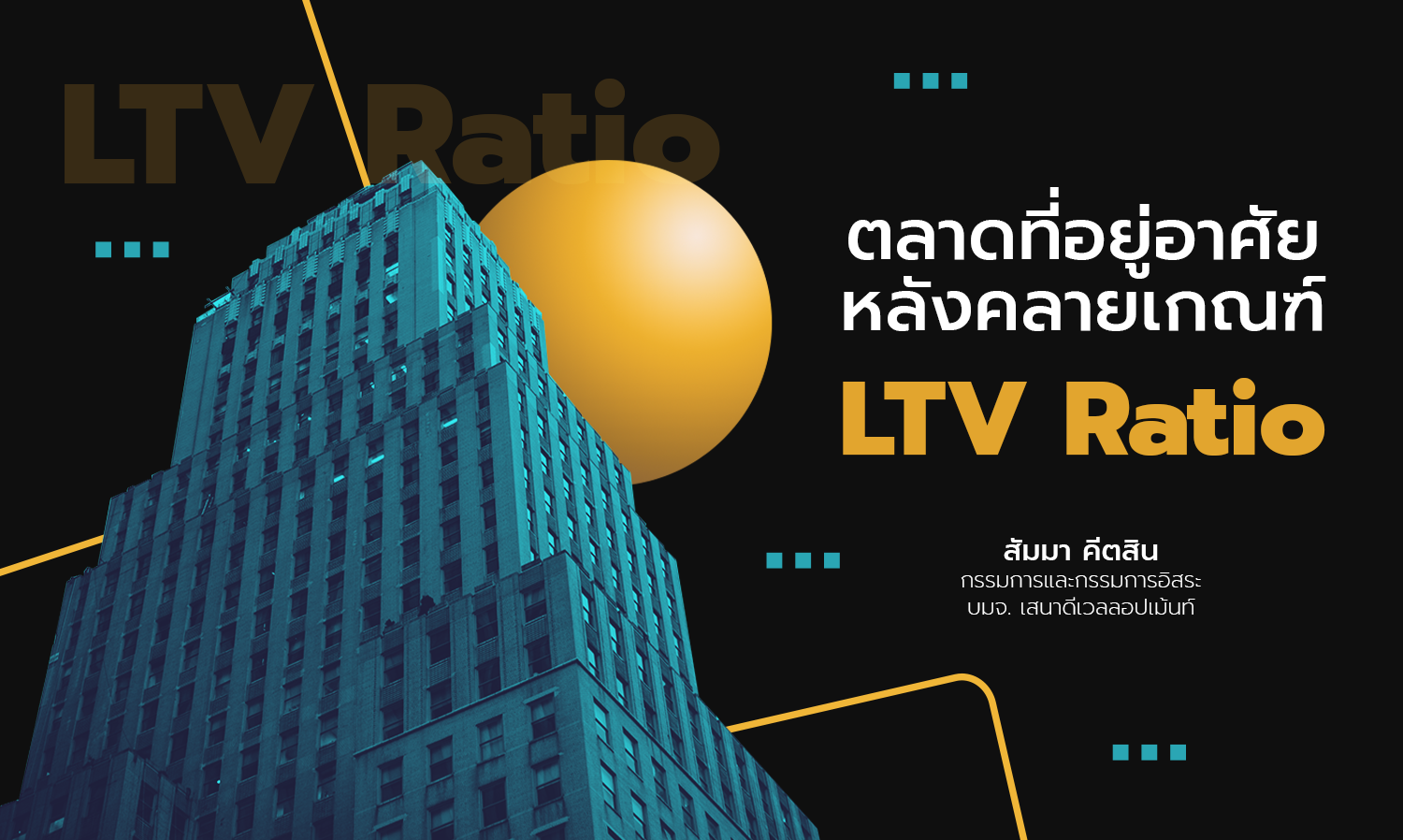
Housing Market After Relaxation of LTV Ratio Regulations
Samma Keetsin
Director and Independent Director, Sena Development Public Company Limited
The Bank of Thailand (BOT) has announced a relaxation of the criteria for granting housing loans by financial institutions to individuals, specifically the “Loan-to-Value Ratio” (LTV), effective from October 20, 2021, until the end of 2022, for a period of approximately 14 months. The LTV Ratio is set at 100%, meaning that financial institutions can provide loans up to the full value of the property being used as collateral.
This announcement is a positive factor for buyers applying for housing loans from both commercial banks and state banks, allowing them to secure loans at higher amounts than before, especially in a situation where they may still lack the ability to raise a significant amount of cash for a down payment on properties, whether they are condominiums, townhouses, duplexes, or single-family homes, both new and second-hand.
Previously, the BOT had established LTV Ratio criteria for financial institutions to follow since April 1, 2019. Later, on January 20, 2020, coinciding with the onset of the COVID-19 situation in Thailand, the BOT relaxed these criteria once again, significantly reducing the required payment history for the first housing loan from 3 years to just 2 years for loans under 10 million baht. In the first scenario, if the borrower has not paid off the first loan for 2 years, the LTV Ratio is set at 80%, meaning financial institutions can lend up to 80% (or the borrower must make a down payment of at least 20%) of the property value used as collateral. In the second scenario, if the borrower has completed 2 years of payments on the first loan, the LTV Ratio is set at 90%, allowing lending up to 90% (or the borrower must make a down payment of at least 10%) of the property value used as collateral.
Additionally, in the same announcement, the BOT also relaxed the LTV Ratio for housing loans of 10 million baht and above. For first loans, the new LTV Ratio is set at 90%, allowing lending up to 90% (or the borrower must make a down payment of at least 10%) of the property value used as collateral. For second and third loans, the LTV Ratios remain at 80% and 70%, respectively.
The reason for the latest relaxation of the LTV Ratio on October 20, 2021, which eased all the previously strict criteria, is likely due to the BOT's assessment that speculation in the housing market has significantly decreased amid a sluggish housing market caused by the COVID-19 situation. There is also a necessity to rely on the housing sector to drive the recovery of the economy, as the housing sector is a key component of the Gross Domestic Product (GDP) and generates subsequent production chains, such as various construction materials, furniture, electrical appliances, home decor, car and motorcycle purchases, and advertising expenditures, among others.
The BOT executives anticipate that this relaxation of the LTV Ratio will lead to an increase in new housing loans of approximately 50 billion baht in 2022. If this occurs, it would mean an increase of about 8% in new loans from this relaxation compared to the total housing loan issuance nationwide of approximately 612 billion baht in 2020 (with total housing loan issuance of about 640 billion baht in 2019 before the COVID-19 situation and approximately 700 billion baht in 2018, which was the highest level before the initial LTV measures were announced). Therefore, it can be expected that if there are no other risk factors impacting the economy and financial institutions more than currently, financial institutions will consider granting housing loans at higher values to buyers of completed properties ready for transfer of ownership within the timeframe that the BOT has relaxed the criteria, which is from now until the end of 2022.
At the same time, the measures to reduce the transfer fee for property ownership from 20,000 baht per million to 100 baht per million, and to reduce the mortgage registration fee for housing used as collateral from 10,000 baht per million to 100 baht per million, will remain in effect until the end of 2021 (there is a high possibility that these measures may be extended for a further period to stimulate the economy).
This presents a great opportunity for anyone looking to purchase any type of housing to consider buying according to their own financial capacity, especially if they need to apply for housing loans from financial institutions. On average, 90% of homebuyers in Thailand purchase through loans from financial institutions.