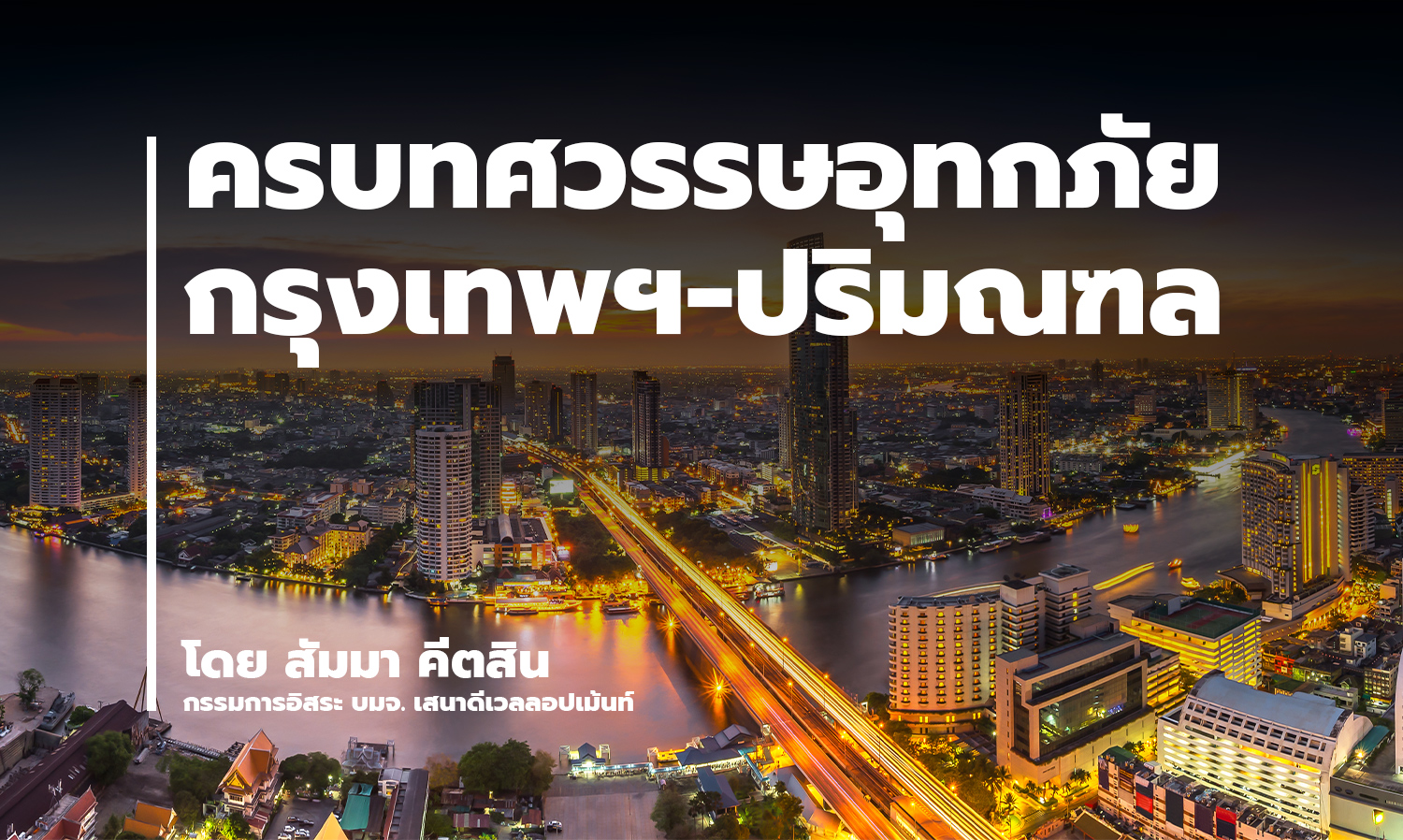
A Decade Since the Floods in Bangkok and Surrounding Areas
By Summa Keetsin
Independent Director, Sena Development Public Company Limited
October 2021 marks the tenth anniversary of the great flood in 2011, which saw a massive influx of water inundating Bangkok and its surrounding areas. Additionally, other provinces were affected by flooding both prior to and during this time, totaling 63 provinces across the country that experienced the impact.
The cause of the flooding was attributed to a series of monsoon winds hitting various areas in five consecutive waves: Haima, Nock-ten, Haitang, Nesat, and Nalgae. This resulted in rainfall exceeding normal levels from mid-year through October 2011, leading to significantly higher water levels. The total water flow collected in Nakhon Sawan reached 9.89 billion cubic meters, surpassing the amount recorded in 1995 (the year of another major flood in Bangkok). The upper river basin was much wider than the lower basin, which hindered drainage. Consequently, the excessive water led to prolonged flooding in central regions of the country, including Bangkok and its vicinity, particularly between October 18 and early December 2011.
Overall, in 2011, the economic growth rate shrank by 328 billion baht, resulting in a GDP growth of only 0.1% for that year. The World Bank and the Asian Development Bank estimated that the floods at the end of 2011 caused losses to Thailand amounting to 1.44 trillion baht.
Approximately 2.2 million households were affected, with Bangkok, its surrounding areas, and Phra Nakhon Si Ayutthaya province accounting for the highest number of affected households—1.8 million, or 82% of all households impacted nationwide. Of these, around 670,000 households were in Bangkok, followed by Nonthaburi and Pathum Thani, each with about 370,000 households.
In the second half of 2011, there were about 850 new housing projects for sale in the Bangkok and surrounding areas, with a total of approximately 162,000 units. It was found that around 200 projects experienced flooding in the houses themselves, with about 46,000 units affected. Additionally, around 100 projects had flooding on the internal roads without significant damage to the houses, while about 120 projects faced flooding on the main roads, making access impossible.
Bangkok had more than 30 housing projects that suffered damage from flooding, with approximately 5,000 units affected. Pathum Thani had the highest number of projects damaged by flooding, around 100, due to being a flood-prone area. This province had a total of about 24,000 affected units, while Nonthaburi also had over 60 projects impacted by flooding.
The flooding situation affected property transfers, as some buyers in heavily flooded areas faced loss of income and increased expenses, undermining their ability to make mortgage payments. Some delayed property transfers due to uncertainty about future flooding, leading to only about 90,000 residential property transfers in Bangkok and its vicinity in 2011, an 18% decrease from 2010.
New housing projects for sale in the second half of 2011 in Bangkok and surrounding areas were impacted by the flooding situation, with only 12,000 units sold, a 15% decrease compared to the second half of 2010.
After the floods, developers invested in additional measures to create flood protection systems, such as raising land levels, elevating house foundations, constructing flood barriers, and installing drainage systems. They also developed flood protection standards for housing projects, including physical standards for the projects and the houses in flood-prone areas. However, condominium projects were less affected by the past flooding due to their architectural characteristics, which provided better flood protection compared to housing projects.
The recovery of housing projects after the flood crisis in Bangkok and surrounding areas took about 6 to 24 months, depending on location and the severity of the flooding. This prompted many central developers to diversify their investments into regional provinces such as Chiang Mai, Chonburi, Phuket, Hat Yai, and Khon Kaen. Some developers shifted their new project offerings from single-family homes in suburban areas to condominium projects along the subway lines or in urban areas. However, since the end of 2013, housing projects and condominiums in flood-affected areas of Bangkok and its vicinity have seen a resurgence, especially with the opening of the Purple Line subway from Tao Poon to Khlong Bang Phai, which has further developed Nonthaburi. Similarly, the recent extension of the Green Line subway to Kukot has made Pathum Thani more attractive.