The Metaverse and its Economic Foundations
Metaverse has become a widely discussed topic over the past 1-2 years. In this article, we will attempt to answer fundamental questions such as: What is the definition of the Metaverse? How will it come to be (or has it already)? What are the economic and social foundations of the Metaverse?
What is the Metaverse?
If you've seen the movie Ready Player One, you might get an idea of what the Metaverse could look like and why major tech companies like Facebook and large gaming companies are trying to create their own versions of the Metaverse.
In this film, the protagonist tries to escape his real-world life by entering a Virtual Reality world (referred to as The OASIS in the movie) using a VR headset and other devices. In this virtual world, users can engage in various activities such as shopping, playing games, attending concerts, and many other activities similar to what we do in the real world, or even some activities that we can't do in real life (like traveling to space).
Figure 1: The movie Ready Player One discusses the emergence of the Metaverse

Source: imdb.com
What is the Metaverse really?
The Metaverse is a collaboration of various technologies, but ultimately, it must be able to integrate into a larger system (think of the internet, which consists of many systems that must communicate with each other) that allows for communication, has interconnected databases (possibly through blockchain?), and has rules that all parts of the Metaverse must adhere to. This integration will create a virtual world where users can engage with their five senses (sight, taste, smell, sound, touch) and interact with other users (or possibly objects created in the virtual world).
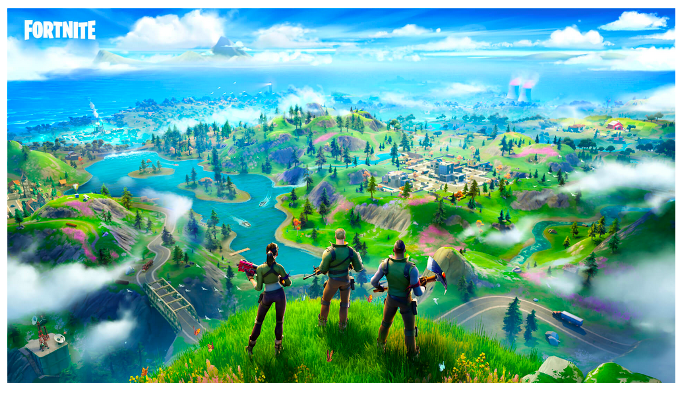
The Metaverse will consist of many subcomponents (which may be created by various companies or individuals), but these components must be able to work together and recognize each other's existence under a shared "database" that all parties agree upon. For example, a user might enter Facebook's Metaverse to meet friends, then play a game in Fortnite's virtual world, go shopping in a mall in Decentraland, and purchase home decor in Roblox's virtual world (the names mentioned are examples of products or companies related to content creation in the virtual world).
Users will be attracted to the virtual world because they can "create" an identity that differs from their real-world selves. For instance, in reality, everyone may have something they wish to change, such as wanting to be taller, run faster, or fly. In the virtual world, they have the opportunity to choose their desired identity.
Figure 2: The world of Fortnite
Source: epicgames.com
The Metaverse from an Economic and Social Perspective
If we view the Metaverse as a country or state, this state would consist of a population, governance, laws, resources, and cooperation to achieve the state's objectives.
The state must strive to organize its population and resources under its governance (such as conducting a census, registering companies, and creating a national land registry) to ensure efficient tax collection and use the tax revenue to create "Public Goods" or public utilities that everyone can access and use (for example, public roads, parks, or a military for state security).
This accounting must be done meticulously to enable taxation based on value, such as knowing individual income, addresses, company profits, and land valuations.
This kind of organization allows human society to progress from living in the wild to coexisting as tribes and eventually becoming great nations and civilizations.
Modern states are thus built on databases of everything valuable under their governance to understand resource conditions and efficiently collect taxes.
The Internal Management System of the Metaverse Requires Blockchain, Especially Ethereum
Since the state has an internal management system for accounting and tax collection, as well as creating various Public Goods, what would this system look like in the Metaverse?
This system must be accepted by all parties involved in the Metaverse (both creators and users). It must be secure and capable of accounting and managing all economic activities within the Metaverse (addresses, spending, user assets, system income, etc.). For any blockchain system to be accepted by all parties, it must be decentralized, meaning no single group or company can control everything about that blockchain (which would lead to data manipulation for personal gain).
The current technology that can meet these needs is likely blockchain technology, and the blockchain system that is currently capable of handling such transactions and widely accepted is likely Ethereum.
In the future, there may be new systems that replace Ethereum or work alongside it, but the author does not mean to imply that it must only be Ethereum; this is merely an example.
Ethereum as a System to Organize Items within the Metaverse
If we want to participate in the Metaverse system, what we need to do is create an ETH address.
If we want to purchase items within the Metaverse (which is likely similar to the concept of NFTs (Non-fungible Tokens) today).
For more information about Non-fungible Tokens (NFT): https://en.wikipedia.org/wiki/Non-fungible_token
We can transfer money through a contract address to pay for and receive that item into our ETH address.
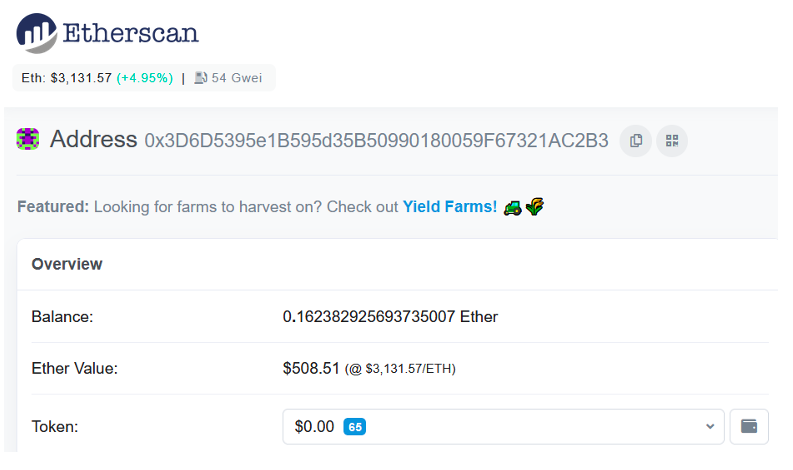
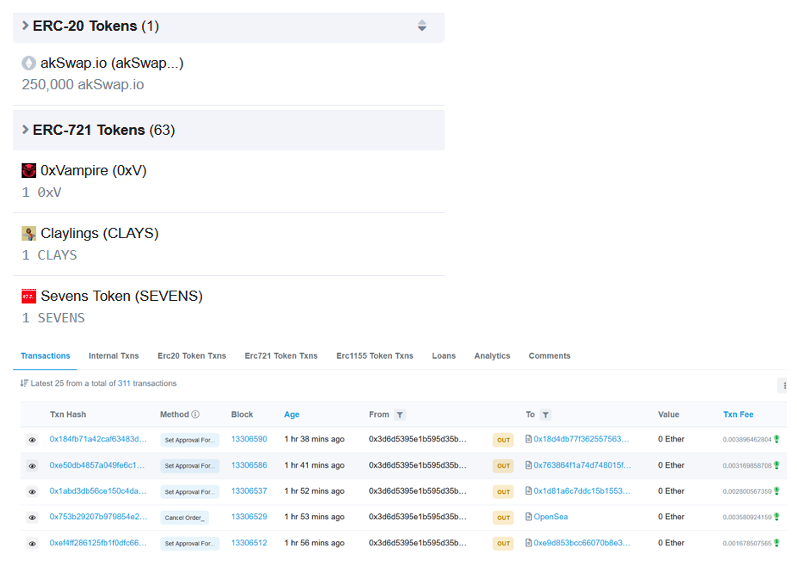
The value of items within the Metaverse will be measured in ETH, and we do not need someone to assess the value because the market will evaluate it on its own. If we open our ETH wallet, we will see the items stored in that address.
Figure 3: Example data of an address in ETH
Source: etherscan.io
In terms of tax collection, the Ethereum system charges transaction fees (gas fees), which depend on the amount of resources used in the Ethereum system for transactions (based on the data size used, which depends on the complexity of the transaction or smart contract). This is akin to paying taxes to the system administrator, which is the validator node of Ethereum.
Thus, Ethereum can be likened to a state system managing the Metaverse and Public Goods that all users can freely access to transact, trade, create, or store assets within the Metaverse.
Tokenization and Universal Ledger are Key to Creating an Economy in the Metaverse
Every object in the Metaverse must have a presence in the virtual world. The meaning of having a presence is that every system in the Metaverse must recognize each object and be able to interact with it (such as buying, selling, wearing, seeing, colliding, etc.).
For an object to have a presence, it must first be "born," a process known as tokenization (if it is a unique object, it is called a Non-fungible Token (NFT)).
Once born, the information about this object will be stored in the blockchain system, which serves as a universal ledger or database that all systems can access to know the status of this object (such as which address owns it, what transactions have occurred, how many times it has been traded, and what characteristics it has).
The processes of tokenization and having a universal ledger are crucial and form the foundation of the economy in the Metaverse.
Identity in the Metaverse
In the real world, we can identify a person by their ID number, which the state issues at birth, and we can know their physical characteristics, such as black hair, oval face, height of 170 cm, etc.
In the Metaverse, users can choose to create their own "identity" anew and do not need to have just one account (some may have multiple user accounts). If they do not want to use a particular account, they simply do not log in, unlike in the real world where we cannot "stop" being our identity. Identifying oneself using an ETH address allows everyone to have an account in the Metaverse.
Having a presence in the virtual world is accessible to everyone and cannot be blocked (in the real world, some people may not be able to be citizens of certain countries due to restrictions based on nationality or birthplace), which is an important characteristic for creating a fair and equal system.
Non-fungible Tokens (NFTs) Create Uniqueness Between Each Address
This is akin to how a person in the real world has specific differences, such as fingerprints, facial features, hair color, and clothing style.
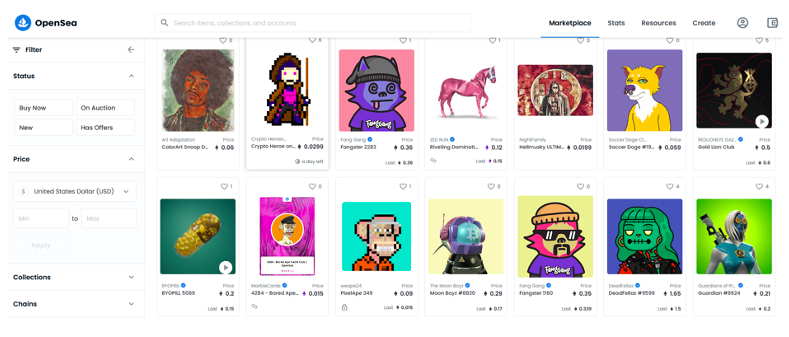
In the Metaverse built on Ethereum, there are NFTs, each of which is unique. We can choose to purchase NFTs to reside in our address to express our identity, similar to how we select an avatar image to represent us on Facebook or Line. These NFTs do not have to be just images; they can also be music, domain names, collectible cards, or even items in games, and in the future, many other forms are likely to emerge.
Each address will have its own story recorded in the blockchain.
Figure 4: Non-fungible Tokens for sale on Opensea
Source: Opensea
The Emergence of the Metaverse
The emergence will initially be fragmented, such as Fortnite creating its own virtual world or Axie Infinity creating its own world. Social media platforms like Facebook or Snap may also create their own worlds, but ultimately these worlds will be interconnected through blockchain to allow the transfer of objects or value from one world to another.
Previously, when we played games (like Warcraft), we could accumulate resources in the game, but when we stopped playing, we could not convert those resources into real-world wealth or transfer that wealth to other games or virtual worlds.
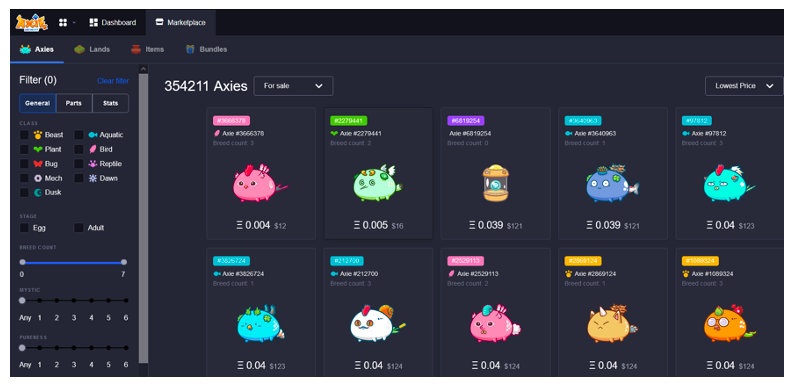
The emergence of blockchain, such as Ethereum, and play-to-earn games like Axie Infinity allows us to play games, earn rewards, and sell them for real money or convert them to ETH and transfer them to other virtual worlds.
The ability to freely transfer value and for different systems to work together is crucial for the birth of the Metaverse.
Ultimately, these diverse virtual worlds will be connected by a common protocol (just as the internet connects the world of data communication).
Figure 5: Axie Infinity, a popular play-to-earn game with millions of players, allows players to sell what they earn for real money.
Why Ethereum Blockchain is Likely to Facilitate the Emergence of the Metaverse
To serve as the economic foundation of the Metaverse, three things are necessary:
1. A shared database of every object.
2. Various applications that facilitate transactions for exchanging value, such as NFTs, ERC20 Tokens, DeFi, and others.
3. Decentralization, so that all parties can accept the accuracy and fairness without anyone owning it (imagine if Facebook owned the blockchain; Microsoft, Google, or Amazon would likely not want to build platforms on it).
All of this makes Ethereum the most viable option currently, but in the future, there may be other blockchains that perform better than Ethereum or Ethereum may work alongside new blockchains to create a network of blockchains that serve as the economic foundation of the Metaverse. This is something to watch for in the near future of the Metaverse.