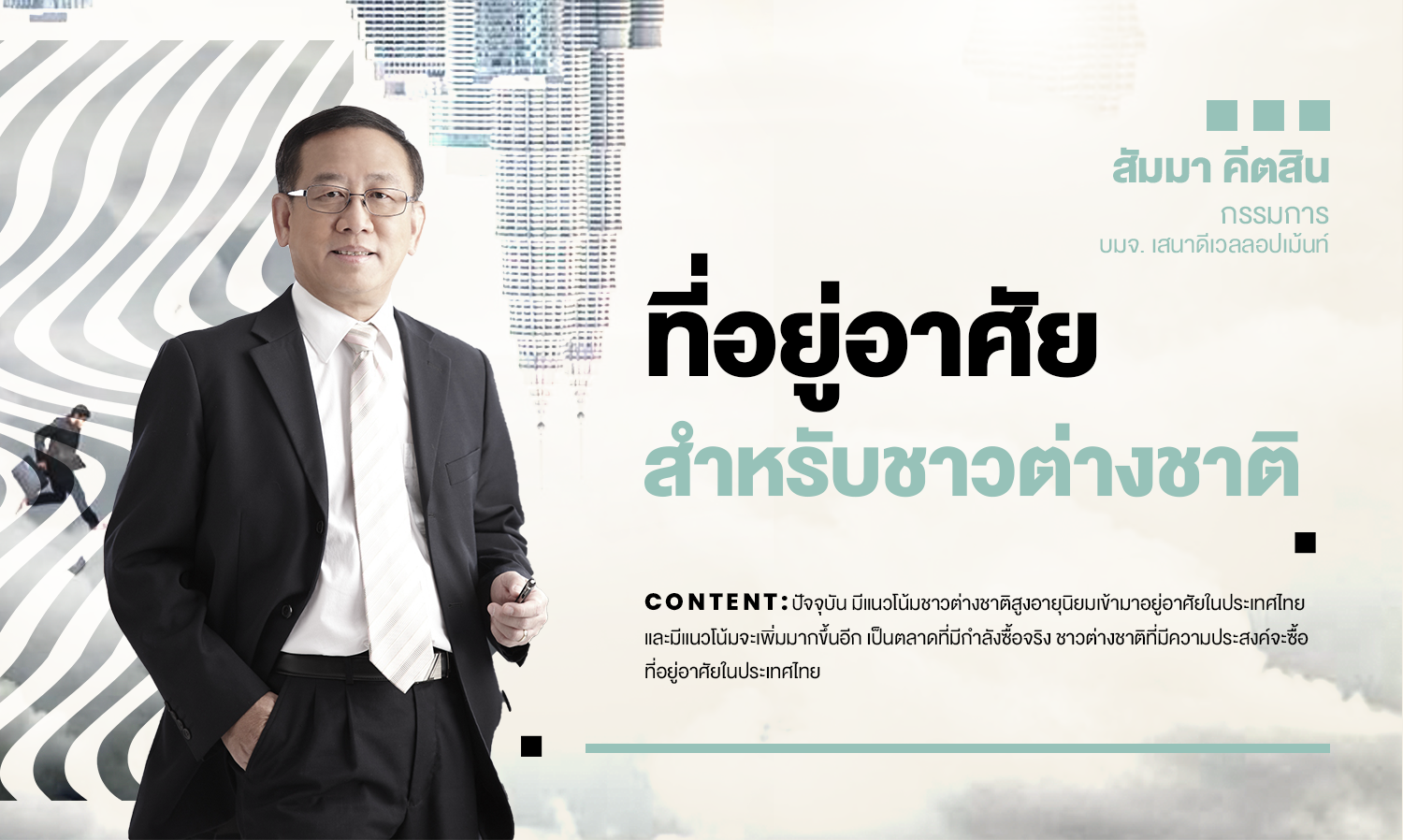
Housing for Foreigners
The global economy today is increasingly interconnected, with international trade and rapid cross-border capital movement. People can travel between countries conveniently, and there is a growing trend of investing in foreign assets, whether in the bond market, capital market, or real estate. It is no longer unusual to see citizens from other countries traveling for short or long stays or settling permanently in Thailand. Additionally, the number of marriages between Thai nationals and foreigners has also increased.
Generally, foreigners (both individuals and foreign legal entities) in Thailand can own residential real estate in two forms: Freehold ownership and Long-term leasehold.
Foreigners can hold freehold ownership in the case of condominium units or residential properties that do not include land, provided that the total foreign ownership does not exceed 49% of the total saleable area of the condominium building.
Foreigners and foreign legal entities cannot hold freehold ownership of land unless granted special privileges under investment promotion measures or laws.
As for long-term leasehold, the maximum lease period is up to 30 years. When selling residential real estate to foreigners, it is often presented that the foreign buyer can extend the leasehold rights for an additional two terms, totaling up to 90 years.
The policies and regulations regarding foreign ownership of real estate are often influenced by nationalism, political ideologies, levels of economic development, protection of specific interest groups, openness to foreign investment, and the long-term stability of the market. This leads to varying policies on foreign property ownership in different countries. However, in countries where the government can swiftly make policy decisions, such as China, Singapore, and the Hong Kong Special Economic Zone, these regulations can be adjusted quickly based on current economic needs. For instance, if housing prices are rising rapidly, making it difficult for ordinary citizens to afford homes, the government may tighten regulations. Conversely, if the housing market appears to be declining, the government may relax restrictions.
In Western countries such as the United States, Canada, the UK, Australia, and New Zealand, where land is relatively abundant compared to the population, foreigners are often allowed to purchase residential properties with land. In contrast, Asian countries typically avoid granting freehold ownership of landed properties to foreigners but are willing to allow freehold ownership of condominium units as long as no land is included.
Long-term leasehold rights are present in nearly every country, with varying terms. In Malaysia, the government has established the Make Malaysia Tour Second Home (MM2H) program, which includes specific requirements for bringing money into the country and maintaining deposits in Malaysian financial institutions to encourage foreigners to retire there. However, some countries do not offer foreigners more residential ownership rights than those provided in Thailand.
Currently, there is a growing trend of elderly foreigners choosing to reside in Thailand, and this trend is expected to increase. This demographic represents a significant purchasing power. Foreigners wishing to buy property in Thailand can be categorized based on various characteristics. Foreign buyers can contribute to the economy by bringing in foreign currency or generating economic activities, such as expenses for property maintenance, hiring housekeepers, cleaning services, cooking, gardening, and paying for utilities and transportation, which can create both direct and indirect employment opportunities. Thailand may need to improve housing measures for foreigners to align with the changing global context. However, any actions taken should be cautious and consider the broader benefits to consumers and the overall economy of the country.
______________
Samma Keetsin
Director, Sena Development Public Company Limited