
IQUAL MODEL: A Framework for Developing Quality Inspection Innovations in Construction
The expansion of the real estate sector has led to the growth of related businesses, particularly in construction contracting, which includes infrastructure projects, industrial factory construction, building construction, and residential construction. These projects involve personnel from various agencies, and the success of a construction project hinges on the ability to deliver products to consumers as per the defined goals. However, challenges in the quality inspection process before delivery are still prevalent today, especially regarding misunderstandings about construction quality between inspectors and contractors. Key issues identified include a lack of knowledge among project owners regarding construction inspections, the absence of clear criteria or standards for inspectors, ambiguity about the quality levels desired by clients, inspection criteria, measurement methods, acceptable tolerances, appropriate tools for quality measurement, and the reliance on the subjective judgment of inspectors, which varies from person to person based on their knowledge, experience, expertise, and satisfaction. This is particularly true for architectural work, such as wall construction, painting, wallpapering, and furniture, where aesthetics are as crucial as strength and durability.
IQUAL Model has been developed to facilitate the innovation of quality inspection methods that are accepted by stakeholders involved in the operations. The author presents the construction of interior walls as a case study for this explanation.
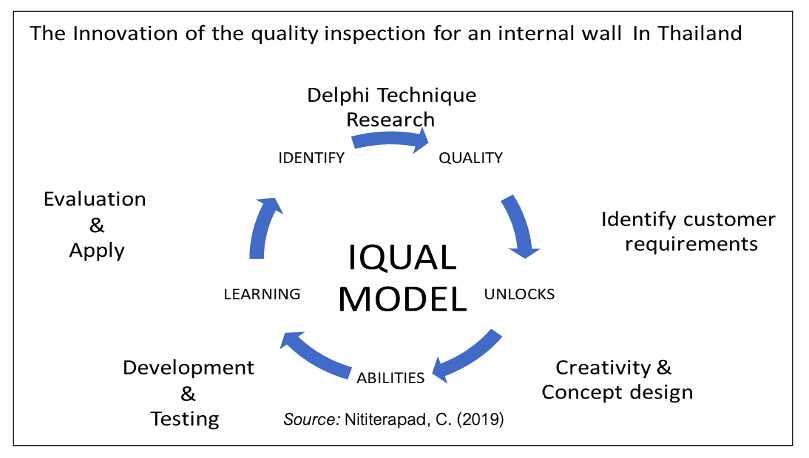
IQUAL Model: Developing Innovations for Quality Inspection in Interior Wall Construction
It consists of 5 components and 5 processes as follows:
1. Components for Developing Quality Inspection Innovations
- Identify
- Quality
- Unlock of Limitations
- Abilities
- Learning
2. Processes for Developing Quality Inspection Innovations
- Delphi Technique Research
- Identify Customer Requirements
- Creative & Concept Design
- Development & Testing
- 5) Evaluation and Apply
Identify
Identifying needs and defining characteristics and specifications of innovations is crucial. It is essential to seek facts to create new knowledge that lacks clear answers regarding quality inspection, which is a specialized task involving theoretical and practical knowledge from personnel across various agencies with expertise in the field. Therefore, in the innovation identification phase, which includes determining needs, characteristics, and specifications, it is vital to choose appropriate methods.
The Delphi technique is suitable for studying areas that require conclusions and clarity in quality inspection methods or for seeking knowledge that lacks definitive answers, which can lead to misunderstandings and conflicts in current work processes. The outcome of this process is a consensus from the majority based on the opinions of experts or qualified individuals with knowledge, skills, and experience related to building construction and interior wall work, making it possible to effectively and reliably utilize these conclusions for innovation development.
Quality
The study of quality inspection for interior walls involves identifying components and key factors for innovation development. The data obtained is the result of research from documents, textbooks on quality standards, surveys, and interviews with experts and stakeholders to gain insights into problems and genuine customer needs. The Delphi technique and the process of identifying customer requirements were employed to define the main components for developing quality inspection methods for interior walls, which include:
- Quality Requirements of Work
- Criteria of Work
- Measurement Method
- Measurement Tools
- Tolerance Acceptance
The outcome of this phase is crucial and reliable knowledge suitable for developing a quality inspection guideline for interior walls for stakeholders to reference in collaborative work processes across all projects. It can also lead to the development of appropriate measurement tools for quality inspection that effectively meet customer needs.
Unlock of Limitations
In developing quality inspection innovations, it is essential for innovators to unlock themselves from various limitations, particularly mental, emotional, attitudinal, and behavioral constraints. Since this innovation development is a new endeavor requiring a development team with interdisciplinary knowledge, during the design phase (Creative and Concept Design), innovators must be open to new ideas from knowledge and experience exchanges with team members, including innovators, architects, tool inventors, and users or those in the interior wall construction industry. Embracing cross-disciplinary learning, such as knowledge in mechanics, materials, structural design, and the operational systems of measuring tools, is vital for achieving the best design concepts for further product development. Thus, freeing oneself from limitations is a key to innovating and designing quality inspection tools.
The outcome of this phase is a variety of design concepts that are beneficial for further development and can be evaluated and selected for prototype development that meets customer needs.
Abilities
Product development abilities involve selecting the most feasible design concepts for innovation, assessed by customer and user groups, collecting data to study the feasibility of developing those concepts into prototypes. In the product development and testing phase (Development and Testing), innovators must utilize three fundamental abilities:
1) Product Development Ability: Selecting appropriate and feasible design concepts for innovation and studying the feasibility of developing those concepts into prototypes.
2) Product Testing Ability: Conducting performance tests and usability of prototype tools while collecting feedback for further improvements to enhance the product.
3) Commercial Ability: Pushing innovative products into the market in various commercial forms.
Learning
Learning is a crucial component of developing quality inspection innovations for interior walls. The results from the evaluation process and application to target market groups during product development and testing provide innovators with important information for continuous product improvement, ensuring that products become more effective and meet target market needs. The outcome of this process is that innovators learn from both research findings and practical experiences, supported by product development data and testing results for future improvements. This also creates a learning lesson and knowledge development for further innovation effectively.
In the previous issue, we learned about the necessity of incorporating technology to support real estate business operations. The content presented in this issue is IQUAL MODEL – Developing Quality Inspection Innovations in Construction for entrepreneurs to utilize in organizational innovation development.
On behalf of the Master of Science program in Real Estate Development Innovation (MIRED) at the Faculty of Architecture and Planning, Thammasat University, we are pleased to offer consulting services for new product development and organizational innovation for real estate entrepreneurs. Lastly, we wish to encourage everyone to overcome obstacles and navigate through the challenges of the new normal era.