
Preliminary Hotel Valuation #1
Hotels are a crucial mechanism in the tourism business that has supported Thailand's economy for many years. However, the COVID-19 pandemic that began in early 2020 significantly impacted the tourism sector and extended to the hotel industry, leading to a gradual influx of hotels being put up for sale in the market. This article aims to present the basic principles of hotel valuation to provide information for those interested in acquiring hotel businesses.
Generally, for hotel businesses, room revenue typically constitutes the primary source of income. This is evident in the annual information forms (56-1) of several hotels listed on the Stock Exchange of Thailand, such as SHANG and ROH, as shown in Table 1.
Table 1: Example of Hotel Revenue Structure for 2019
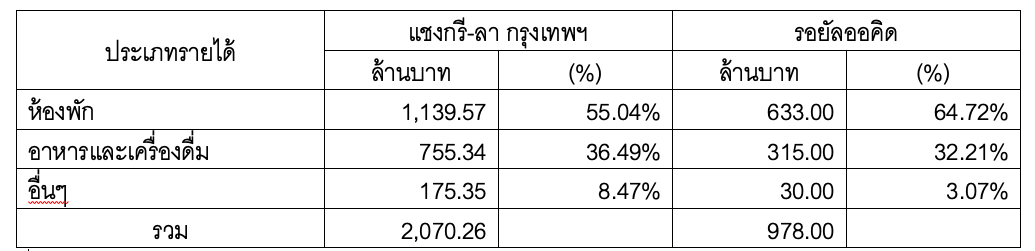
The data in Table 1 illustrates the importance of room revenue, which significantly affects the hotel's value, especially when assessed using the Income Approach, the most widely accepted method (Rushmore and deRoos, 1999). This approach calculates the hotel's value based on future operational performance. To better understand room revenue, it is essential to grasp three key terms related to it:
1) ADR (Average Daily Rate) is the average revenue per room sold. It indicates the average price at which the hotel can sell its rooms, regardless of the number sold. The room rates used to calculate ADR should exclude VAT and Service Charge, as these are amounts collected from customers and passed on to the tax authorities and hotel staff, thus not counted as part of revenue. The formula for calculating ADR is as follows:

This involves taking the room revenue for a specific period—be it annually, monthly, or daily—and dividing it by the number of rooms sold during the same period. ADR is expressed in Baht/room.
2) OR (Occupancy Rate) is calculated using the following formula:

This involves taking the number of rooms sold during a specific period—annually, monthly, or daily—and dividing it by the total number of rooms available for sale. OR is typically expressed as a percentage.
3) RevPAR (Revenue Per Available Room) is the average revenue per room available for sale. It indicates how much revenue the hotel can generate on average per available room. Therefore, this figure does not reflect the selling price. The formula for calculating RevPAR is as follows:

This involves taking the room revenue for a specific period—annually, monthly, or daily—and dividing it by the total number of rooms available for sale during the same period. RevPAR is also expressed in Baht/room, similar to ADR. Notably, if you multiply ADR by OR, you will arrive at RevPAR, as shown in the formula:

Mathematically, ADR will always be greater than RevPAR unless the number of Rooms Occupied equals the number of Rooms Available, which would make ADR equal to RevPAR. To enhance understanding, consider the following calculation example:
Example 1 A hotel with 200 rooms has the following room sales details from last night:
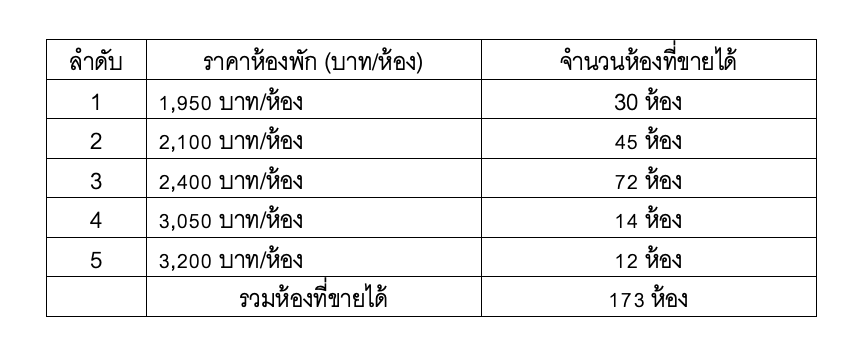
Step 1 Calculate room revenue by multiplying the price of each room sold by the number of rooms sold and summing them up, which here is considered daily revenue.
Room Revenue = (1,950x30) + (2,100x45) + (2,400x72) + (3,050x14) + (3,200x12)
= 406,900 Baht/day
Step 2 Calculate ADR by dividing the room revenue of 406,900 Baht/day by the number of rooms sold, which is 173 rooms/day, resulting in an ADR of 2,352 Baht/room (sold rooms).
Step 3 Calculate OR by dividing the number of rooms sold (173 rooms/day) by the total number of rooms available (200 rooms/day), resulting in an OR of 86.50%.
Step 4 Calculate RevPAR by dividing the room revenue of 406,900 Baht/day by the total number of rooms available (200 rooms/day), resulting in a RevPAR of 2,034 Baht/room (available rooms). Alternatively, if calculated by multiplying ADR of 2,352 Baht/room (sold rooms) by OR of 86.50%, it also equals 2,034 Baht/room (available rooms).
Example 2 A hotel with 200 rooms has the following room sales details from last year:
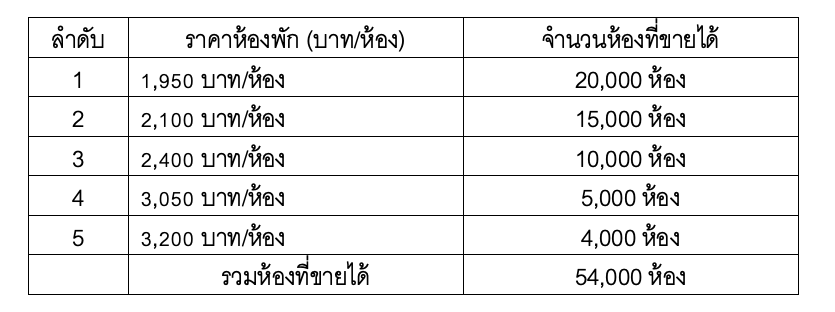
Step 1 Calculate room revenue by multiplying the price of each room sold by the number of rooms sold and summing them up, which here is considered annual revenue.
Room Revenue = (1,950x20,000) + (2,100x15,000) + (2,400x10,000) + (3,050x5,000) + (3,200x4,000)
= 122,550,000 Baht/year
Step 2 Calculate ADR by dividing the room revenue of 122,550,000 Baht/year by the number of rooms sold, which is 54,000 rooms/year, resulting in an ADR of 2,269 Baht/room (sold rooms).
Step 3 Calculate OR by dividing the number of rooms sold (54,000 rooms/year) by the total number of rooms available (73,000 rooms/year), calculated as 200 rooms multiplied by 365 days of operation, resulting in an OR of 73.97%.
Step 4 Calculate RevPAR by dividing the room revenue of 122,550,000 Baht/year by the total number of rooms available (73,000 rooms/year), resulting in a RevPAR of 1,679 Baht/room (available rooms). Alternatively, if calculated by multiplying ADR of 2,269 Baht (sold rooms) by OR of 73.97%, it also equals 1,679 Baht/room (available rooms).
After understanding the meanings of these three key terms, one can estimate room revenue based on the room rates of hotels available through various channels and other relevant information. For instance, if we are to assess the value of the MIRED hotel, which has 120 rooms, we might find room rates from OTA (Online Travel Agency) websites, which are reliable sources for the lowest prices for general retail customers. We could randomly check the selling prices of all room types in the hotel each month, as room rates may vary by season. It is essential to exclude breakfast, VAT, and Service Charge from the room rates. Then, we can calculate a rough ADR based on the gathered data. Additionally, we need to investigate the OR (Occupancy Rate) of hotels in the area, which can be found in the 56-1 reports of hotels listed on the stock exchange in the same locality or from published statistical data and market research. Once we have ADR, OR, and the number of rooms in the hotel, we can estimate room revenue roughly.
As for using room revenue to calculate further leading to operational income, cash flow from operations, and ultimately the hotel's value, this will be discussed in the next article. However, detailed information on hotel room revenue and hotel valuation is also taught in the course on the feasibility study of real estate projects in the Master's program in Real Estate Development Innovation at the Faculty of Architecture and Planning, Thammasat University.
References
Rushmore, S. & deRoos, J. (1999). Hotel Valuation Techniques. Hotel Investments Issue & Perspectives, USA, Education Institute of the American Hotel & Motel Association.
Shangri-La Hotel Public Company Limited: SHANG (2020). Annual Information Form (56-1) ending December 31, 2019.
Royal Orchid Hotel (Thailand) Public Company Limited: ROH (2020). Annual Information Form (56-1) ending December 31, 2019.