Lessons from Plants: 4 Fundamental Insights for Designing Natural Agriculture
Dr. Prasert Pin-ngam (Ph.D., TREES-A NC)
B.Sc. Public Health, Mahidol University
Thailand has good news regarding the number of new patients, which has been in single digits for several consecutive days. We must commend the medical personnel, especially those working in remote and underserved areas, such as community health volunteers, health promotion hospitals, and district hospitals. These individuals work across the country, and their outreach is less than that of urban teams. Nevertheless, I want to encourage everyone to work together to help Thailand get through this situation with minimal damage. Currently, the world is facing a COVID-19 crisis, and each country is trying to implement measures to manage and control the situation to prevent it from worsening. The role of leaders in such circumstances is a crucial test, leading to widespread dissemination of speeches from leaders around the world on social media. One notable statement came from the President of Uganda, who compared the current situation to a real war, suggesting that if it were a true war, citizens would not complain about being confined to their homes, lacking freedom of movement, and suffering from hunger, while businesses are forced to close. This situation is indeed akin to a real war, with the COVID-19 virus as the aggressor, showing no mercy and attacking globally with the intent to destroy all people. However, this virus will be defeated by a disciplined society that maintains proper hygiene and social distancing. This comparison effectively illustrates the situation and strategically encourages the public to seriously adhere to government policies. If we view this situation as a war aimed at annihilating the opposing side, humanity is bound to lose. As the ancient military adage states, “Know your enemy and know yourself, and you can fight a hundred battles without disaster.” We have only recently come to understand our enemy. We must await the development of vaccines for long-term prevention and control of this disease. Moreover, we have discovered that 90% of the cells in the human body are not human cells but microbial cells. In reality, humans and microorganisms have coexisted in a symbiotic relationship for a long time. Therefore, the true approach to disease control is not eradication but rather achieving a balanced coexistence. This will require further study. Thus, our lack of understanding of our enemy, or even ourselves, makes it easy to predict the outcome of this war.
“Know your enemy and know yourself, and you can fight a hundred battles without disaster” is the essence of designing natural agriculture.
The term “agriculture” for Thais is more than just a means of livelihood. It is a culture. Agriculture has a direct impact on a good way of life that has existed for a long time. The interdependence between people, animals, and the environment has always been conducted in a sustainable manner, following the royal initiative of His Majesty King Bhumibol Adulyadej, which is based on the principles of sufficiency economy. These principles align with the ancient traditions of the Thai people.
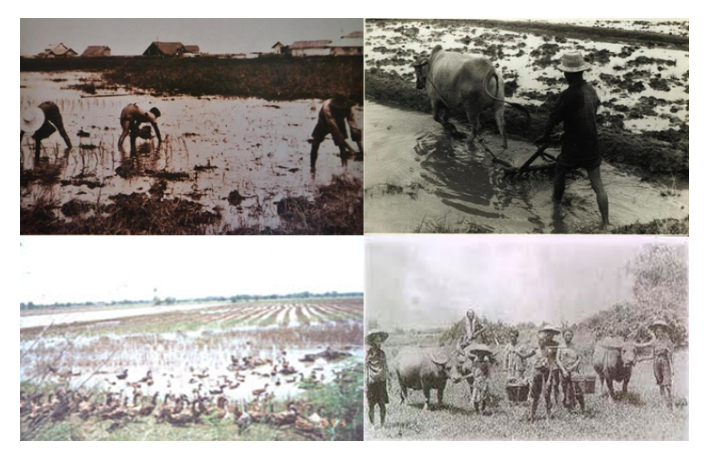
Image depicting ancient Thai agriculture.
Our agricultural practices are aimed at subsistence, ensuring we have enough to eat, and sharing any surplus without disturbing the ecosystem or causing environmental harm. There is a harmonious coexistence with animals and nature, with ancient farmers possessing an understanding of climate, soil, water, and plants in ways that sometimes cannot be explained by scientific principles.
Scientific advancements have brought new knowledge and prosperity, but they have also harmed traditional wisdom.
The first arrow of disaster for natural agriculture.
A significant change began about 200 years ago with Justus von Liebig, who formulated the Law of Minimum.
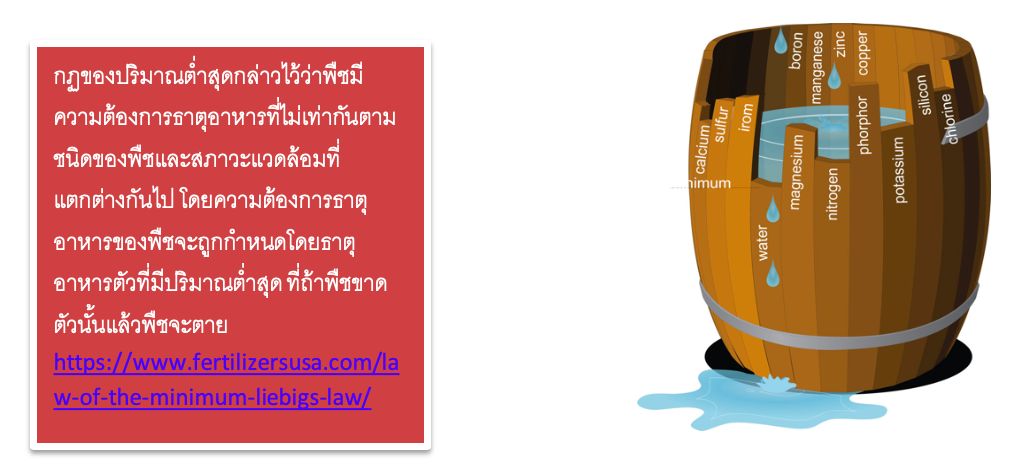
The Law of Minimum marked the beginning of chemical fertilizer use in agriculture, with some claiming that Liebig dismantled Aristotle's theory of humus (Mengel and Kirkby, 1978). The Law of Minimum is still in use today, but if we look back at how this law was derived, we can understand its weaknesses. In 1840, Justus von Liebig and his research team sought to determine what nutrients plants needed for growth by analyzing various plant samples to identify their chemical components. They hypothesized that any chemical detected in the analysis was a necessary nutrient for plants. The results of this hypothesis have persisted to this day, leading to the current tables of essential and non-essential nutrients.
The Green Revolution is a rose covered in poison, the arrow that pierces the heart of farmers.
At the beginning of last year, 2019, Pius Floris explained to the European Union's cabinet the long-term damage caused by chemical use in agriculture. He noted that after World War II, there was a severe food shortage worldwide, necessitating an urgent increase in agricultural production. After the war, factories that produced explosives were repurposed to produce chemical fertilizers based on Liebig's Law of Minimum, which successfully increased yields and generated wealth for many stakeholders. The agricultural chemical industry has since expanded globally.
Liebig's perspective as a chemist led to the formulation of the Law of Minimum, which is correct only from a chemist's viewpoint. What Liebig overlooked were the aspects of microbiology, botany, and ecology. The consequences of the Green Revolution, beyond increased yields, include:
- Plants become weak due to a lack of nutrients that build resistance, which are produced by soil microorganisms. The use of chemical fertilizers disrupts the microbial cycles in the soil. Additionally, when plants absorb excessive nitrogen, it interferes with calcium absorption, which is a signaling substance for plants, leading to compromised defense systems.
- Weak plants are then severely attacked by pests, prompting scientists to develop numerous pesticides and herbicides, marking the true end of natural agriculture (https://www.youtube.com/watch?v=YMW2uLumAQw&t=806s).
- The environment is destroyed, with soil degradation, acidification, chemical contamination of water, and severe destruction of soil microorganisms.
- Local wisdom is ignored and deemed outdated, with organic matter and food scraps considered waste and allowed to become pollutants.
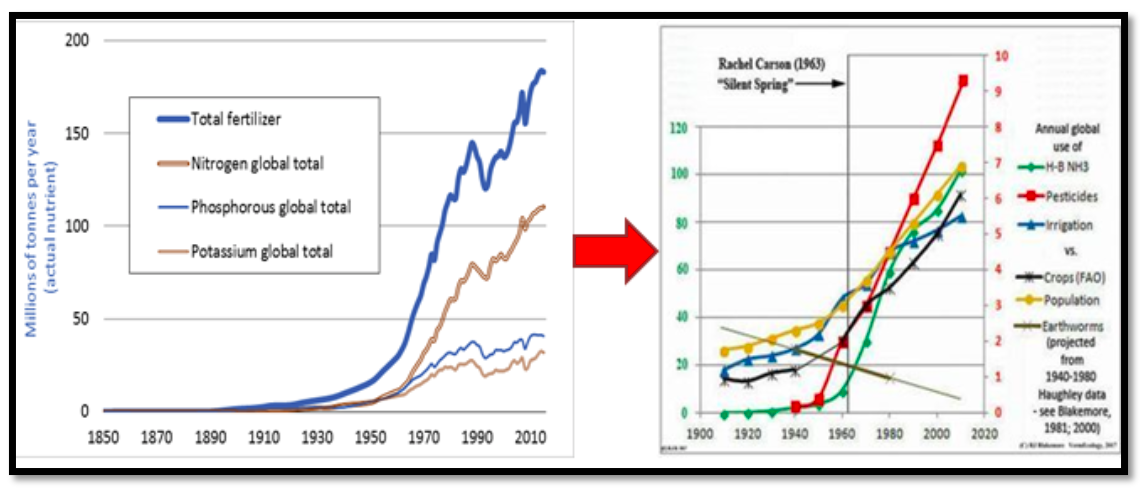
Image showing the increased use of chemical fertilizers and pesticides, while the number of earthworms in the soil decreases.
As shown in the image, since 1950, the increased use of chemical fertilizers has indeed led to higher yields, but the use of pesticides has also increased, and the number of earthworms has significantly decreased. Numerous studies confirm the clear detrimental effects on the soil.
The discovery of essential nutrients for plants led to the transformation of explosive factories into chemical fertilizer production for the first Green Revolution, resulting in soil degradation and weak plants that require increased pesticide use. This is a mutually reinforcing cause-and-effect relationship, akin to “blind men touching an elephant,” where only one aspect is understood and immediately applied. It is time to gain a deeper understanding for sustainable agriculture in the future.
Four Fundamental Insights for Designing Natural Agriculture
The successful completion of the Human Genome Project in 2003 has clearly underscored the research and knowledge generated before and after that point. Research conducted prior to this, particularly related to genetics and microorganisms, must be revisited, as the tools used to sequence genetic material have allowed us to understand the workings of small living organisms that we had never known before. Today, we can comprehend the communication systems of microorganisms, leading to the prediction that new antibiotics may not need to kill pathogens; we may simply need to disrupt their communication systems to halt their growth. Knowledge related to agriculture is similarly connected to discoveries made in 2003. The fundamental knowledge that must be deeply understood for the agriculture of the future can be divided into four areas:
- Plants as the elder siblings, the generous providers, truly the kitchen of the world.
- The environment—soil, water, air, and fire—as the origin of all things, balancing everything.
- Microorganisms, insects, and both small and large animals as long-standing allies of humanity.
- The human race as the younger siblings, newcomers to this world, self-indulgent and know-it-alls, yet eager to learn.
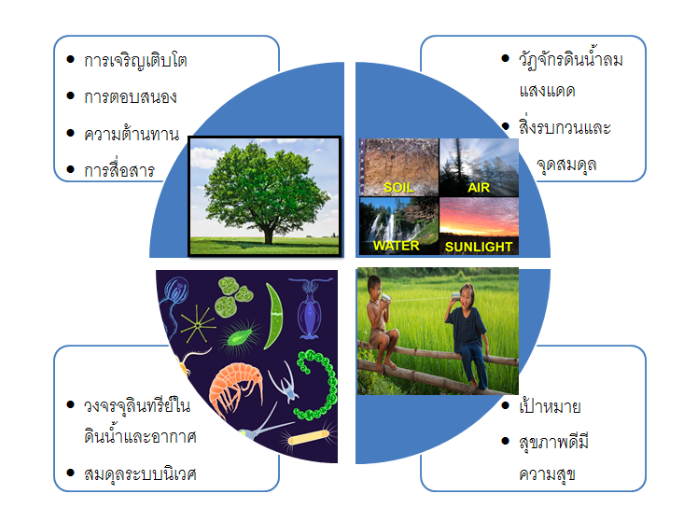
Four Fundamental Insights for Designing Natural Agriculture
- Plants: For farmers interested in natural agriculture, it is essential to start learning about plants from a different perspective. Plants are not just trees; they are living beings with consciousness, aware of heat and cold, and capable of internal and external communication, much like us. The only difference is that plants may not move at the speed we humans define. However, movement is not an issue for plants, as they have chosen to consume sunlight, carbon dioxide, and water as their food, all of which are abundantly available without the need for movement. Nevertheless, there are certain truths that nature-loving farmers must learn to design systems for maximum benefit.
1.1 Plants live like warm-blooded animals and humans.
Plants have mechanisms to regulate their temperature as much as possible. If exposed to hot sunlight, they will transpire through their leaves. If water is insufficient, they will close their stomata and turn away from the light. Additionally, the temperature underground, where microorganisms reside, directly affects growth. If the root zone temperature exceeds 28 degrees Celsius, it can be extremely harmful to soil microorganisms.
Design connection topic: Controlling temperature and humidity of the air and soil at the surface and root levels. Monitoring leaf and stem temperatures at different times can also indicate plant health.
1.2 Plants and humans have similar relationships with microorganisms.
Humans, animals, and plants have evolved alongside microorganisms for a long time. Generally, beneficial microorganisms are those that use oxygen, just like humans, animals, and plants. When the environment has sufficient oxygen and water, these microorganisms thrive, aiding in digestion, building immunity, and eliminating pathogens for humans, animals, and plants. Therefore, in design, it is crucial to balance air and water factors in the soil. If there is too much or too little water, it will affect the amount of air, leading to the growth of pathogenic microorganisms instead of beneficial ones.
Design connection topic: Creating living soil by controlling moisture, electrical conductivity, and temperature to balance water and air. These factors will sustainably revive the soil without using any additives.
1.3 Plants and humans prefer food from nature.
After the Green Revolution, the economy flourished, and people's lives became more convenient. However, alongside the significant increase in chemical fertilizer use in agriculture, the use of other chemicals also rose, particularly sugar consumption, which has led to a significant increase in diabetes and non-communicable diseases (NCDs). This causation is already acknowledged in the medical field.
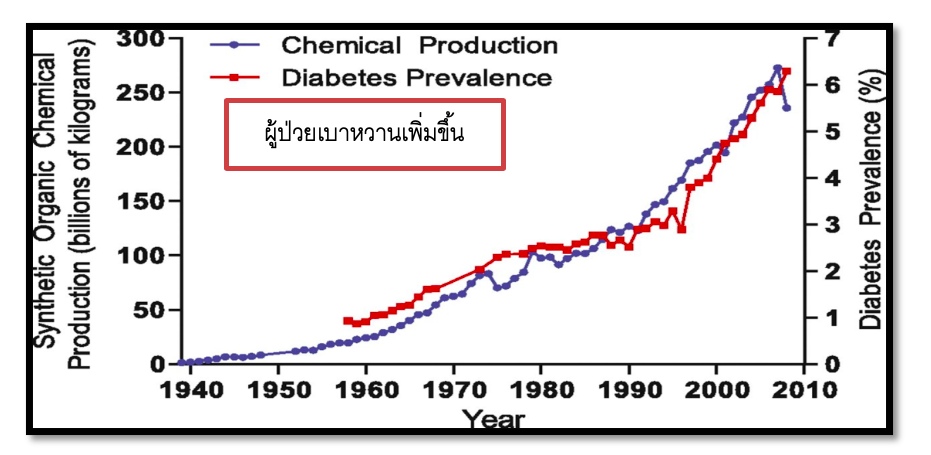
Image showing the increase in patients corresponding to the use of synthetic chemicals.
In addition to diabetes, excessive sugar consumption directly affects the body's immune system. This issue aligns with the use of chemical fertilizers for plants. Beyond the residual effects of chemical fertilizers on soil and water, there is also the mechanism of calcium absorption in plants, which decreases due to nitrogen fertilizer use, as calcium plays a role in immune regulation. The resulting weakness is a consequence of chemical use. Besides the adverse effects of diabetes, the chemicals consumed can also integrate into genes, affecting mutation and cancer directly.
Design connection topic: Controlling temperature, humidity, and stable electrical conductivity in the soil will create a favorable atmosphere for microorganisms to assist plants in nutrient acquisition. Therefore, the temperature should not exceed 28 degrees Celsius, and moisture should be at a level that plants can utilize (50% of available water).
1.4 Plants and humans have similar nutrient absorption processes.
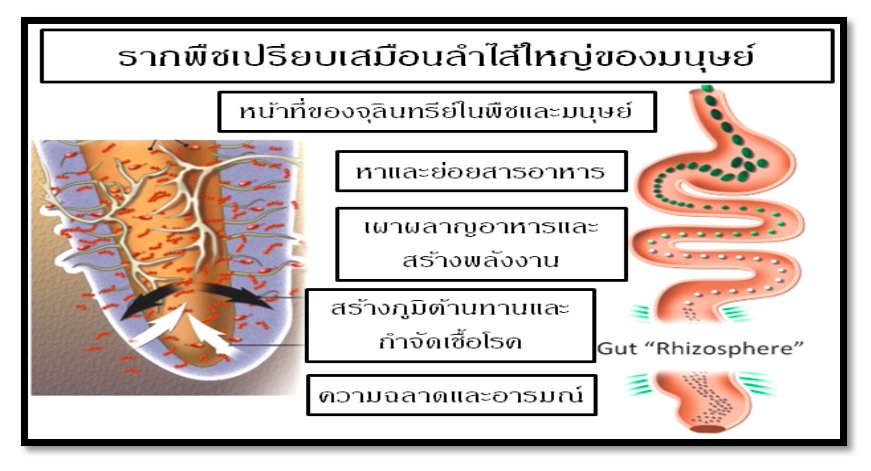
Humans consume food through the mouth, but most nutrient absorption occurs in the large intestine, which functions similarly to plants. Humans have microorganisms, prebiotics, and probiotics that aid in digestion and absorption, while plants have rhizosphere microorganisms that operate through similar mechanisms. We have only recently begun to understand these relationships deeply. The use of various chemicals, including fertilizers, pesticides, or herbicides, directly harms the microorganisms around plant roots. The symptoms of plants with destroyed root-associated microorganisms resemble those of humans with inflammatory bowel disease. Therefore, the use of synthetic chemicals must be carefully considered before application.
Design connection topic: The use of organic fertilizers, local plants, companion plants, and local microorganisms are essential considerations in our designs.
There are still many interesting stories about plants to share. See you next time.
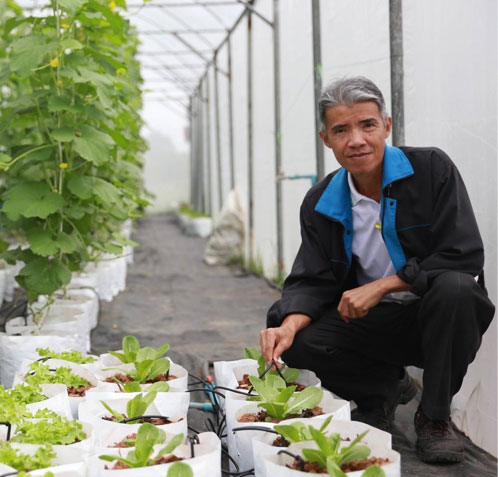
ABOUT THE AUTHOR
ดร.ประเสริฐ ปิ่นงาม (Ph.D., TREES-A NC) วท.บ. สาธารณสุขศาสตร์ ม.มหิดล