
Good News! Asia Will Be the First Region to Recover Economically from COVID-19
Recently, the term that many people are discussing is undoubtedly New normal, which literally translates to the new normal. This is a prediction from experts around the world regarding the future situation, forced by the COVID-19 pandemic to undergo changes. An article titled Could the next normal emerge from Asia? from McKinsey has forecasted the situation and new normal of Asia with great interest, and TerraBKK would like to summarize it as follows:
Asia: The Land of the Birth of the Next Normal
McKinsey has simulated and assessed the global economic impact, indicating that the effects of COVID-19 could lead to a global GDP decline of approximately 4.9% to 6.2% from Q4/2019 to Q2/2020. For Asia, which comprises 60% of the world's population and has a poverty rate of 35%, a concerning report from the World Bank states that the economy in Asia will contract by 0.5%, pushing 11 million people across the continent into deeper poverty, especially in countries severely affected by the pandemic.
However, being among the first regions to be impacted by the pandemic and managing to control and limit its spread effectively has led to the perception that Asia can recover quickly, becoming a beacon of hope for the New normal in the global economy.
This expectation is not unfounded. In 2018, a study on developing countries worldwide by McKinsey found that Asia's economic figures were among the highest in the world, with 7 industries growing between 3.5% and 7%. Over the past 50 years, GDP per capita in Asia has shown remarkable growth, particularly in China, Hong Kong, Singapore, Indonesia, South Korea, Malaysia, and Thailand. This is evident from the recovery of the economy following the global financial crises in 1997 and 2008, where Asian countries managed to return to normal GDP levels within just 1-2 years.
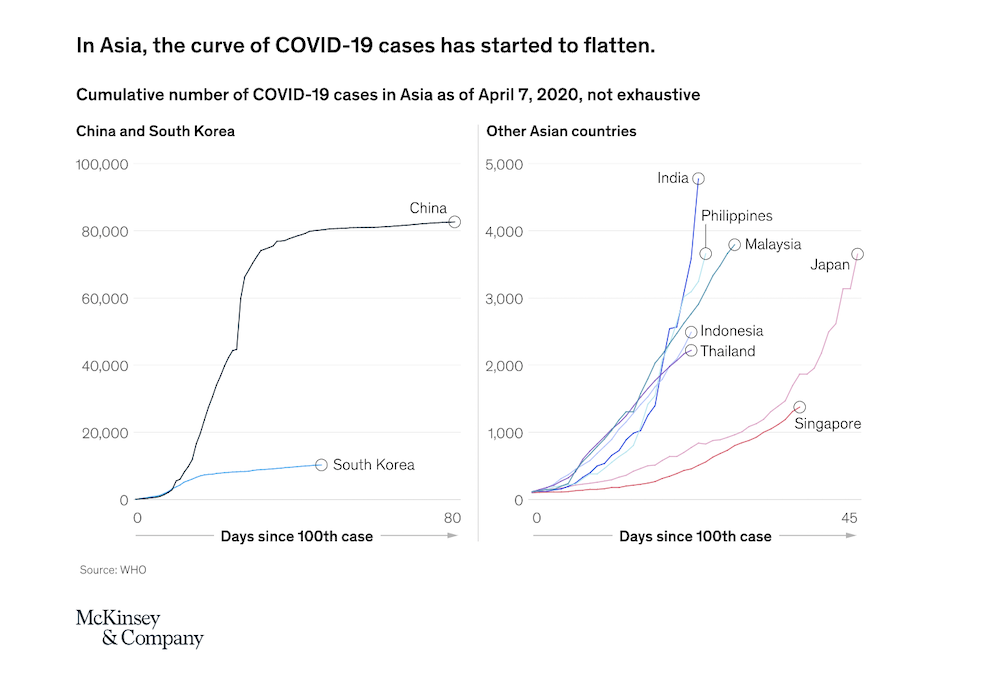
Although the COVID-19 outbreak began in China, today China has demonstrated its ability to recover economically and manage the pandemic effectively, returning to normal economic activities as before the outbreak. Similarly, South Korea appears to be on track to follow China's success, as evidenced by the stable growth of cumulative cases.
Regarding economic recovery in Asia, McKinsey believes that it will be among the first regions in the world to recover and will also be a key player in creating the global New normal or Next normal due to the following factors:
Social Management and Governance
In the face of an acute crisis, many regulations and rights have been re-evaluated, especially regarding tracking individuals through applications, which were previously seen as violations of personal rights and faced societal opposition. However, during the pandemic, this measure has gained more acceptance. Not only government tracking but also private sectors allowing employees to work remotely have contributed to effective tracking, helping to limit and control the spread of the virus. The norms of privacy during this pandemic may become the new standard or New normal for tracking in a post-COVID-19 world.
Additionally, there has been an interesting prioritization in managing issues, particularly concerning employment. The pandemic has left many unemployed, and in Australia, measures have been taken to address this by allowing over 20,000 airline workers, convenience store employees, and others to work with Woolworths, an Australian retail business, to distribute food and essential supplies to others, simultaneously addressing unemployment and welfare issues.

New Ways of Working and Consuming
It is evident that e-commerce has become a booming business, thriving despite the COVID-19 crisis. The work from home and social distancing measures have integrated online systems into daily life, affecting routines, work, education, consumption, and more. This is undoubtedly one of the New normals that have emerged during this time.
For example, China has developed an online learning platform capable of accommodating 50 million students simultaneously. In terms of consumption, China's parcel delivery business saw a 400% increase in sales during the pandemic, similar to South Korea, which recorded 3.3 million online orders in a single day.
The activities on the online world that have become intertwined with people's daily lives demonstrate the expanded limits of connectivity, raising questions for companies and other industries about whether they can keep pace with the technological advancements that are now integral to consumers' daily lives.

Rapid and Comprehensive Problem Solving: Top Down and Bottom Up
This represents a genuine problem-solving approach that involves participation from the population and other sectors. For instance, China was able to mobilize tens of thousands of doctors and other personnel within just a few weeks, increasing the number of hospital beds by tens of thousands and injecting 1 trillion yuan to enhance the necessary infrastructure to address the pandemic crisis swiftly.
Financial policies have also been implemented to stimulate the economy from the grassroots level. For example, Australia provided wage subsidies of 130 billion Australian dollars, while Singapore injected 38 billion dollars to boost the economy.
Such financial policies, according to McKinsey, have positioned Asia as a region capable of attracting and managing resources effectively from both top down and bottom up.