Why Humans Need to Learn to Live from Plants
Dr. Prasert Pin-ngam (Ph.D., TREES-A NC)
B.Sc. in Public Health, Mahidol University
The evolution of the latest generation of plants that have survived to the present day occurred approximately 1.8 million years ago during a period known as the Quaternary Period. This was a time when the world was cooling down, large trees died, and grasslands of plants such as wheat and barley emerged. Meanwhile, early humans survived by hunting for food, gradually transitioning to agriculture about 13,000 years ago (https://www.kremp.com/plant-evolution-timeline). Our ancestors, Homo Sapiens, began walking on this Earth around 200,000 years ago, so it is not surprising that the number of gene phenotypes in rice exceeds that of humans. Despite having fewer genes, humans have a unique way of passing knowledge to future generations, which is through learning and documentation. However, no one is perfect, and mistakes are bound to happen.
The Apology of the Decade
In November 1992, Pope John Paul II publicly apologized to Galileo for the Church's wrongdoing against him 359 years prior. The accusation against Galileo was his assertion that the Earth revolves around the Sun, which contradicted the biblical claim that the Earth is the center of the universe. This led to Galileo's imprisonment until his death. He famously stated, “He truly accepted the Church's accusations, but the Earth still revolves around the Sun.” Later, it was argued that Galileo's actions were meant to protect the Bible from misinterpretation by some, while the Church did the opposite by defending a misinterpreted scripture. Nevertheless, this highlights what distinguishes humans from other living beings: our system of recording knowledge, transmitting it, and preserving traditions and cultures. Throughout history, there have been many events that demonstrate human errors stemming from the learning and transmission systems we adhere to today. This prompts us to reconsider what accuracy means from a human perspective. Today, the knowledge, beliefs, and faith we pass on are they truly what will ensure our species' survival? When compared to plants, which have a system of passing on experiences and survival strategies through genes to future generations, the question arises: does having more genes make plants smarter than us? This is an intriguing point, because having more genes may provide a more accurate data recording system, or we could say that plants have a larger and more stable Big Data system than we do. Therefore, understanding plants more deeply is essential.

Source: https://web.ku.ac.th/schoolnet/snet2/knowledge_math/time_nature.htm
Efforts to Understand Plants
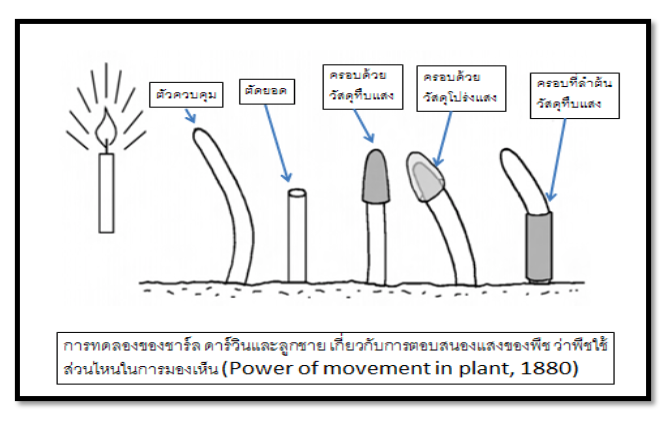
Charles Darwin published the book On the Origin of Species in 1859, a famous work that has influenced the world's perspective on living things to this day. The book explains how different life forms evolve or adapt based on various factors, with these processes occurring gradually. However, it is now discovered that changes can happen rapidly, leading to the notion that living beings are continuously evolving. After publishing this historical book, in 1880, Charles Darwin and his son, Francis Darwin, a botanist, published another book titled Power of Movement in Plants, which sold out quickly at the time. One experiment that still impacts us today is the study of how plants perceive light, conducted with Canary grass. The experiment began by growing the grass in a dark room, and once it grew, it was taken out for testing.
In the experiment:
Plant 1: Control
Plant 2: Top cut off
Plant 3: Covered with opaque material at the top
Plant 4: Covered with transparent material at the top
Plant 5: Covered with opaque material on the stem
The results concluded that plants use their tops to perceive light and orient themselves towards the light source. This simple experiment has been around for nearly 200 years.
In the present day, Daniel Chamovitz published What a Plant Knows in 2012, which includes experiments and compiles the capabilities of plants in terms of sight, taste, smell, touch, hearing, balance, and memory. This can be summarized in a comparison table between plants and humans.
Comparison Table of Plant and Human Capabilities
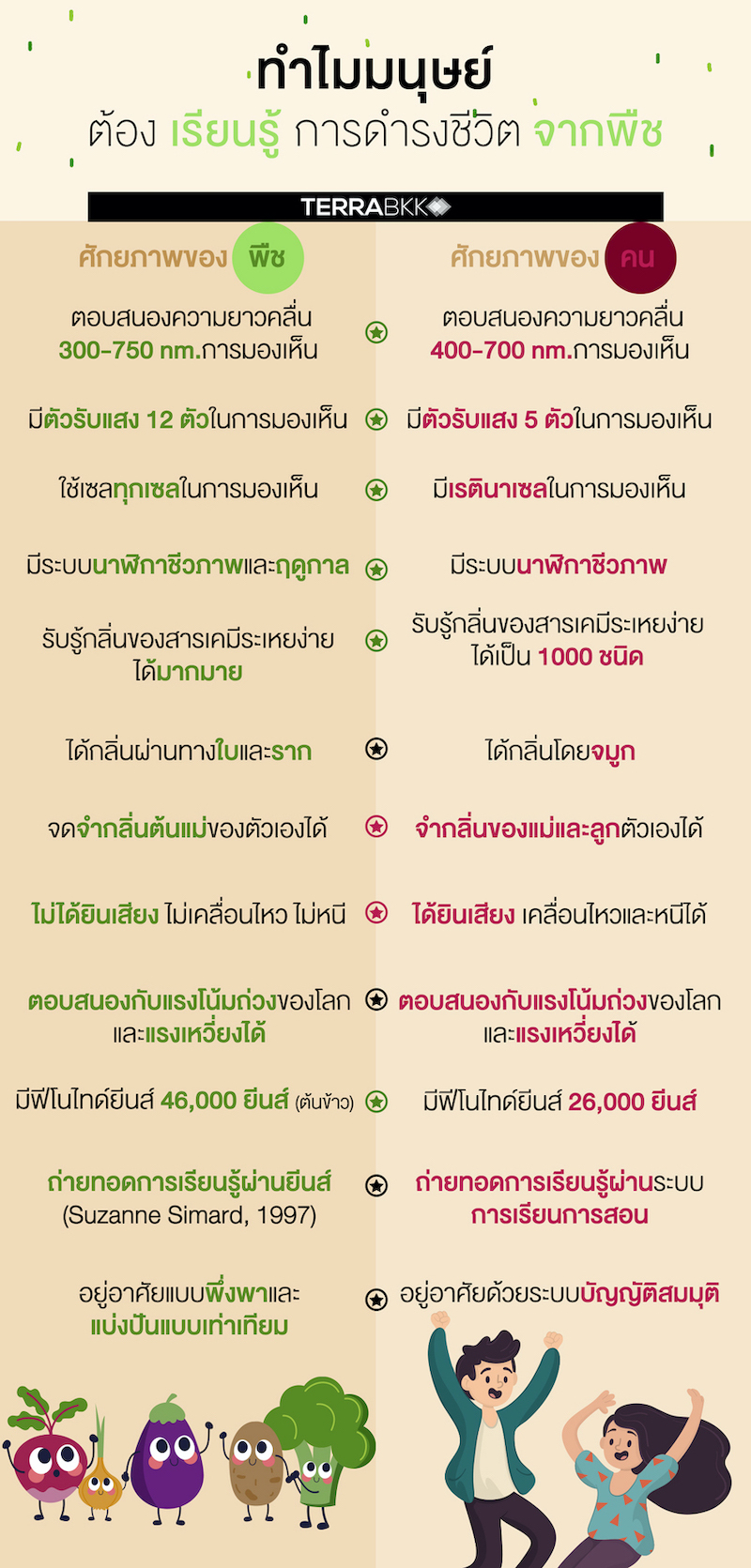
**Yuval Noah, Homo Deus; 2016. Inter subjective reality = Constructed conventions
This refers to what humans collectively establish as guidelines for shared practices, such as laws, religions, nations, ethnicities, and economic systems.
From the table above, it is evident that when studying the actual capabilities, plants respond to environmental conditions or stimuli far more than humans do, except in terms of hearing, where it was found that plants have genes that can lead to deafness. This may be linked to the fact that plants do not move or escape. Overall, it can be concluded that the potential of plants generally surpasses that of humans.
Sharing Equally Without Discrimination
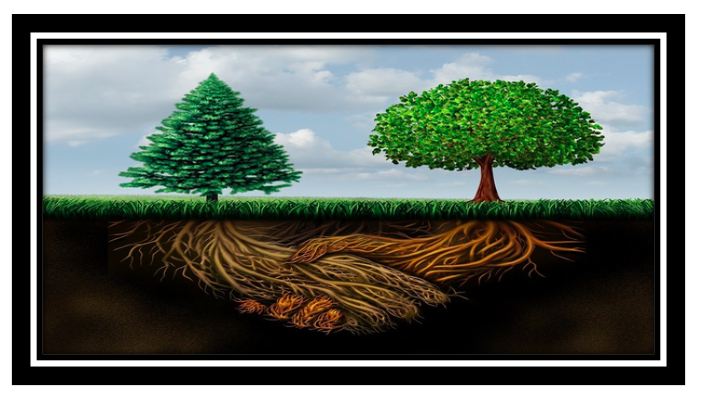
Source: https://www.wikye.com/trees-talk-to-each-other-in-a-language-we-can-learn-how
Our education system emphasizes learning and transmitting knowledge that is tangible and observable. Understanding these aspects inevitably guides our actions passed down through generations. Understanding plants is no different. Knowledge about fertilizers or chemicals used on plants is a product of studying plants above ground. However, we have little understanding of the impacts or factors occurring underground, leading to a lack of attention. Nevertheless, there is research (Below Ground Study) by Suzanne Simard that attempts to study the underground mechanisms of forest systems, revealing relationships that provide us with new knowledge as significant as the discovery of the Higgs particle from the perspective of nature and environmental lovers. Suzanne conducted experiments injecting isotopes C-13 and C-14 into three different tree species and tracked the changes in the transmission of isotopes between the trees and surrounding mycorrhizae, demonstrating a relationship that shows true interdependence.
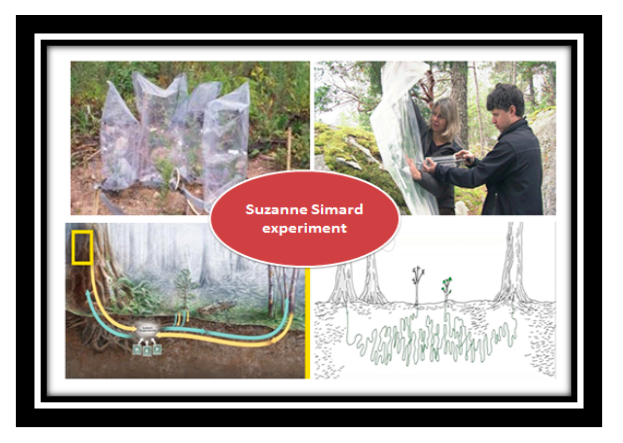
The key point illustrating coexistence is that all three tree species share food produced from photosynthesis equally. The larger or shaded trees share more of their yield than others, with mycorrhizae acting as a connector between the three trees and extending to others as well. This shows that the underground system of trees communicates and shares food with each other continuously, and they also send alarm signals when intruders enter the area. Additionally, an interesting point is that when a mother tree dies, it transmits information about disturbances through genes to the next generations.
In summary, the lessons from trees show that with greater evolution than humans, a larger number of genes, and better response capabilities, they perceive the world more broadly according to the light spectrum. Furthermore, plants have a system of transmitting knowledge and experiences through genes that is less prone to error than spoken words, and importantly, they have a sharing and interdependent system that does not discriminate by class or ethnicity for sustainable growth together. These factors may provide sufficient reason as to why we should learn sustainable living from plants as a model. If we just open our minds, I believe that the plant species are ready to teach us, the unfortunate Homo Sapiens, various lessons so that we can work together to preserve this Earth, the planet that has given birth to us all—humans, animals, plants, and microorganisms—to coexist for a long time to come. So how should we begin? Stay tuned for the next installment.
ABOUT THE AUTHOR
ดร.ประเสริฐ ปิ่นงาม (Ph.D., TREES-A NC) วท.บ. สาธารณสุขศาสตร์ ม.มหิดล