How Vulnerable is Bangkok on Rainy Days?
Approximately 250 years ago, Bangkok was like a flower in full bloom. From 1958 to the present decade, Bangkok has grown about 16 times, with the population increasing from 1.6 million to 5.6 million in 2016, and it is expected to rise to as much as 15.32 million by 2020 due to a significant number of hidden residents and ongoing migration from other provinces to the capital.
The city's growth, which has not been planned for the long term, has led to unsustainability. This is why it is essential to prepare urban development strategies at least 5-10 years in advance, covering public service provision, adequate infrastructure, land use regulations, land ownership reform, and more. Additionally, there are challenges in other areas such as safety, health, poverty, and the quality of life of the population.
Is flooding in Bangkok due to land subsidence every year?
One of the significant challenges is that Bangkok is located on low-lying land, with some areas below sea level. Originally, the potential of the Bangkok area was suitable for agriculture and as a floodplain for the Chao Phraya River. However, replacing flood-absorbing areas with housing and urban development has significantly influenced land use regulations and urban development control.
The reason Bangkok is always at risk of flooding crises is due to its geographical location in a river delta, combined with land subsidence caused by excessive groundwater extraction, leading to groundwater depletion and unstable soil layers. Did you know that Bangkok subsides by an average of more than 10 cm per year? Meanwhile, sea levels are rising every year, particularly since 1967, at a rate of 4.1 millimeters per year.
The Department of Groundwater Resources has surveyed areas facing groundwater shortages (indicating that groundwater is critically low, leading to land subsidence) using data from 1978 to 2008, a total of 30 years. The survey utilized benchmark stations for measuring land subsidence, revealing that the area with the highest accumulated land subsidence is Bang Kapi District, which has subsided by over 1.2 meters, while Nonthaburi has the lowest subsidence rate, averaging no more than 1 cm per year (data from the Military Mapping Department, Royal Thai Army).
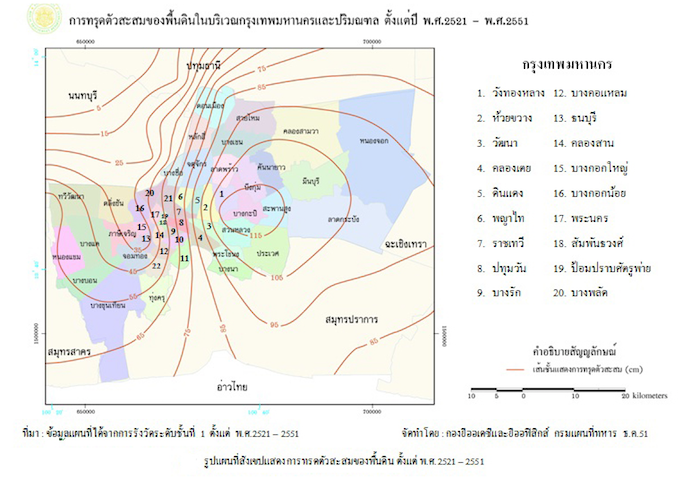
Despite the clear statistical evidence showing that Bangkok has been experiencing continuous land subsidence for many years, did you know that in some areas, the ground level is already 2 cm below the Chao Phraya River? Therefore, it would be inaccurate to generalize that the frequent flooding in Bangkok, especially during heavy rain, is solely due to land subsidence. What are the other causes of flooding?
Waste and Sewage Related to Flood Risk
Although local administrative agencies like municipalities have been seriously campaigning for waste management since 2005, the amount of waste in the city and light industry has alarmingly increased from 7,000 tons per day in 1993 to 8,800 tons per day in 2015, and it is expected to reach 11,500 tons by 2025, leading to waste clogging or contamination in various water sources.
Due to the rapid urbanization of Bangkok, the flow of water from the Chao Phraya River during the monsoon season is slow. When there is a prolonged period of rain, flooding occurs quickly. Bangkok has experienced such flooding events multiple times, including in 1975, 1977, 1978, 1983, 1995, and most recently in 2011.

The major flooding event in 2011 provided clear lessons in post-flood management. Many communities that collaborated in preparation and prevention processes were able to recover quickly. However, in urban areas with diverse and dynamic sizes, management is not easily achievable, leading to widespread damage, particularly in the manufacturing sector, which suffered 82% of the losses.
If you ask how vulnerable Bangkok is on rainy days, statistics from rainfall measurement stations during the recent heavy rain indicate that if rainfall exceeds 100-120 millimeters, flooding can occur within 15 minutes. If rainfall exceeds 140 millimeters, flooding can take over an hour to drain. - เทอร์ร่า บีเคเค
Article by: TerraBKK Investment Tips
TerraBKK Find Good, Valuable, Affordable Homes