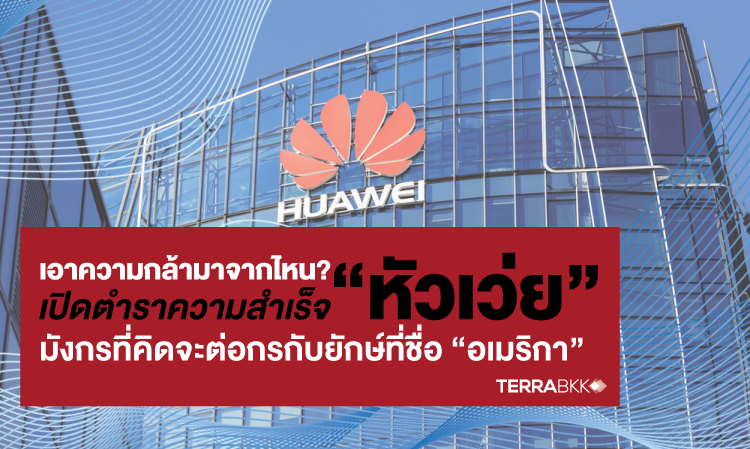
Where Does the Courage Come From? Unveiling the Success Formula of Huawei, the Dragon Ready to Challenge the Giant Named America
Where Does the Courage Come From?? Unveiling the Success Formula of Huawei, the Dragon Ready to Challenge the Giant Named America
Over the past few weeks, the world's attention has been focused on the trade war between China and the United States, which has escalated into a technology war (Tech war). The Chinese IT brand, Huawei, has refused to bow down to the U.S. any longer. The outcome of this situation remains to be seen, but one question that many, especially those outside the industry who are starting to follow this news, might wonder is, "Where does Huawei get the courage to confront a heavyweight like the United States, and what has made the heavyweight so furious?"
One of the key reasons lies in Huawei's remarkable leap in success, which has made it impossible for the heavyweight to overlook. Moreover, Huawei's robust growth has positioned it as the most influential brand in China, with a company valuation ranking among the Top 100 in the world. This has given the relatively young IT brand, just over 30 years old, the audacity to stand firm against the United States without fear. If you want to know the secret behind Huawei's success, let's explore the Huawei brand management manual together.
1. Build a Business on a Solid Foundation Although the world knows Huawei as a smartphone manufacturer, if we trace back to the brand's origins in 1987, founded by Ren Zhengfei, a former military officer, along with six others in Shenzhen, it started as a major producer of networking and telecommunications equipment. It gradually grew in tandem with China's population growth before branching out into other businesses.
One of Huawei's advantages is that it was in the right place at the right time. When Huawei was founded, China was experiencing rapid development, leading to a high demand for communication network systems in many major cities. As we know, China's population is enormous; according to McKinsey & Company, a leading global management consulting firm, by 2030, China's population will reach nearly one billion, and by 2025, 221 cities in China will have populations exceeding one million. Given this demand, it's no surprise that Huawei has been able to expand its business rapidly and shows no signs of slowing down.
Today, Huawei is not just a small company serving only domestically; it operates in over 170 countries worldwide, providing services to one-third of the global population. While it may not yet be number one in the market, it holds a top-three market share.
2. As Long as the World Keeps Turning, Huawei Will Keep Developing Huawei is known as one of the world's leading companies in research and development. To illustrate, in 2016, Huawei was willing to cut 14.6% of its revenue to invest in development, establishing 15 research centers and collaborating with over 30 Innovation Centers worldwide. This is because they believe in the power of continuous development to meet customer needs in terms of design, functionality, and innovative features that consumers seek.
3. Implement a Rotating CEO System Instead of appointing a single CEO to lead the organization, Huawei has chosen to rotate its CEO every six months through a voting system involving over 80,000 employees. They select 60 representatives to choose candidates to form a committee that will select the next CEO, while Ren Zhengfei remains the ultimate decision-maker.
The origin of this strategy is said to come from studying the leadership behavior of two animal species: a herd of wild buffalo, which has only one leader. When the leader decides on a direction, the rest of the herd follows without question. However, when the leader dies, chaos ensues, and the herd may disband. In contrast, a flock of birds flies in a V formation, with the bird at the tip leading the others. When it tires, another bird takes its place. Ren Zhengfei has chosen to manage the company like the birds, distributing responsibilities systematically, as he does not want the company to rely solely on one individual.
4. If Heart Isn't Enough, Give Shares Finally, Huawei employs a unique strategy that deserves admiration. Many people may not know that Huawei is not a publicly traded company because it does not want shareholders to interfere with the company's principles, which are key to its success. Instead, it chooses to win the hearts of employees by allowing them to become co-owners of the company. Although he is the founder, Ren Zhengfei holds only 1.4% of the company's shares; the rest are given to employees who perform at their best, hoping to instill a sense of ownership in these employees rather than treating them as mere wage earners.
This is the strategy that solidifies the brand's strength, leaving no doubt as to why it has emerged as a brand recognized worldwide and has made the United States react so intensely.