4 Deadly Diseases That Destroy the Lungs
"Cough cough" is a familiar sound that you can recognize without turning around. For some, a few coughs might be normal, but for others, in addition to coughing, they may appear emaciated and worn out. If I had to guess, that person must be a smoker! Why? Because coughing is one of the signs indicating abnormal lung function.
Every year on May 31, we observe World No Tobacco Day to raise awareness about the impacts and dangers of smoking and tobacco, including secondhand and thirdhand smoke. This year, the World Health Organization (WHO) has set the theme for member countries to collaborate on: Tobacco and Lung Health. In Thailand, the campaign theme is "Cigarettes Burn Lungs" to educate the public about the importance of lung health. Most lung diseases take years, often over a decade, to develop, leading people to overlook the potential consequences.

How Are Cigarettes Related to the Lungs?
Professor Dr. Prakit Watthasathakij, Secretary-General of the Tobacco Control Foundation explains that the lungs are the first barrier that absorbs the most toxins from cigarette smoke compared to other organs. Smoking causes various diseases, with half of the deaths attributed to smoking resulting from lung diseases. The majority of Thai smokers suffer from lung cancer, emphysema, and pneumonia due to smoking, which weakens the lung's immunity against infections, as well as tuberculosis, making smokers more susceptible to contracting and exacerbating the disease.
According to data from 2017 analyzed by the Department of Community Medicine at Ramathibodi Hospital, 72,656 Thais died from smoking, with 49% of those deaths resulting from lung diseases caused by smoking: 13,727 from lung cancer, 10,852 from emphysema, and 10,833 from pneumonia and tuberculosis, totaling 35,412 deaths.
Today, the Thai Health Promotion Foundation team invites everyone to learn about the 4 Deadly Diseases That Cigarettes Destroy the Lungs to raise awareness and ensure safety from cigarette smoke for ourselves and those around us.
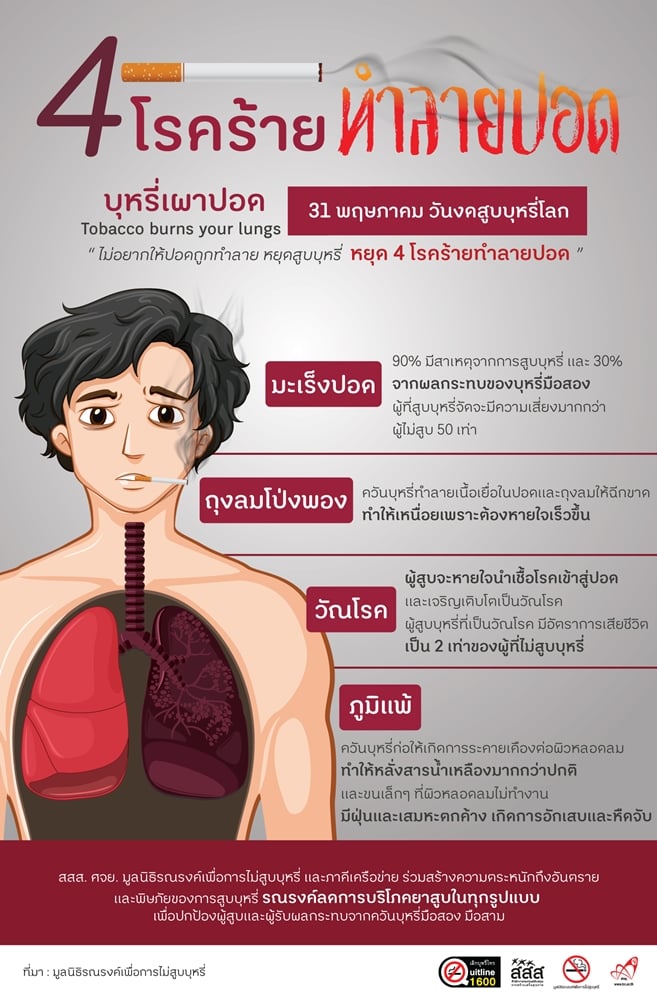
Download at... 4 Deadly Diseases That Destroy the Lungs http://llln.me/tggcm0t
4 Deadly Diseases That Cigarettes Destroy the Lungs
Lung Cancer is caused by the lungs being exposed to toxic or carcinogenic chemicals through breathing. Approximately 85-90% of lung cancer cases are attributed to smoking.
Symptoms of Lung Cancer
- Chronic cough, blood in sputum, shortness of breath
- Other symptoms may include bone pain and headaches if it has spread to other organs
- At-risk groups should consult a doctor if coughing persists for more than 3 weeks or if there are unusual coughs
Emphysema consists of millions of tiny air sacs in the lungs. These air sacs are smaller than the tip of a needle, with very thin walls and capillaries lining them. When breathing, oxygen-rich air reaches these tiny sacs, where oxygen passes through the walls into the capillaries to nourish the body, while carbon dioxide is expelled from the capillaries into the air sacs and exhaled.
When smoking, cigarette smoke is inhaled into the respiratory tract and reaches the air sacs, where nicotine and other chemicals in the smoke are absorbed into the capillaries. Nicotine then travels through the bloodstream to the brain, acting as an addictive substance that keeps smokers hooked.
Symptoms of Emphysema
- Chest tightness
- Shortness of breath due to rapid lung deterioration
Tuberculosis is caused by lung tissue being damaged by toxins in cigarette smoke, reducing the effectiveness of eliminating tuberculosis bacteria that are inhaled into the lungs. This makes smokers more susceptible to tuberculosis infections. Smokers who contract tuberculosis find it harder to control the infection, leading to pulmonary tuberculosis.
In smokers with tuberculosis, the disease is more severe, progresses rapidly, and is harder to treat. Smokers with tuberculosis have a 3-4 times higher risk of death.
- Symptoms of Tuberculosis
- Coughing for more than 2 weeks
- Coughing up blood-stained sputum
- Weight loss, fatigue, easy exhaustion
- Chest pain while breathing or coughing
- Loss of appetite
- Low-grade fever, night sweats
Allergies cause irritation to the bronchial tubes, leading to excessive mucus production. Cigarette smoke disables the tiny hairs lining the bronchial tubes, which normally help sweep dust and mucus out. When these tiny hairs are impaired by cigarette smoke, dust and mucus accumulate in the bronchial tubes. For those with asthma, smoking or exposure to cigarette smoke can worsen symptoms and make them harder to control, leading to faster lung deterioration and requiring more medication.
How Do Asthma Attacks Occur?
In individuals with asthma, when breathing in allergens or irritants, the bronchial lining becomes inflamed, and the muscles around the bronchial tubes constrict, narrowing the airways and making it difficult to breathe, resulting in asthma attacks.

Professor Dr. Prakit concludes by urging smokers and their families to recognize the truth that the lungs are harmed by smoking. Every time a cigarette is smoked, one might think it’s harmless and that it will be a long time before developing tuberculosis, lung cancer, or emphysema. However, every cigarette smoked damages lung tissue. Just as cigarette smoke irritates our eyes, imagine how it affects our lungs. The damage from smoking accumulates over time, and by the time symptoms appear, it may be too late. Therefore, the best way to heal the lungs is to quit smoking and avoid exposure to secondhand and thirdhand smoke, as they can also trigger asthma symptoms.
Everyone can help reduce the risk of illness. All it takes is to start by putting down the cigarette today and opening up to a healthier future. The Thai Health Promotion Foundation, the Tobacco Control Research and Knowledge Management Center, the Tobacco Control Foundation, and partner networks are working together to raise awareness about the dangers and harms of smoking, campaigning to reduce tobacco consumption in all forms to protect smokers and those affected by secondhand and thirdhand smoke.
Thank you for the information from www.thaihealth.or.th