
How Do Trees Absorb Airborne Toxins?
It is a curious question: how do trees absorb toxins, and how can they be grown indoors when we learned as children that trees release carbon dioxide at night, making them unsuitable for bedrooms?
However, a shift in this traditional thinking came from NASA's research, which discovered that certain types of trees can absorb toxins and purify the air. Many of these can be grown both indoors and outdoors, thriving particularly well in Thailand's humid tropical climate. This awareness has sparked a new trend in home decoration, as these plants are incorporated into rooms just like furniture or decorative props. The reason trees can absorb airborne toxins can be explained simply as follows:

1. Absorbing toxins through transpiration via stomata - Air-purifying plants transpire more than other types of trees. This transpiration process causes the temperature on the leaf surface to differ from the outside air, creating air circulation around them. This allows toxic air to flow down to the plant roots, which are rich in microorganisms. These microorganisms break down the toxins into nutrients for the plant.
2. Absorbing toxins through water uptake from the roots - When watering the plant at the base, water seeps into the roots, and the plant quickly absorbs it for use in various parts. In this process, air containing oxygen, nitrogen, and mixed toxins is drawn into the soil around the roots, where microorganisms convert the toxins into nutrients for the plant.
3. Absorbing toxins through air uptake - Simultaneously, when the plant absorbs air contaminated with toxins through the stomata, it transfers this air to the roots, and the microorganisms surrounding the roots break down those toxins.
In addition to the familiar carbon dioxide that we know trees help absorb, there are many other toxins present in our living environments, whether at home or in the office, that are released into the air from everyday items. These include formaldehyde, xylene, toluene, benzene, ammonia, and alcohol, which are found in various chemical products.

Air-purifying plants can be grown both indoors and outdoors, and there are many types available, including Dracaena Fragrans, Gerbera, chrysanthemums, anthuriums, Croton, Rhapis, Spider Plant, Neoregalia, Golden Pothos, and many more.
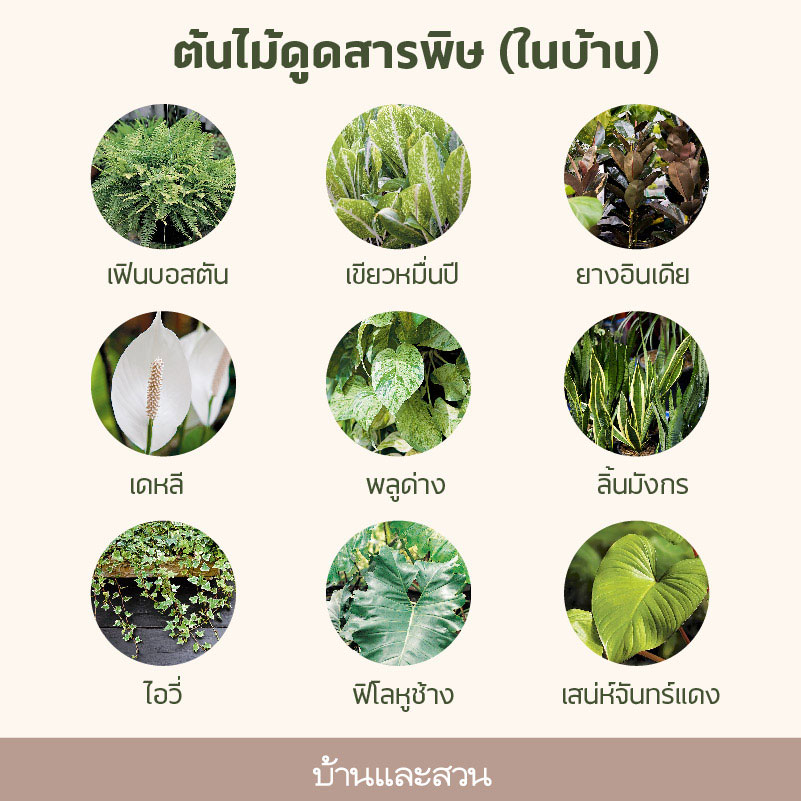
Air-purifying plants are suitable for indoor planting.

Air-purifying plants are suitable for outdoor planting.
The principle of placing air-purifying plants indoors is to choose locations with adequate light to maximize their air-purifying processes, including transpiration, water absorption, and air uptake, all of which require sunlight. Additionally, consider that the breathing space for humans occupies approximately 0.17-0.23 cubic meters. If plants are placed within this breathing zone, they can help purify the air toxins from the human body as well.

In the bedroom, where we spend time at night when trees release carbon dioxide, there are several types of plants that release oxygen during the night, such as Snake Plant and Aloe Vera, making them suitable to place near the bed. However, other types of plants can also be placed in the bedroom as long as they are positioned outside the breathing zone.
For outdoor areas, such as gardens, there are many types of trees that can be planted. Larger trees, like Rain Trees and Devil Trees, can effectively absorb carbon dioxide and help trap dust from entering the home. Therefore, landscaping or planting trees around the house is one of the solutions to address air pollution at its source, which has been proven effective in many countries.
By JOMM YB
Illustrations by Atiyah Supakun
References: Department of Health, Ministry of Public Health / www.wur.nl / www.nectec.or.th
Thanks to information from www.baanlaesuan.com