Navigating the Diverse Educational Landscape of Thailand
Navigating the Diverse Educational Landscape of Thailand
In recent years, Thailand has become an increasingly popular destination for international students, particularly those from China. This trend is not coincidental; it arises from several positive factors that have attracted many international families and individuals to pursue their education at various academic institutions across Thailand.
A Popular Trend Not by Chance
Over the past decade, academic institutions in Thailand have gained popularity among international students, especially from China. Although there was a slowdown during the COVID-19 pandemic, interest has surged again as the situation improved.
The main factors contributing to the appeal of academic institutions in Thailand include global dynamics such as economic downturns, political instability, and rising education costs in Western countries. These circumstances have led Chinese parents to consider Southeast Asia as a viable option for their children's education. Thailand, in particular, has seen a significant increase in the number of students from China.

Since 2019, over 90,000 Chinese students have enrolled in academic institutions across Southeast Asia, with the majority in Singapore, Thailand, Indonesia, and Vietnam. Notably, Thailand ranks among the top 10 countries where Chinese families send their children to study abroad.
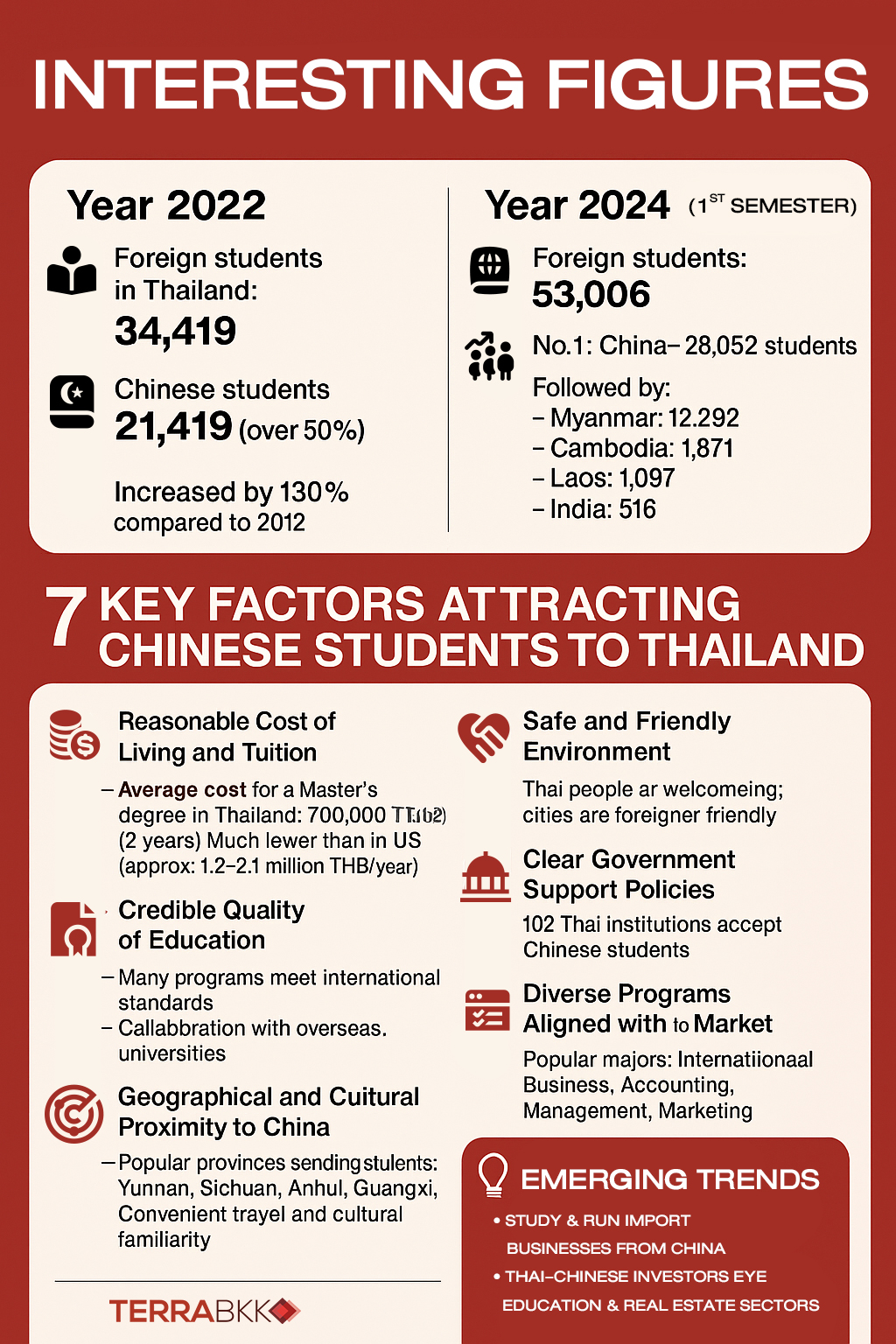
According to data from the Ministry of Higher Education, Science, Research and Innovation, in the academic year 2022, there were a total of 34,202 international students, with more than half being Chinese (21,419 students). This marks a 130% increase from 9,329 Chinese students in the academic year 2012. This rise is attributed to an open education system, lower tuition fees, straightforward visa procedures, and a relatively relaxed lifestyle in Thailand.
By the first semester of the academic year 2024, the total number of international students in higher education had risen to 53,006, a significant increase from 2022. It's clear that over the past 2-3 years, the number of Chinese students in Thai universities has grown substantially. Currently, China ranks first among international students in Thailand with 28,052 students, followed by Myanmar with 12,292, Cambodia with 1,871, and Laos with 1,097. Other countries represented include Vietnam, Indonesia, the Philippines, and India.
Uncover the Popularity of Studying in Thailand Among Chinese Students
The key factors driving Chinese students to pursue education in Thailand include:
- Reasonable Costs:
Compared to Western countries or even some major cities in China, the cost of living and tuition fees in Thailand are significantly more affordable. This makes studying in Thailand an attractive option for many Chinese families.
Factors that make ASEAN an important choice include reasonable costs. For example, the average cost of a master’s degree in Thailand is approximately 150,000 yuan, or around 700,000 baht for two years, which is lower than the average cost in the United States, ranging from 200,000 to 350,000 yuan per year.
- Reputable Quality of Education:
Many universities in Thailand have developed internationally recognized curricula and teaching standards, collaborating with foreign educational institutions, and some fields of study are well-known regionally.
3. Geographic and Cultural Proximity
Thailand shares closer geographical and cultural ties with China than countries on other continents, making it easier for Chinese students to adapt and live in Thailand. Most Chinese students studying in Thailand come from southern provinces such as Yunnan, Sichuan, Anhui, and Guangxi, as well as Shandong, Guangdong, and Beijing, which are all conveniently located for travel.
4. Opportunities to Learn a Third Language
In addition to English-language programs, Chinese students also have the opportunity to learn Thai or other regionally important languages, enhancing their future employment prospects.
5. Friendly and Safe Environment
Thailand is renowned for the hospitality of its people and is considered a relatively safe country for international students.
6. Policies Promoting Education for Foreigners
The Thai government and many educational institutions have policies and projects supporting international students, with over 100 institutions nationwide, more than 50 of which are located in Bangkok and its vicinity.
7. Diverse Course Offerings
Thai higher education institutions offer a wide variety of courses across different fields, catering to diverse student interests. Chinese students show a keen interest in studying at all levels, from bachelor’s to doctoral degrees, with bachelor’s degrees being the most popular.

Popular courses among Chinese students include Business Administration with specializations in commerce, management, international business, marketing, and accounting.
Additionally, some students have started businesses, such as importing goods from China to Thailand. While they do purchase Thai products, they often prefer and are accustomed to using Chinese goods, which are more readily available in Chinese supermarkets.
Given these positive factors, it’s not surprising that both Thai and Chinese investors are developing educational systems to accommodate Chinese students. This includes investing in and acquiring educational institutions, as well as investing in related businesses such as residential real estate and retail stores to support the growing number of Chinese students in Thailand.
References
https://www.mhesi.go.th/
https://thai.cri.cn/2023/10/06/VIDEWW6awcBFFlhgwhvUaYOi231006.shtml
https://www.thaipbs.or.th/news/content/343985
https://nakornchiangrainews.com/chinese-students-study-thailand-asean-education/#google_vignette
https://www.thairath.co.th/money/economics/thai_economics/2838979