TERRA HINT: ECONOMIC HACK 2023 - Understanding the Global Economy and Thai Real Estate in 2023 from 7 Leading Experts
This seminar, titled TERRA HINT: ECONOMIC HACK 2023 - Boosting the Real Estate Business in 2023, is packed with valuable insights for entrepreneurs until the very last drop. It is the first seminar of the year in Thailand organized by TERRABKK, bringing together experts in Thai-Chinese economics, real estate, finance, and investment to analyze the economic trends for Thailand in 2023. The analysis indicates a recovery trend supported by several positive signals, particularly in private investment, especially foreign investment, which is expected to stimulate housing demand in the EEC zone, as well as the long-stay tourism sector.
This event summarizes the highlights from the presentations of the seven experts, each providing insights into the future of the global and Thai economies from their unique perspectives. Let's follow the discussion from the Economic Hack Panel.
Global Economic Overview and Opportunities for Thailand's Economic Recovery by Dr. Piyasak Mana-san, Senior Director of Investment Research at Siam Commercial Bank

According to economists worldwide, a recession is expected in developed countries due to rising interest rates, particularly in the United States, which impacts the global economy, especially in the manufacturing sector, while the service sector shows signs of improvement. Thailand will benefit from consumption and tourism, driven by the demand from China's reopening and expected investments from China, which may lead to a relocation of production bases. These improved indicators will also positively influence the real estate sector compared to last year, although Thailand must remain cautious regarding the financial sector due to interest rates and potential LTV relaxation measures returning to previous levels.
"At the beginning of 2023, the economy will look better than expected. Many countries, including China and India, show signs of recovery, but we must be cautious about interest rates. As inflation persists, interest rates are likely to rise above 5%, which may cause concern among entrepreneurs and investors, while the manufacturing, export, and investment sectors face global declines. However, the service sector continues to progress," he stated.
In Thailand, it is believed that the first half of the year will recover due to tourism, with an expected influx of over 25 million tourists, including about 5 million from China. The export and manufacturing sectors will undergo a base adjustment, relocating production to Thailand, but actual investments may not materialize this year, leading to a projected economic growth of no more than 3%.
Last year, the real estate sector grew significantly by over 21%, but in 2023, it is expected to slow down due to the Bank of Thailand's monetary policy, which is likely to raise interest rates, impacting the purchasing power of lower-income groups. Additionally, tighter lending practices and rising financial and construction costs, along with increased minimum wages, contribute to this slowdown. However, it is still believed that the real estate sector will experience organic growth, with a projected growth rate of around 5% due to foreign investment and the influx of Chinese investors.
Fiscal Economic Policies to Stimulate the Real Estate Sector by Dr. Phisit Phuapan, Director of the Macroeconomic Policy Bureau, Ministry of Finance

The overall Thai economy has a recovery opportunity of 3.8%, with tourism being a key driver. The global economy is expected to slow down compared to last year, but a significant highlight is China's economy, which is projected to grow better than last year, with the government announcing a 5% economic growth target for this year.
"This year, the outlook for the Thai economy is improving, with the Thai baht strengthening compared to last year. However, tourism spending is not expected to return to pre-COVID levels. Before COVID, spending was around 50,000 baht per person per trip, but this year it is projected to be around 44,000 baht per person per trip. Nevertheless, tourism will support the economy from 2023 to 2024," he added.
Overall, the supporting factors for the Thai economy include the recovery of the tourism sector, the expansion of public and private investments, and the continuous growth of domestic consumption. However, risks include the global economic slowdown, volatility in the global financial system, and high household debt burdens.
Therefore, the Ministry of Finance's macroeconomic policy management in 2023 focuses on addressing the debt problems of small borrowers, supporting agricultural production, maintaining export momentum, supporting the recovery of the tourism sector, and promoting private sector investment.
"In the private sector, looking back at the real estate sector, 3 out of 4 domestic investments are related to construction, which is crucial for revitalizing domestic investment," he emphasized.
"In 2023, the overall fiscal policy emphasizes supporting the purchasing power of the public, especially low-income groups, through registration for low-income individuals. Additionally, there are financial measures to support SMEs, extending repayment periods for small borrowers. Future financial measures will gradually return to normal, including interest rates and LTV relaxation measures. Fiscal measures aim to address the budget deficit, targeting a reduction to no more than 3% of GDP," he stated.
The real estate sector is expected to recover as the COVID situation improves, evidenced by increased new sales and transfers at the end of last year, 2022. Housing prices have expanded, and loan approvals under LTV relaxation measures have increased, along with improved retail rental rates. However, office rental rates remain sluggish. The Eastern Economic Corridor (EEC) development projects will play a significant role in the real estate sector moving forward.
Emerging Industry Trends and Investment Opportunities in Real Estate Investment Trusts (REITs) by Ms. Aranong Chaitong, CEO of Prospect REIT Management Co., Ltd.

During the COVID-19 pandemic, while many businesses struggled, some industries benefited due to government support for emerging industries (New S-Curve Industries), which managed to grow during various crises. In the past year, 2022, the total promotion requests amounted to approximately 83.48 billion baht, which is considered a good figure. These are divided into five industry categories: digital industries such as e-commerce, mobile applications, cloud services, and data centers, which grew the most at 59%. The medical industry grew by 28%, including telemedicine, drug research, and biochemistry industries, which grew by 10%, such as biodiesel development or agricultural product transformation. The robotics and automation industry grew by 2%, and the aviation and logistics industry grew by 1%, primarily in logistics. The average growth rate over the past five years from 2018 to 2022 (CAGR) is 23.84%, indicating good growth amid various crises.
In an uncertain and volatile economic environment, risk management is crucial. REITs play a role as a financial and investment tool that helps manage risks for developers and investors. REITs involve direct and indirect investments in real estate, both domestically and internationally, registered on the stock exchange, providing returns based on performance, typically on a quarterly basis.
In foreign markets, REITs are popular investments in countries like Singapore, Japan, and Australia, allowing diverse business investments. In Thailand, there are no restrictions on types of investments, as long as the real estate provides consistent and legal returns.
"Previously, we referred to this type of investment as a Property Fund. After restructuring for better suitability and flexibility in investment and to meet international standards, REITs emerged and have continuously grown. From 2018 to 2022, REITs' asset value grew by 31%. It is evident that during economic downturns, rising interest rates, or the recent COVID period, REITs continued to grow, driven by retail and industrial sectors, while consistently providing returns. Looking back over the past year, the average yield was 7.27% (as of February 2023), making it a good investment option that helps manage risks in investors' portfolios," she explained.
Using REITs as a risk management tool for developers allows for sufficient capital raising for project development at once. By selling into REITs, either as outright ownership or lease rights, developers can secure substantial funding for project development and maintain ongoing capital. Since REITs are long-term investments without a maturity date, if quality assets are available, they can be considered for inclusion in the REIT, allowing for continuous project development without worrying about interest rates and economic conditions. Using other funding sources may not provide enough capital for project development and could risk credit rating downgrades.
Moreover, if credit assessments or various securities are utilized, creating recurring income as a REIT unit holder will yield consistent dividend returns. If there is expertise in real estate management, one can also manage the REIT, ensuring sufficient and continuous capital while generating additional income.
For investors, REITs are a risk management investment tool, as diversifying investments across various types and maintaining a proportion of investments in REITs that can provide consistent returns will reduce volatility in investment portfolios. REITs are long-term investments, primarily providing returns in the form of dividends from operations, with the main income derived from leasing, such as REITs for factories and warehouses with long-term contracts of at least three years, ensuring stable and consistent income that can be passed on to investors. Additionally, investors can manage risks by selecting the type of REIT that suits their economic conditions and personal risk profiles, making REITs a popular choice in investors' portfolios today.
Opportunities for Real Estate Recovery from Foreign Purchasing Power by Mr. Simon Lee, CEO of Angel Real Estate Consultancy Co., Ltd.

The trend of real estate transactions in Thailand among Chinese buyers is driven by the demand for a second passport among Chinese nationals. Although China has reopened its borders post-COVID, actual investment in the Thai real estate market by Chinese investors has not seen an immediate surge but is gradually recovering. The influx of foreign investors is still slow compared to the past, where there were 4,000-5,000 flights from China to Thailand, now reduced to just over a thousand flights.
"The rate of real estate transactions by foreigners is still low, primarily driven by rental demand. Some are real buyers focusing on purchasing individual units, but decision-making has slowed compared to the pre-COVID period. Capital gains are gradually recovering in various locations, except for Phuket, where capital gains have surged threefold, primarily driven by European buyers," he noted.
Locations generating actual transactions among Chinese investors post-COVID remain popular areas such as Ratchada, Rama 9, followed by Sukhumvit, Rama 4, and Sathorn.
"The acceleration of purchasing decisions for Chinese investors and residents largely depends on functionality, as this group prefers comprehensive amenities that offer more benefits, such as a swimming pool with an additional jacuzzi, or if there is a fitness service, they may desire additional features like massage chairs or personal trainers," he added.
Global Financial Market Trends and China's Economy with Growth Opportunities for Thailand by Mr. Warut Phromboon, Managing Partner, Bondcritic

The reopening of China is a crucial stimulus for Thailand's economy. However, it must be acknowledged that news from China is often filtered by the government, which may not reflect the actual situation. Additionally, China's domestic economy is not in a good state, with many companies shutting down, leading to skepticism about the return of Chinese investments this year.
"Personally, I believe Thailand should address structural issues and not overly rely on tourism; otherwise, Thailand may end up like Egypt. From a global economic perspective, recovery is not guaranteed. However, Thailand has several advantages to support its economy: first, the tourism sector; second, Thailand is a food-producing country that can reduce inflation through prudent spending; and third, it can stimulate exports due to the Russia-Ukraine war, as Thailand's food exports to those countries have increased, which is an advantage for Thailand as a neutral country," he stated.
When asked if Thai real estate remains attractive to Chinese investors, Warut expressed that the Super Rich group may not invest in Thailand, but Thailand still holds many advantages for other Chinese investors, including policies favorable to foreign investors, a neutral political stance, and friendliness towards Chinese nationals. Additionally, from a macroeconomic perspective, Thailand is experiencing a slowdown in inflation, while China is cautious about domestic real estate investments, leading to a preference for investing in Thailand due to greater confidence and a pre-existing fondness for the country.
Thailand Elite Card Strategy and High-end Stay Services by Mr. Manate Annavat, General Manager of Thailand Privilege Card Co., Ltd.

As a private sector player closely involved with high-spending consumers, Thailand Elite Card currently has over 20,000 members, generating tens of billions of baht in revenue for the country. The top customer group remains Chinese, followed by Japanese, American, European, and Korean clients. Particularly after the Russia-Ukraine war, there has been an increase in Russian spending in Thailand after a downturn at the war's onset. In the future, Thailand Elite Card aims to increase its membership to over 30,000.
"The real benefit for Thailand from China's reopening is in tourism. The Tourism Authority of Thailand estimates that around 28 million tourists will visit Thailand in 2023. This figure is still below the 40 million tourists in 2019 before COVID, but the influx of tourists is expected to generate 2.25 trillion baht in spending. While this is not equal to the 3.3 trillion baht in 2019, it still represents significant growth compared to last year," he stated.
However, consumer spending behavior has changed. Thai consumers are spending less due to various factors, including shorter trips, opting for less expensive secondary cities, or government tourism stimulus policies. In contrast, foreign tourists are showing an upward trend in spending, focusing more on long-stay tourism, primarily from European visitors, unlike Chinese tourists who tend to take shorter trips.
Moving forward, Thai entrepreneurs face challenges. Firstly, Thailand must understand tourism trends and how to navigate the global tourism market, as the world is experiencing trends like Work from Anywhere and Digital Nomad, leading to longer trip durations. This trend is expected to increase spending as travelers seek to fulfill their lifestyle needs. Additionally, reducing costs and maintaining flexibility in business operations are as crucial as understanding tourism trends.
"The global high-end market consists of over 20 million people and is growing rapidly, especially in Asia. In the past, this market has increasingly engaged in long-term stays due to the Work from Anywhere trend. Some segments are retirees who prioritize convenience and medical services, which is a significant market. Meanwhile, the Digital Nomad segment, though not strictly high-end, has high spending potential and is interested in technology that facilitates their work in various locations. Another group consists of those traveling to work in Thailand," he concluded.
In summary, the influx of foreign groups, especially from China, Japan, and the United States, serves as a catalyst for increased travel to Thailand. Thailand Elite must enhance its service offerings to provide superior benefits through a special membership card aimed at expanding its base of high-potential foreign tourists and investors.
"The benefits for these customers go beyond traditional amenities like spas or golf; they seek diverse experiences in dining, entertainment, and lifestyle, such as beach clubs, Michelin-star fine dining, or entertainment ranging from sports to music," he added.
Real Estate Market Trends for 2023 by Ms. Sumitra Wongphakdee, Managing Director of Terra Media and Consulting Co., Ltd. (TerraBKK.com)
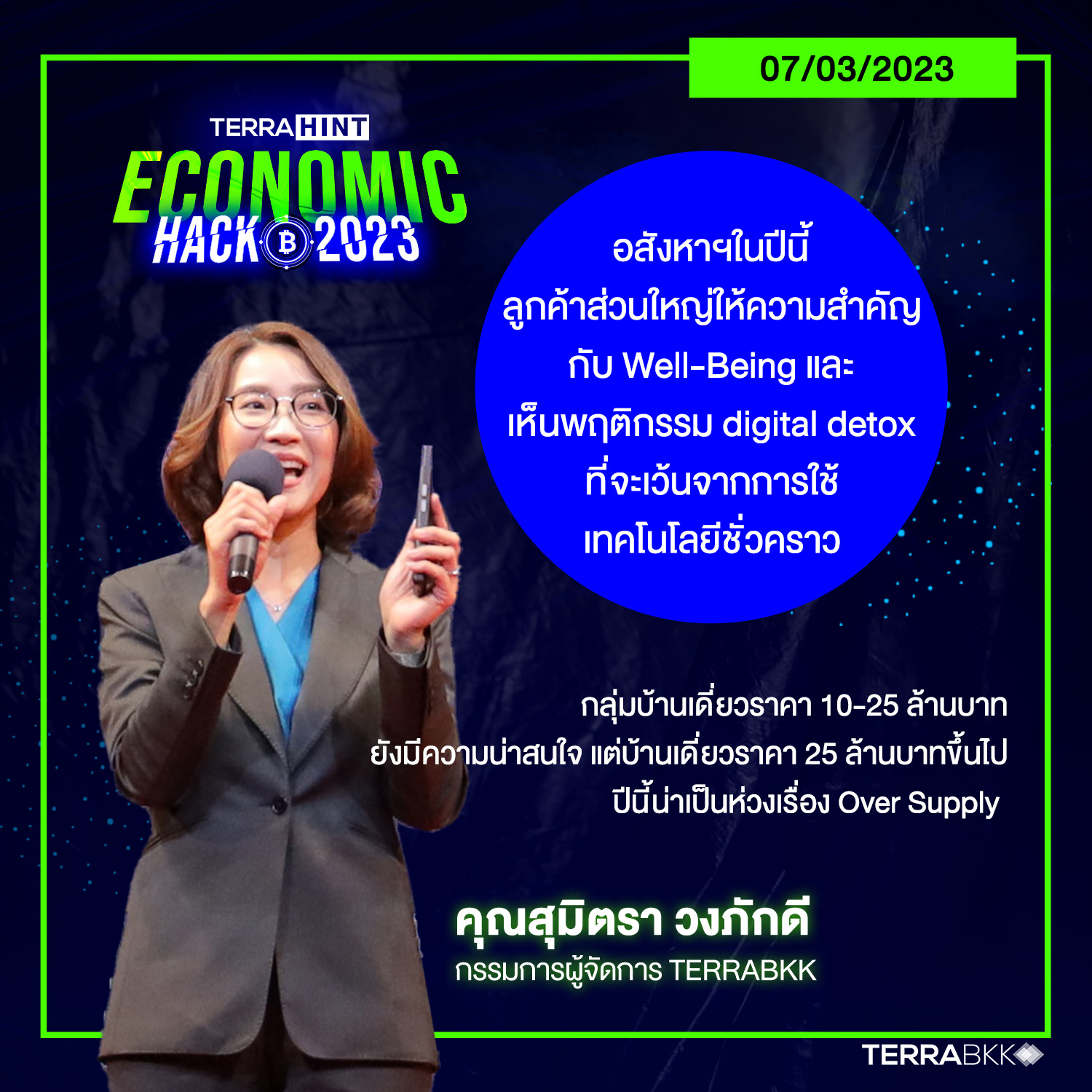
As a real estate research expert, Sumitra presents a broad view of global real estate trends, indicating that the world is currently in a paradigm of sustainable development. Therefore, if businesses aim to align with global trends, they must understand sustainability principles. The current global sustainability framework focuses on reducing carbon dioxide emissions. For real estate developers, this means adopting environmentally friendly production processes to help lower global temperatures and increase green spaces.
"In the future, people's living conditions will increasingly crave a life free from digital dependence, as digital technology will exert more pressure on humans. Everyone will seek a better quality of life, aligning with current living behaviors. Research from TerraBKK last year indicates that most people are considering relocating to achieve a better living standard," she noted.
However, consumers and residents desire real estate that meets their living needs across various dimensions, including modern and secure safety systems, energy efficiency in line with global sustainability trends, increased green spaces in projects, and effective management of public utilities, such as drainage and waste management systems.
"It must be acknowledged that Thais are concerned about flooding, hence their focus on drainage systems in projects, while the new generation is more attentive to energy efficiency," she added.
In addition to analyzing consumer behavior in real estate purchases, Sumitra also shared an overview of the real estate market in 2023, indicating that it can still grow due to purchasing power from the tourism, restaurant, service, and aviation sectors that are beginning to recover.
According to data from the TerraBYTE application, the real estate market trend for 2023 shows promising growth, particularly in the single-detached house segment priced between 10-25 million baht. Customers in this segment are high-income earners with savings who are less affected by economic downturns and are looking to change their residences. In 2022, new launches in the 10-25 million baht single-detached house segment increased by about 25%, with sales growing by 15%, making this segment the highest-selling compared to other housing categories.
Meanwhile, the townhome segment priced below 5 million baht is also expected to grow well due to fewer new launches, with sales growth of around 7-10%.
However, a concerning segment for 2023 is single-detached houses priced above 25 million baht, which currently face oversupply issues. The premium townhome segment priced above 5 million baht has also seen many new launches, while sales rates have noticeably slowed. As for condominiums in 2023, the market direction appears to be recovering, with fewer new project launches, contrasting with luxury condominiums priced over 200,000 baht per square meter, which are still selling slowly.
To stimulate the real estate market's recovery in 2023, it is suggested that banks adjust housing loan criteria by extending repayment periods to a maximum of 35-40 years, which would help mitigate the impact of rising interest rates and stimulate purchasing power for homes priced below 3 million baht, making them more accessible to middle-market and low-income customers. This is crucial for improving the real estate market beyond expectations.
This is just a portion of the seminar content that is believed to benefit entrepreneurs and developers in carefully determining their business direction for 2023. The full content can be viewed on Facebook and YouTube of TerraBKK.